In the first nine months of 1975 the following persons were banned in South Africa under the Suppression of Communism Act (the duration of the ban is shown in brackets):
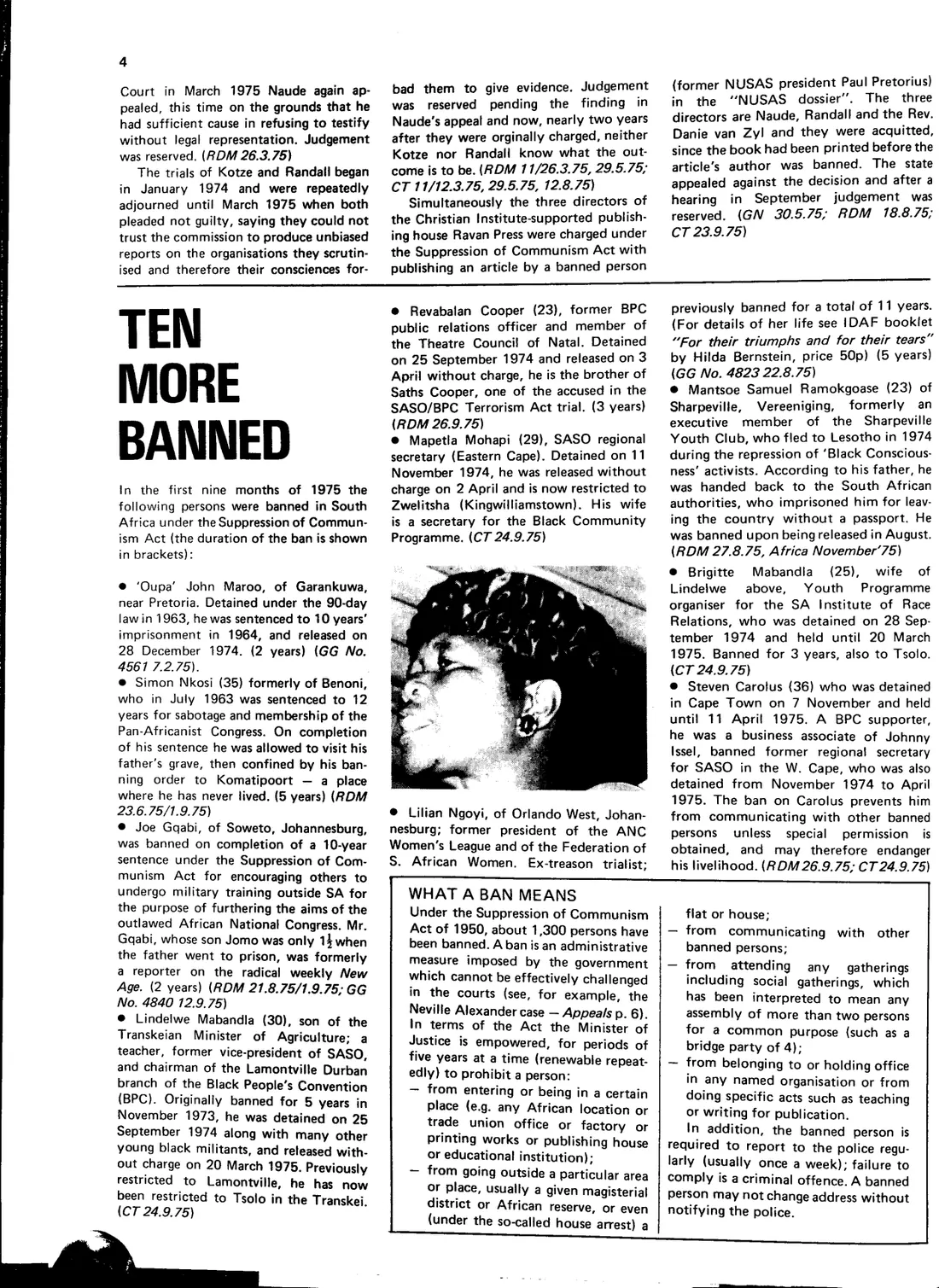
- 'Oupa' John Maroo, of Garankuwa, near Pretoria. Detained under the 90-day law in 1963, he was sentenced to 10 years' imprisonment in 1964, and released on 28 December 1974. (2 years) * Simon Nkosi (35) formerly of Benoni, who in July 1963 was sentenced to 12 years for sabotage and membership of the Pan-Africanist Congress. On completion of his sentence he was allowed to visit his father's grave, then confined by his banning order to Komatipoort - a place where he has never lived. (5 years) * Joe Gqabi, of Soweto, Johannesburg, was banned on completion of a 10-year sentence under the Suppression of Communism Act for encouraging others to undergo military training outside SA for the purpose of furthering the aims of the outlawed African National Congress. Mr. Gqabi, whose son Jomo was only 1½ when the father went to prison, was formerly a reporter on the radical weekly New Age. (2 years) * Lindelwe Mabandla (30), son of the Transkeian Minister of Agriculture; a teacher, former vice-president of SASO, and chairman of the Lamontville Durban branch of the Black People's Convention (BPC). Originally banned for 5 years in November 1973, he was detained on 25 September 1974 along with many other young black militants, and released without charge on 20 March 1975. Previously restricted to Lamontville, he has now been restricted to Tsolo in the Transkei. (CT 24.9.75) * Revabalan Cooper (23), former BPC public relations officer and member of the Theatre Council of Natal. Detained on 25 September 1974 and released on 3 April without charge, he is the brother of Saths Cooper, one of the accused in the SASO/BPC Terrorism Act trial. (3 years) * Mapetla Mohapi (29), SASO regional secretary (Eastern Cape). Detained on 11 November 1974, he was released without charge on 2 April and is now restricted to Zwelitsha (Kingwilliamstown). His wife is a secretary for the Black Community Programme. (CT 24.9.75) * Lilian Ngoyi, of Orlando West, Johannesburg; former president of the ANC Women's League and of the Federation of S. African Women. Ex-treason trialist; previously banned for a total of 11 years. (5 years) * Mantsoe Samuel Ramokgoase (23) of Sharpeville, Vereeniging, formerly an executive member of the Sharpeville Youth Club, who fled to Lesotho in 1974 during the repression of 'Black Consciousness' activists. According to his father, he was handed back to the South African authorities, who imprisoned him for leaving the country without a passport. He was banned upon being released in August. * Brigitte Mabandla (25), wife of Lindelwe above, Youth Programme organiser for the SA Institute of Race Relations, who was detained on 28 September 1974 and held until 20 March 1975. Banned for 3 years, also to Tsolo. * Steven Carolus (36) who was detained in Cape Town on 7 November and held until 11 April 1975. A BPC supporter, he was a business associate of Johnny Issel, banned former regional secretary for SASO in the W. Cape, who was also detained from November 1974 to April 1975. The ban on Carolus prevents him from communicating with other banned persons unless special permission is obtained, and may therefore endanger his livelihood.
WHAT A BAN MEANS
Under the Suppression of Communism Act of 1950, about 1,300 persons have been banned. A ban is an administrative measure imposed by the government which cannot be effectively challenged in the courts. In terms of the Act the Minister of Justice is empowered, for periods of five years at a time (renewable repeatedly) to prohibit a person:
- from entering or being in a certain place (e.g. any African location or trade union office or factory or printing works or publishing house or educational institution); - from going outside a particular area or place, usually a given magisterial district or African reserve, or even (under the so-called house arrest) a flat or house; - from communicating with other banned persons; - from attending any gatherings including social gatherings, which has been interpreted to mean any assembly of more than two persons for a common purpose (such as a bridge party of 4); - from belonging to or holding office in any named organisation or from doing specific acts such as teaching or writing for publication.
In addition, the banned person is required to report to the police regularly (usually once a week); failure to comply is a criminal offence. A banned person may not change address without notifying the police.