In late 1974 three to four dozen people connected with the Black Consciousness movement were detained under the Terrorism Act after the holding of two rallies, one in Durban and one at the University of the North at Turfloop, to celebrate the inauguration of the FRELIMO-led transitional government in Mozambique on 25 September. Fifteen months later some of them are still caught up in the ensuing legal proceedings in one of South Africa's longest political trials.
It is now apparent that the demonstrations, which were peaceful until the police intervened, were used as a pretext for an attack on the Black Consciousness movement which has been a prominent feature of South African politics since 1970. By staging a show trial, in which the attempt has been made to equate the aims and activity of the Black Consciousness movement with "terrorism", the government has apparently sought to eliminate some leading figures, to intimidate others and to crush the whole movement.
But the militance of the accused and their sympathisers, the publicity which the trial attracted internationally – at least in its early months – and the nebulous character of the charges have made the case turn out differently. Although it started in a blaze of publicity one year ago, it is now dragging towards an end which will probably be inconclusive, and may even be, for the Security Police, a fiasco.
On 24 September 1974 the Minister of Justice banned all meetings organized or supported by SASO (the South African Students Organisation) and the BPC (Black Peoples Convention). Nevertheless the following day two rallies went ahead, without explicit backing from these groups, and were broken up by police using dogs and (at Turfloop) tear gas. In Durban a crowd of about 1,000 people gathered outside a closed stadium. Police with dogs scattered them and a number of people were bitten.
Within a few hours the head office of SASO in Durban had been searched and 12 young blacks detained under the Terrorism Act. Offices and homes as far away as Cape Town and Johannesburg were also raided. The ensuing arrests were country-wide and continued throughout October and November. By early 1975 the total number of persons detained in this connection was around forty.
Those detained included several well-known black militants connected with SASO, the BPC and other black organisations such as the Black Allied Workers Union (BAWU), the Theatre Council of Natal (TECON) or the Peoples Experimental Theatre (PET). Some were African, some Indian and some Coloured, the majority being from Natal. Arrests were also made at Turfloop, in Cape Town and on the Rand. Precise details are unavailable because no official announcement or confirmation of detentions is made. By April 1975 about a dozen of the original detainees had been released and twelve had been charged. The rest remained in custody, without access to relatives or lawyers.
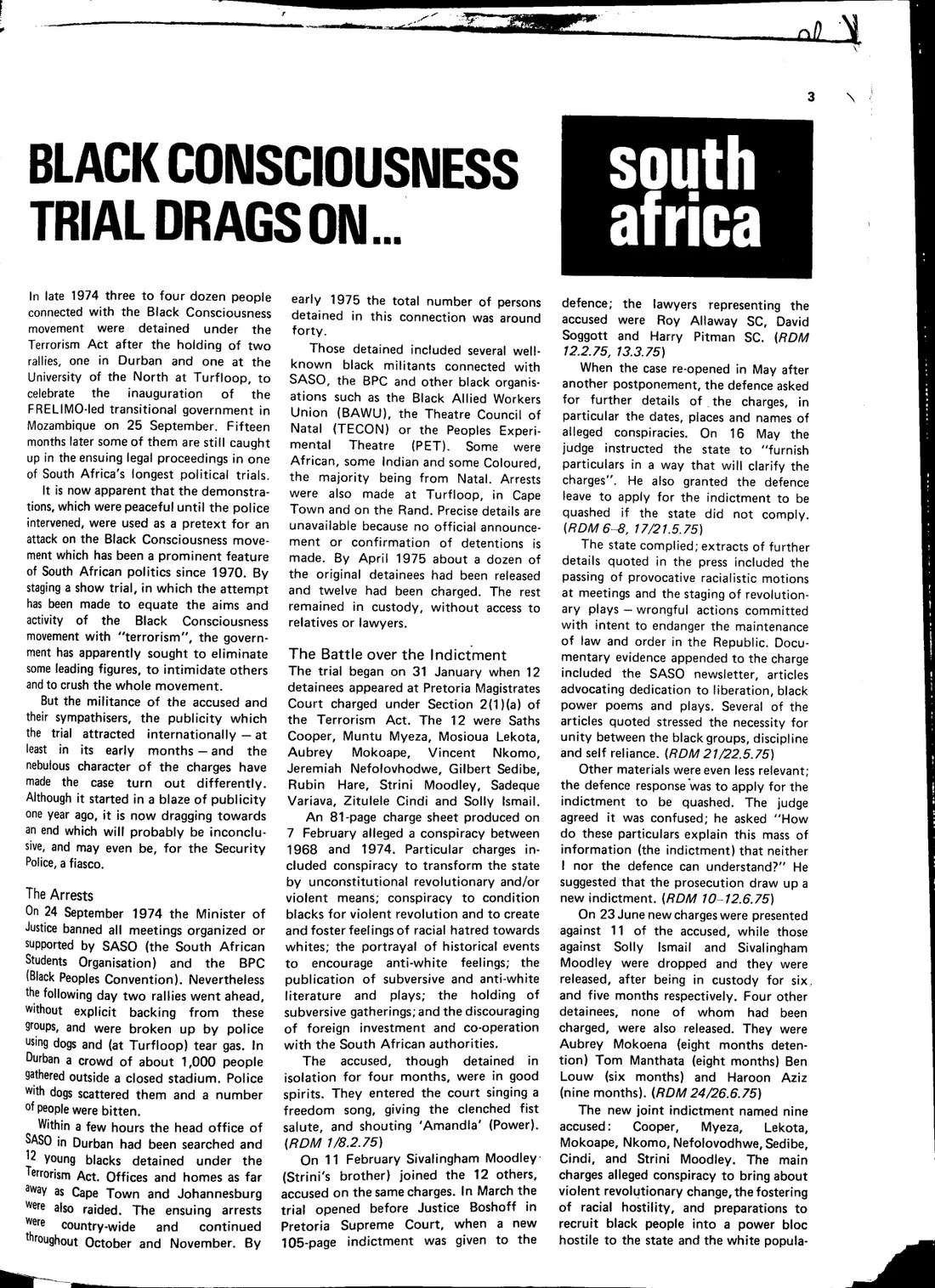
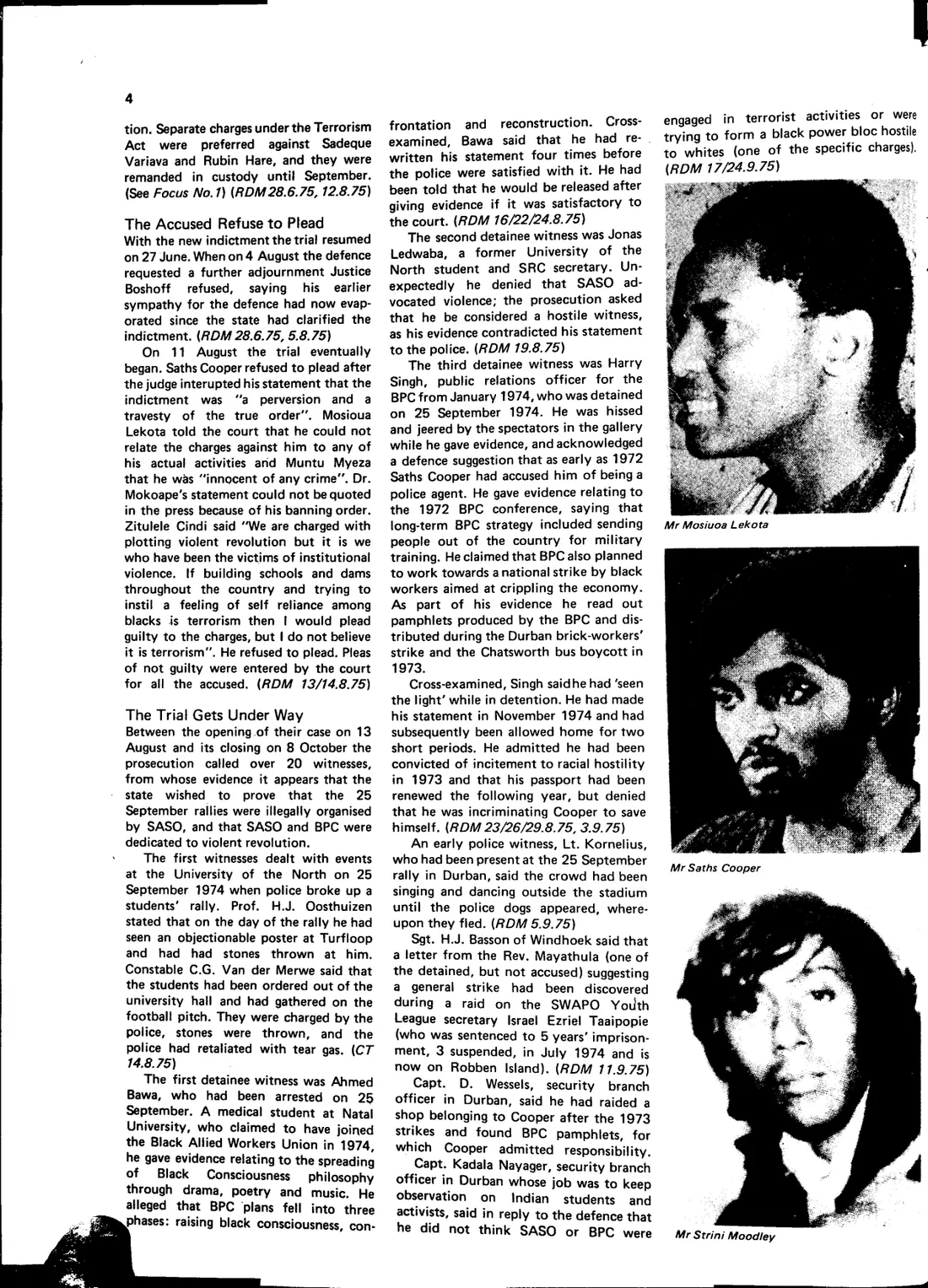
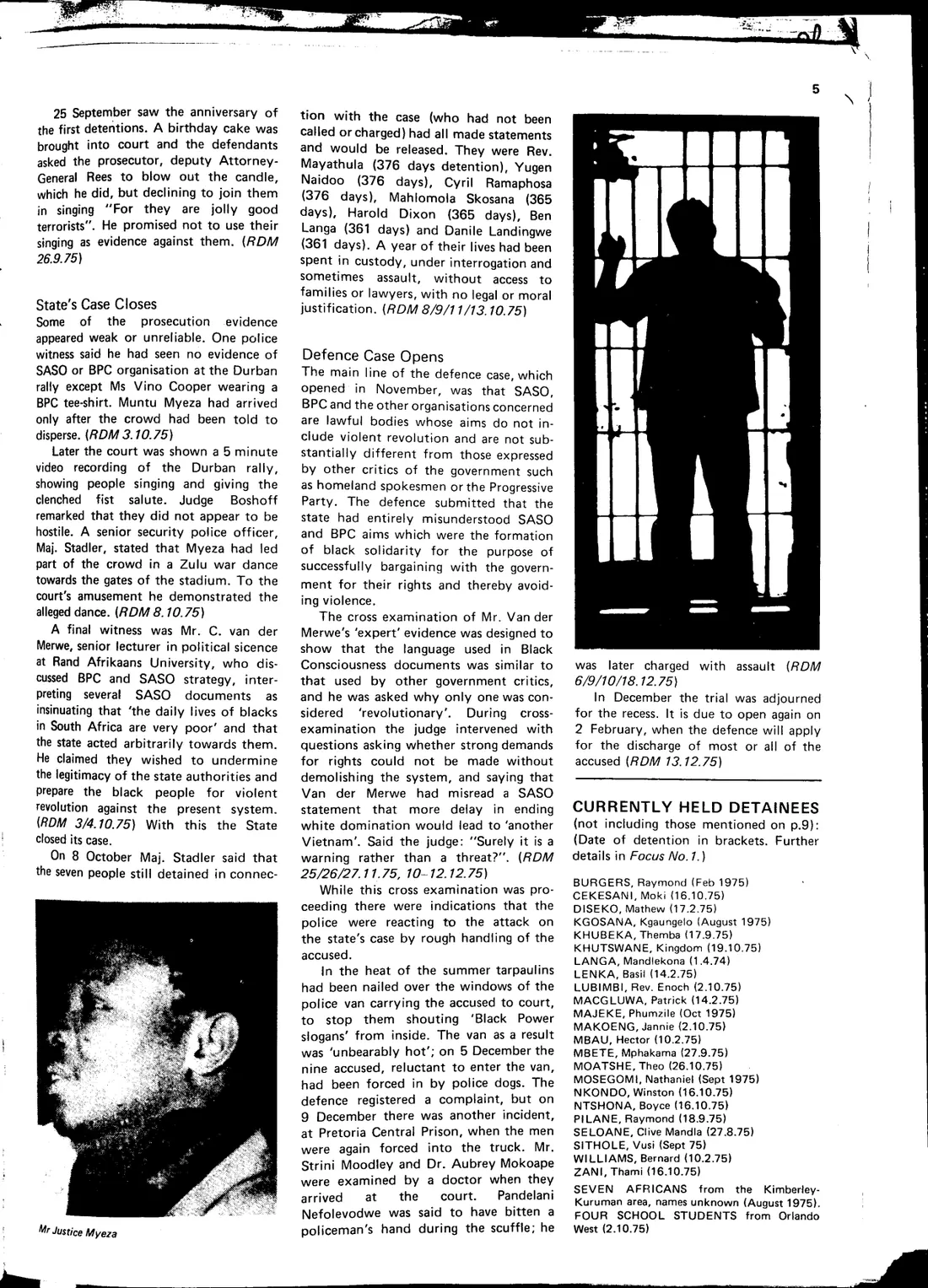
The trial began on 31 January when 12 detainees appeared at Pretoria Magistrates Court charged under Section 2(1)(a) of the Terrorism Act. The 12 were Saths Cooper, Muntu Myeza, Mosioua Lekota, Aubrey Mokoape, Vincent Nkomo, Jeremiah Nefolovhodwe, Gilbert Sedibe, Rubin Hare, Strini Moodley, Sadeque Variava, Zitulele Cindi and Solly Ismail.
An 81-page charge sheet produced on 7 February alleged a conspiracy between 1968 and 1974. Particular charges included conspiracy to transform the state by unconstitutional revolutionary and/or violent means; conspiracy to condition blacks for violent revolution and to create and foster feelings of racial hatred towards whites; the portrayal of historical events to encourage anti-white feelings; the publication of subversive and anti-white literature and plays; the holding of subversive gatherings; and the discouraging of foreign investment and co-operation with the South African authorities.
The accused, though detained in isolation for four months, were in good spirits. They entered the court singing a freedom song, giving the clenched fist salute, and shouting 'Amandla' (Power).
On 11 February Sivalingham Moodley (Strini's brother) joined the 12 others, accused on the same charges. In March the trial opened before Justice Boshoff in Pretoria Supreme Court, when a new 105-page indictment was given to the defence; the lawyers representing the accused were Roy Allaway SC, David Soggott and Harry Pitman SC.
When the case re-opened in May after another postponement, the defence asked for further details of the charges, in particular the dates, places and names of alleged conspiracies. On 16 May the judge instructed the state to "furnish particulars in a way that will clarify the charges". He also granted the defence leave to apply for the indictment to be quashed if the state did not comply.
The state complied; extracts of further details quoted in the press included the passing of provocative racialistic motions at meetings and the staging of revolutionary plays - wrongful actions committed with intent to endanger the maintenance of law and order in the Republic. Documentary evidence appended to the charge included the SASO newsletter, articles advocating dedication to liberation, black power poems and plays. Several of the articles quoted stressed the necessity for unity between the black groups, discipline and self reliance.
Other materials were even less relevant; the defence response was to apply for the indictment to be quashed. The judge agreed it was confused; he asked "How do these particulars explain this mass of information (the indictment) that neither I nor the defence can understand?" He suggested that the prosecution draw up a new indictment.
On 23 June new charges were presented against 11 of the accused, while those against Solly Ismail and Sivalingham Moodley were dropped and they were released, after being in custody for six and five months respectively. Four other detainees, none of whom had been charged, were also released. They were Aubrey Mokoena (eight months detention) Tom Manthata (eight months) Ben Louw (six months) and Haroon Aziz (nine months).
The new joint indictment named nine accused: Cooper, Myeza, Lekota, Mokoape, Nkomo, Nefolovodhwe, Sedibe, Cindi, and Strini Moodley. The main charges alleged conspiracy to bring about violent revolutionary change, the fostering of racial hostility, and preparations to recruit black people into a power bloc hostile to the state and the white population. Separate charges under the Terrorism Act were preferred against Sadeque Variava and Rubin Hare, and they were remanded in custody until September.
With the new indictment the trial resumed on 27 June. When on 4 August the defence requested a further adjournment Justice Boshoff refused, saying his earlier sympathy for the defence had now evaporated since the state had clarified the indictment.
On 11 August the trial eventually began. Saths Cooper refused to plead after the judge interrupted his statement that the indictment was "a perversion and a travesty of the true order". Mosioua Lekota told the court that he could not relate the charges against him to any of his actual activities and Muntu Myeza that he was "innocent of any crime". Dr. Mokoape's statement could not be quoted in the press because of his banning order. Zitulele Cindi said "We are charged with plotting violent revolution but it is we who have been the victims of institutional violence. If building schools and dams throughout the country and trying to instil a feeling of self reliance among blacks is terrorism then I would plead guilty to the charges, but I do not believe it is terrorism". He refused to plead. Pleas of not guilty were entered by the court for all the accused.
Between the opening of their case on 13 August and its closing on 8 October the prosecution called over 20 witnesses, from whose evidence it appears that the state wished to prove that the 25 September rallies were illegally organised by SASO, and that SASO and BPC were dedicated to violent revolution.
The first witnesses dealt with events at the University of the North on 25 September 1974 when police broke up a students' rally. Prof. H.J. Oosthuizen stated that on the day of the rally he had seen an objectionable poster at Turfloop and had had stones thrown at him. Constable C.G. Van der Merwe said that the students had been ordered out of the university hall and had gathered on the football pitch. They were charged by the police, stones were thrown, and the police had retaliated with tear gas.
The first detainee witness was Ahmed Bawa, who had been arrested on 25 September. A medical student at Natal University, who claimed to have joined the Black Allied Workers Union in 1974, he gave evidence relating to the spreading of Black Consciousness philosophy through drama, poetry and music. He alleged that BPC plans fell into three phases: raising black consciousness, confrontation and reconstruction. Cross-examined, Bawa said that he had rewritten his statement four times before the police were satisfied with it. He had been told that he would be released after giving evidence if it was satisfactory to the court.
The second detainee witness was Jonas Ledwaba, a former University of the North student and SRC secretary. Unexpectedly he denied that SASO advocated violence; the prosecution asked that he be considered a hostile witness, as his evidence contradicted his statement to the police.
The third detainee witness was Harry Singh, public relations officer for the BPC from January 1974, who was detained on 25 September 1974. He was hissed and jeered by the spectators in the gallery while he gave evidence, and acknowledged a defence suggestion that as early as 1972 Saths Cooper had accused him of being a police agent. He gave evidence relating to the 1972 BPC conference, saying that long-term BPC strategy included sending people out of the country for military training. He claimed that BPC also planned to work towards a national strike by black workers aimed at crippling the economy. As part of his evidence he read out pamphlets produced by the BPC and distributed during the Durban brick-workers' strike and the Chatsworth bus boycott in 1973.
Cross-examined, Singh said he had 'seen the light' while in detention. He had made his statement in November 1974 and had subsequently been allowed home for two short periods. He admitted he had been convicted of incitement to racial hostility in 1973 and that his passport had been renewed the following year, but denied that he was incriminating Cooper to save himself.
An early police witness, Lt. Kornelius, who had been present at the 25 September rally in Durban, said the crowd had been singing and dancing outside the stadium until the police dogs appeared, whereupon they fled.
Sgt. H.J. Basson of Windhoek said that a letter from the Rev. Mayathula (one of the detained, but not accused) suggesting a general strike had been discovered during a raid on the SWAPO Youth League secretary Israel Ezriel Taaipopie (who was sentenced to 5 years' imprisonment, 3 suspended, in July 1974 and is now on Robben Island).
Capt. D. Wessels, security branch officer in Durban, said he had raided a shop belonging to Cooper after the 1973 strikes and found BPC pamphlets, for which Cooper admitted responsibility.
Capt. Kadala Nayager, security branch officer in Durban whose job was to keep observation on Indian students and activists, said in reply to the defence that he did not think SASO or BPC were engaged in terrorist activities or were trying to form a black power bloc hostile to whites (one of the specific charges).
25 September saw the anniversary of the first detentions. A birthday cake was brought into court and the defendants asked the prosecutor, deputy Attorney-General Rees to blow out the candle, which he did, but declining to join them in singing "For they are jolly good terrorists". He promised not to use their singing as evidence against them.
Some of the prosecution evidence appeared weak or unreliable. One police witness said he had seen no evidence of SASO or BPC organisation at the Durban rally except Ms Vino Cooper wearing a BPC tee-shirt. Muntu Myeza had arrived only after the crowd had been told to disperse.
Later the court was shown a 5 minute video recording of the Durban rally, showing people singing and giving the clenched fist salute. Judge Boshoff remarked that they did not appear to be hostile. A senior security police officer, Maj. Stadler, stated that Myeza had led part of the crowd in a Zulu war dance towards the gates of the stadium. To the court's amusement he demonstrated the alleged dance.
A final witness was Mr. C. van der Merwe, senior lecturer in political science at Rand Afrikaans University, who discussed BPC and SASO strategy, interpreting several SASO documents as insinuating that 'the daily lives of blacks in South Africa are very poor' and that the state acted arbitrarily towards them. He claimed they wished to undermine the legitimacy of the state authorities and prepare the black people for violent revolution against the present system. With this the State closed its case.
On 8 October Maj. Stadler said that the seven people still detained in connection with the case (who had not been called or charged) had all made statements and would be released. They were Rev. Mayathula (376 days detention), Yugen Naidoo (376 days), Cyril Ramaphosa (376 days), Mahlomola Skosana (365 days), Harold Dixon (365 days), Ben Langa (361 days) and Danile Landingwe (361 days). A year of their lives had been spent in custody, under interrogation and sometimes assault, without access to families or lawyers, with no legal or moral justification.
The main line of the defence case, which opened in November, was that SASO, BPC and the other organisations concerned are lawful bodies whose aims do not include violent revolution and are not substantially different from those expressed by other critics of the government such as homeland spokesmen or the Progressive Party. The defence submitted that the state had entirely misunderstood SASO and BPC aims which were the formation of black solidarity for the purpose of successfully bargaining with the government for their rights and thereby avoiding violence.
The cross examination of Mr. Van der Merwe's 'expert' evidence was designed to show that the language used in Black Consciousness documents was similar to that used by other government critics, and he was asked why only one was considered 'revolutionary'. During cross-examination the judge intervened with questions asking whether strong demands for rights could not be made without demolishing the system, and saying that Van der Merwe had misread a SASO statement that more delay in ending white domination would lead to 'another Vietnam'. Said the judge: "Surely it is a warning rather than a threat?".
While this cross examination was proceeding there were indications that the police were reacting to the attack on the state's case by rough handling of the accused.
In the heat of the summer tarpaulins had been nailed over the windows of the police van carrying the accused to court, to stop them shouting 'Black Power slogans' from inside. The van as a result was 'unbearably hot'; on 5 December the nine accused, reluctant to enter the van, had been forced in by police dogs. The defence registered a complaint, but on 9 December there was another incident, at Pretoria Central Prison, when the men were again forced into the truck. Mr. Strini Moodley and Dr. Aubrey Mokoape were examined by a doctor when they arrived at the court. Pandelani Nefolevodwe was said to have bitten a policeman's hand during the scuffle; he was later charged with assault.
In December the trial was adjourned for the recess. It is due to open again on 2 February, when the defence will apply for the discharge of most or all of the accused.