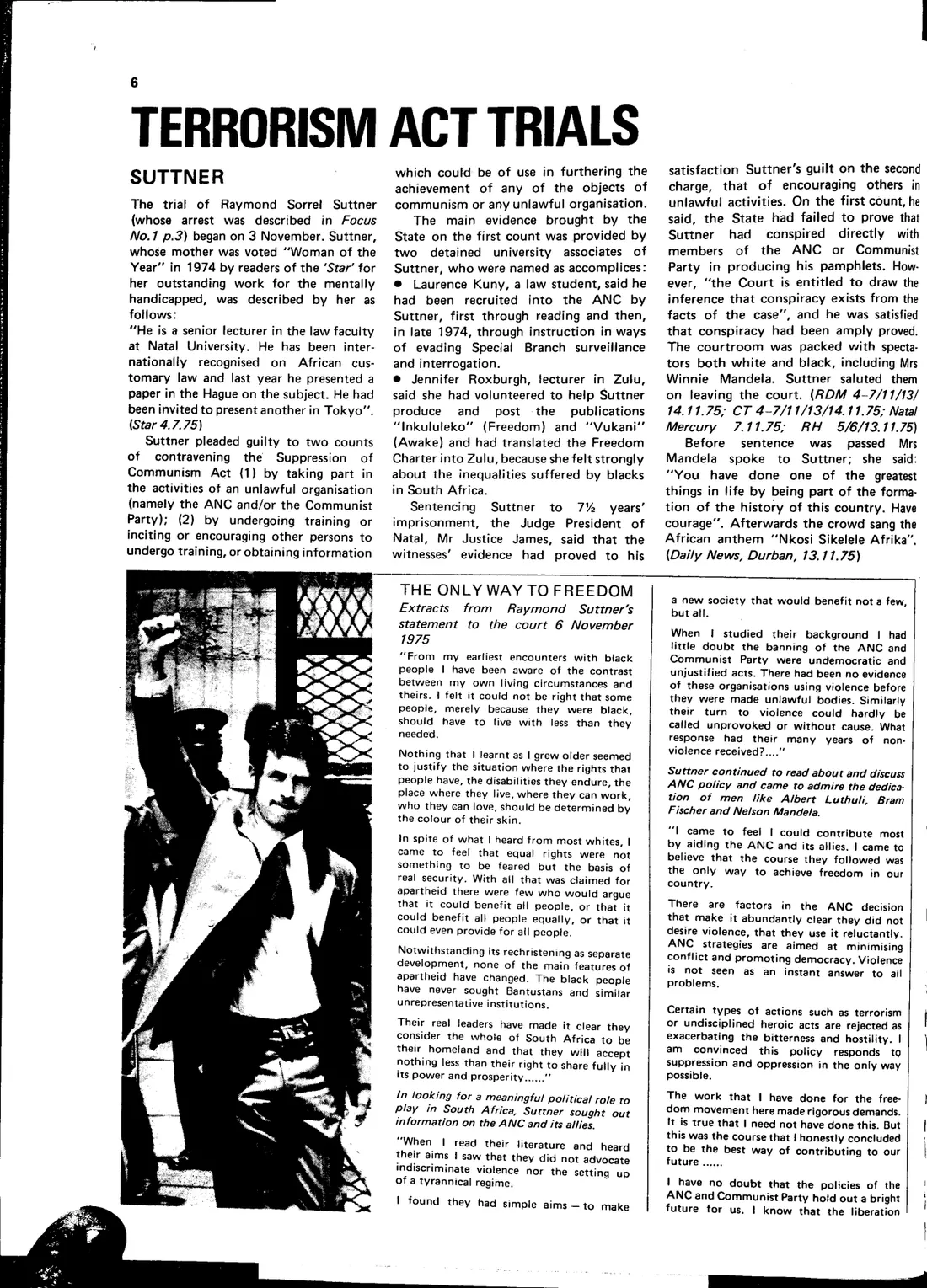
The trial of Raymond Sorrel Suttner (whose arrest was described in Focus No.1 p.3) began on 3 November. Suttner, whose mother was voted "Woman of the Year" in 1974 by readers of the 'Star' for her outstanding work for the mentally handicapped, was described by her as follows:
"He is a senior lecturer in the law faculty at Natal University. He has been internationally recognised on African customary law and last year he presented a paper in the Hague on the subject. He had been invited to present another in Tokyo".
Suttner pleaded guilty to two counts of contravening the Suppression of Communism Act (1) by taking part in the activities of an unlawful organisation (namely the ANC and/or the Communist Party); (2) by undergoing training or inciting or encouraging other persons to undergo training, or obtaining information which could be of use in furthering the achievement of any of the objects of communism or any unlawful organisation.
The main evidence brought by the State on the first count was provided by two detained university associates of Suttner, who were named as accomplices:
- Laurence Kuny, a law student, said he had been recruited into the ANC by Suttner, first through reading and then, in late 1974, through instruction in ways of evading Special Branch surveillance and interrogation.
- Jennifer Roxburgh, lecturer in Zulu, said she had volunteered to help Suttner produce and post the publications "Inkululeko" (Freedom) and "Vukani" (Awake) and had translated the Freedom Charter into Zulu, because she felt strongly about the inequalities suffered by blacks in South Africa.
Sentencing Suttner to 7½ years' imprisonment, the Judge President of Natal, Mr Justice James, said that the witnesses' evidence had proved to his satisfaction Suttner's guilt on the second charge, that of encouraging others in unlawful activities. On the first count, he said, the State had failed to prove that Suttner had conspired directly with members of the ANC or Communist Party in producing his pamphlets. However, "the Court is entitled to draw the inference that conspiracy exists from the facts of the case", and he was satisfied that conspiracy had been amply proved. The courtroom was packed with spectators both white and black, including Mrs Winnie Mandela. Suttner saluted them on leaving the court.
Before sentence was passed Mrs Mandela spoke to Suttner; she said: "You have done one of the greatest things in life by being part of the formation of the history of this country. Have courage". Afterwards the crowd sang the African anthem "Nkosi Sikelele Afrika".
Extracts from Raymond Suttner's statement to the court 6 November 1975
"From my earliest encounters with black people I have been aware of the contrast between my own living circumstances and theirs. I felt it could not be right that some people, merely because they were black, should have to live with less than they needed.
Nothing that I learnt as I grew older seemed to justify the situation where the rights that people have, the disabilities they endure, the place where they live, where they can work, who they can love, should be determined by the colour of their skin.
In spite of what I heard from most whites, I came to feel that equal rights were not something to be feared but the basis of real security. With all that was claimed for apartheid there were few who would argue that it could benefit all people, or that it could benefit all people equally, or that it could even provide for all people.
Notwithstanding its rechristening as separate development, none of the main features of apartheid have changed. The black people have never sought Bantustans and similar unrepresentative institutions.
Their real leaders have made it clear they consider the whole of South Africa to be their homeland and that they will accept nothing less than their right to share fully in its power and prosperity......"
In looking for a meaningful political role to play in South Africa, Suttner sought out information on the ANC and its allies.
"When I read their literature and heard their aims I saw that they did not advocate indiscriminate violence nor the setting up of a tyrannical regime.
I found they had simple aims - to make a new society that would benefit not a few, but all.
When I studied their background I had little doubt the banning of the ANC and Communist Party were undemocratic and unjustified acts. There had been no evidence of these organisations using violence before they were made unlawful bodies. Similarly their turn to violence could hardly be called unprovoked or without cause. What response had their many years of non-violence received?...."
Suttner continued to read about and discuss ANC policy and came to admire the dedication of men like Albert Luthuli, Bram Fischer and Nelson Mandela.
"I came to feel I could contribute most by aiding the ANC and its allies. I came to believe that the course they followed was the only way to achieve freedom in our country.
There are factors in the ANC decision that make it abundantly clear they did not desire violence, that they use it reluctantly. ANC strategies are aimed at minimising conflict and promoting democracy. Violence is not seen as an instant answer to all problems.
Certain types of actions such as terrorism or undisciplined heroic acts are rejected as exacerbating the bitterness and hostility. I am convinced this policy responds to suppression and oppression in the only way possible.
The work that I have done for the freedom movement here made rigorous demands. It is true that I need not have done this. But this was the course that I honestly concluded to be the best way of contributing to our future......
I have no doubt that the policies of the ANC and Communist Party hold out a bright future for us. I know that the liberation movement is neither anti-white nor terrorist, that it works for the day when men and women will have all the comforts and security they need.
I realise this is not the picture that is presented to South Africans. But because I know that it is true I could not obey a law expressly aimed at suppressing these democratic forces.
It was my duty, I honestly believe, to act honestly and for the benefit of all our people, to inform them of their situation and the way to an alternative, free society. That was the aim of my work.
I am not the first nor the last to break the law for moral reasons. I realise the Court may feel I should have shown more respect for legality. Normally I would show this respect. I would consider it wrong to break laws which serve the community. But I have acted against laws that do not serve the majority of South Africans, laws that inculcate hostility between our people and preclude the tolerance and co-operation that is necessary to a contented and peaceful community.
For this I will go to prison. But I cannot ever accept that it is wrong to act as I have done, for freedom and equality, for an end to racial discrimination and poverty. I have acted in the interests of the overwhelming majority of our people. I am confident I have their support."