Seven Africans, including one woman, are facing charges under the Terrorism Act. The accused, whose names were listed in Focus No.2 p.9, appeared in the Johannesburg Magistrates Court on 26 January and were remanded to 1 March, except for Patrick Maisela, who is charged separately and who was due to appear on 27 February. Most of the accused are members of the National Youth Organisation (NAYO).
The charges relate to the period 1 May 1974 to 30 September 1975. It is alleged that the accused, with other people and organisations, conspired to form underground cells "to study and gather information on certain places like railway stations, bridges, dams, roads, airports, etc. with the intention of later making the information available to other accomplices and other people unknown to the prosecution for the purposes of sabotage or for bringing about a revolution against the South African government". It is also alleged that the accused studied the economy and obtained information on the role that could be played by the black labour force as a weapon to cripple it.
Attached to the charge sheet is a list of co-conspirators comprising 44 individuals and seven organisations, (NAYO, the Transvaal Youth Organisation, Natal Youth Organisation, Azanian Liberation Movement, ANC, SASO and Black Peoples Convention). Amongst the alleged co-conspirators are at least 5 who have been detained under the Terrorism Act since last September, (Themba Khubeka, Mphakama Mbete, Nathaniel Mosegomi, Raymond Pilane, and Vusi Sithole) and at least one who has been detained since February 1975 - Mathew Diseko, a poet and former president of NAYO who was banned for 5 years in September 1973. Other alleged co-conspirators include: Bokwe Mafuna, a banned former SASO leader now living in Botswana; Elizabeth Kgosana from the Kimberley-Kuruman area, who was detained last August; Danile Landingwe, who in 1974/5 was detained for 361 days in connection with the SASO/BPC trial and eventually released without being charged or called as a witness; Mandla Kuzwayo; Bernice Noxolo; Jairus Kgokong; Glen Masokoana; and Theobald Moatshe.
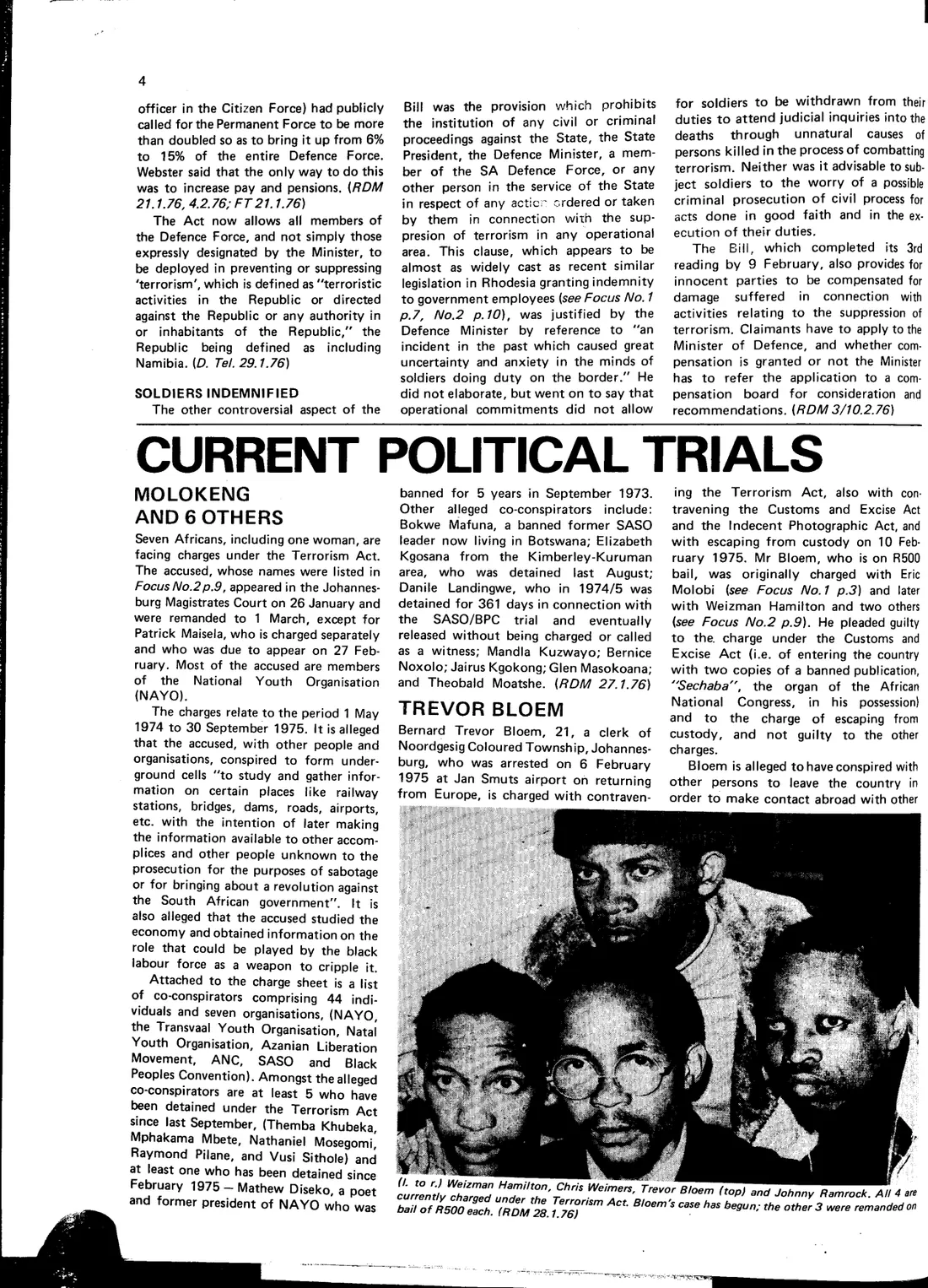
Bernard Trevor Bloem, 21, a clerk of Noordgesig Coloured Township, Johannesburg, who was arrested on 6 February 1975 at Jan Smuts airport on returning from Europe, is charged with contravening the Terrorism Act, also with contravening the Customs and Excise Act and the Indecent Photographic Act, and with escaping from custody on 10 February 1975. Mr Bloem, who is on R500 bail, was originally charged with Eric Molobi and later with Weizman Hamilton and two others. He pleaded guilty to the charge under the Customs and Excise Act (i.e. of entering the country with two copies of a banned publication, "Sechaba", the organ of the African National Congress, in his possession) and to the charge of escaping from custody, and not guilty to the other charges.
Bloem is alleged to have conspired with other persons to leave the country in order to make contact abroad with other organisations, to enable them to obtain military training and training in political science and economics, philosophy, urban guerilla warfare, terrorism and subversion. The conspiracy is said to have taken place between June 1974 and February 1975, in South Africa, Botswana and Denmark. Co-conspirators are alleged to be Clarence Hamilton, Weizman Hamilton, Lawrence McGosh, Christopher Weimers, Patrick McGluwa, Johnny Ramrock, Cyril Carter, Saville Carter, and Raymond Burgers. (Of these, Clarence Hamilton was convicted of two charges under the Suppression of Communism Act in October 1974 but escaped to Botswana; and most of the rest have been in detention since February 1975). The organisations they are alleged to have sought contact with were ZANU and ZAPU of Rhodesia, SWAPO, FRELIMO, and the South African ANC and PAC.
Bloem is further alleged to have conspired with the others to re-enter the Republic after training, and to organise trade unions or politicize the masses, organise strikes, commit acts of sabotage or, if necessary, to fight the internal forces, with a view to political, economic or social changes. The state alleges that the commission of these acts would have interfered in the maintenance of law and order, crippled or prejudiced industry, and damage or disrupted the supply of light, power, water, food and other essential services. As part of the alleged conspiracy, Bloem and the others are said to have arranged with Mr Phineas Pheto and Mr Eric Molobi for their departure from the Republic.
Alternatively, the accused is charged under the Terrorism Act with attempting or consenting to undergo training of the sort described, and under the Suppression of Communism Act with furthering there-by the objects of communism. He is also charged under the Indecent & Obscene Photographic Matter Act of 1967 with being in possession of pornographic playing cards.
An early witness was a Coloured Security Police lieutenant who claimed to have found in Bloem's luggage at the airport various codes for secret communications, two issues of "Sechaba" and the packet of playing cards. Two alleged co-conspirators both refused to give evidence and were imprisoned for 10 days (a procedure which can be repeated indefinitely while the trial is proceeding): (1) Raymond Anthony Burgers, who was arrested shortly after Bloem in February 1975, had been in detention ever since; (2) Patrick McGluwa, also detained for over a year, gave a black power salute to the gallery before entering the box. He explained his refusal: "I was subjected to brutality while in detention." He complained a number of times but was never helped. "Nobody could help me. I was totally powerless in the cells...... I am a politician and believe in black consciousness. We black people are always bound to white people. It will stay like this if I give evidence in this court against my black fellow man." The case was adjourned.
The trial of Saths Cooper and 8 other prominent figures in SASO/BPC circles, resumed in February with the defence team applying for the acquittal of five of the nine and the discharge of the other four on all but one of the charges. A summary of the legal arguments and details of the outcome will appear in the next issue of Focus.
One of the accused, Pandelani Nefololovodhwe, 28, was convicted of assaulting a policeman by biting his hand. The incident occured on 8 December when the accused refused to enter a police van because the canvas flaps on the air vents had been lowered, making the interior suffocatingly hot. Carried into the van, the accused was said to have bitten a policeman. He said that he and the other accused were placed in solitary confinement for 28 days after the incident.
Nefololovodhwe, a former SASO president, pleaded not guilty and gave a black power salute when asked to take the oath.
Vincent Vuyisile Selanto, 24, of Soweto, originally detained in March 1975, appeared in the Johannesburg Magistrates Court on 9 February charged with perjury. The basis of the charge is that Selanto's testimony under oath in the Molobi case differed materially from a statement made by the accused to Captain Heystek of the security police on 20 March 1975. In evidence Heystek said that when Selanto made the statement he was in solitary confinement and eager to cooperate. He knew nothing of Selanto's allegation that he had been assaulted by the police. Another security police officer denied knowledge of Selanto's face being held under water in a wash basin. The trial was adjourned to 22 April.
- The trial of GLEN MOSS and four white student leaders which started in December resumed again on 2 February. Apparently the prosecution was not yet able to furnish the indictment, so the case was postponed until 1 April without evidence being led.
- PETRUS MAGASE NCHABALENG, 47, appeared in the Pretoria Regional Court in January charged under the Suppression of Communism Act with breaking his banning order. In May 1963 Nchabaleng was detained under the 90-day law. In March 1964 he was sentenced along with five others to 3 years' imprisonment (of which 2½ years were suspended) for membership of a banned organisation, the ANC. In September of the same year he was again convicted, this time for 8 years (which he served on Robben Island) for activities connected with Unkhonto we Sizwe and sabotage. On his release he was banned and restricted to the Sekhukhuneland district of the Eastern Transvaal.
According to the Rand Daily Mail (29.1.76), Nchabaleng, whose ban expired on 17 December, applied for an adjournment to April. He had only arrived in Pretoria to consult his lawyer the day before the case started. He told the court that he was unemployed and receiving a monthly income of R19, which had made him unable to afford the transport to consult his lawyer in time.
- BREYTEN BREYTENBACH, the poet who was sentenced to 9 years imprisonment last November applied for leave to appeal against the sentence. The application was refused by the Judge President of the Transvaal, after it had been opposed by the Attorney General for the Transvaal, Dr Percy Yutar, who at the time of the trial supported a defence plea for the minimum sentence under the Terrorism Act (5 years) to be imposed. Breytenbach will now petition the Chief Justice for leave to appeal.
LATE NEWS: Raymond Burgers, 23, and Patrick McGluwa, 23, were again called to give evidence against Bloem on 20 February, and again refused. This time they were represented by defence counsel Mr E. Wentzel who explained that considerations of black solidarity made them unable to give evidence against the accused, and asked the court to take into account that they had already been in detention for 12 months. But the judge called them obstructionists and sentenced them both to 1 year's imprisonment.