The South African presence in Angola has thrown into the spotlight the size and character of the regime's army, and also given rise to new legislation enhancing the army's role.
South Africa's armed forces (excluding the police, although they play a paramilitary role in counter-insurgency operations) now total in the region of 265,000 men. The Permanent Force is the professional core of the South African Defence Force (SADF) as a whole, and comprises about 20,000 regulars in all three services.
This is augmented at any one time by about 32,000 national servicemen (conscripts) undergoing training. The current intake of national servicemen called up in January, numbers over 15,000, and is probably the largest call-up in the country's history. Those affected are white males between the ages of 17 and 25, who serve for a year of which the first three months is basic training. The use of such conscripts in the "Operational Zone" (the official term, which though undefined apparently includes northern Namibia and south-central Angola) has been openly questioned in the South African press.
In addition to these there are some 75,000 Kommandos, civilians trained for 12 months on the same lines as infantry-men and organised into local militias, based historically on the fighting organisation of the Boers and forming an important adjunct to the police in the smaller white towns and rural areas. But the bulk of the white fighting forces, called the Citizen Force, is made up of civilians who have already done national service and who are kept on active reserve for 10 years before being posted to the general reserve in which they serve up to the age of 65. Since the number of these is increasing year by year, and precise official statistics are not available, a reliable estimate cannot be made. But the authoritative Institute for Strategic Studies in London reports that the Citizen Force now totals 138,000. However, Brigadier W.F.K. Thompson, a British expert, describes this number as the active reserve, and it is therefore possible that if the general reserve figure is added to it the size of the Citizen Force is much greater. Indeed, Brigadier Cyrus Smith, the SADF's director of public relations, was quoted recently as claiming that "practically every second male over the age of 18 is a member of the Defence Force." This could be an exaggeration. Calculations based on the 1970 census figures indicate that in that year there were 993,000 white males in the age range 20–64 inclusive.
One of the consequences of the South African invasion of Angola has been a greatly increased mobilisation of the Citizen Force. Thus whereas Citizen Force members on active reserve are normally required to do one 19-day training session per year, those recently called up (who include 7 Johannesburg-based regiments, several Cape regiments and the Natal Mounted Rifles) will have to serve a further 3 months after their 19-day camps. The Minister of Defence, speaking in parliament on 27 January, made it clear that this extension was designed to enable trained Citizen Force units to supplement and replace national servicemen in the "Operational Area." No official figures are available but one report spoke of 'several thousand' Citizen Force men being on the move to Bloemfontein for training before going to the operational area. The same report indicated that the 3-month call-ups were expected to continue throughout 1976.
The pro-government Africa Institute in Pretoria describes the Citizen Force as follows: "(It) provides the bulk of the combatant and administrative units which go to make up the fighting formations which would be deployed in the field should the Republic have to face an attack from any quarter. To maintain the state of preparedness of the Citizen Force units they adhere to a training cycle which requires them to undergo continuous training for a period of 19 days each year. They can be mobilized for service very quickly and after intensive re-training of short duration can, like the Israeli Army, be committed to full-scale operations in defence of the country. To help achieve realism in field training a number of Citizen Force units are annually posted to border areas where they act, inter alia, as firm bases for deployed security forces. In this way units become acquainted with actual field conditions which contributes to the development of esprit de corps and greatly enhances the state of unit and individual training."
Back in March 1967 the then chief of the army Commandant-General Hiemstra stated that the aim was to be able in about ten years to mobilise 100,000 men for the Citizen Force in a very short time. In view of that aim it is not clear why, aside from logistical difficulties, little use was made of the Citizen Force in Angola until late January when the tide was already running against the South African-UNITA-FNLA forces - although it is understandable that the Permanent Force involvement there has been kept relatively low. (According to Bob Hitchcock, the Rand Daily Mail's military correspondent, only one-tenth of the soldiers serving in the "Operational Area" are Permanent Force members, although they have suffered one-third of all South African casualties.)
In the same article Hitchcock reported that the vast majority of the troops in the "Operational Area" were conscripted trainees, "youths, mainly in their late teens, doing their compulsory 12 months' military training.... A few among them have signed on for additional periods of service, some 18 months, others two years. In some cases they have been sent to the "Operational Area" after only 3 months of basic military training. On the other hand, there are some trainees in the operational zone who have undergone at least 6 months of rigorous infantry training in such fighting units as the Parachute Battalion."
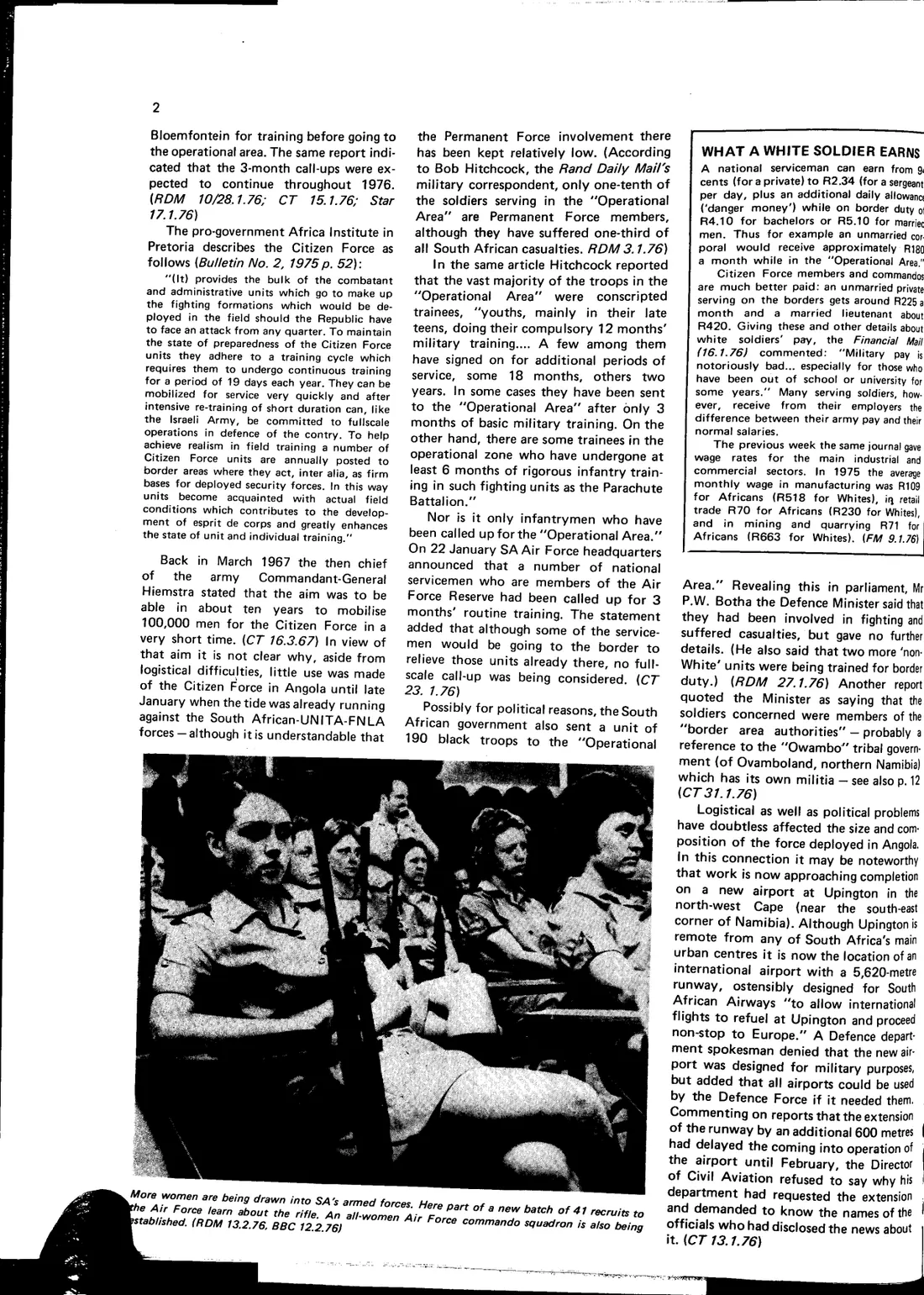
Nor is it only infantrymen who have been called up for the "Operational Area." On 22 January SA Air Force headquarters announced that a number of national servicemen who are members of the Air Force Reserve had been called up for 3 months' routine training. The statement added that although some of the service-men would be going to the border to relieve those units already there, no full-scale call-up was being considered.
Possibly for political reasons, the South African government also sent a unit of 190 black troops to the "Operational Area." Revealing this in parliament, Mr P.W. Botha the Defence Minister said that they had been involved in fighting and suffered casualties, but gave no further details. (He also said that two more 'non-White' units were being trained for border duty.) Another report quoted the Minister as saying that the soldiers concerned were members of the "border area authorities" - probably a reference to the "Owambo" tribal government (of Ovamboland, northern Namibia) which has its own militia.
Logistical as well as political problems have doubtless affected the size and composition of the force deployed in Angola. In this connection it may be noteworthy that work is now approaching completion on a new airport at Upington in the north-west Cape (near the south-east corner of Namibia). Although Upington is remote from any of South Africa's main urban centres it is now the location of an international airport with a 5,620-metre runway, ostensibly designed for South African Airways "to allow international flights to refuel at Upington and proceed non-stop to Europe." A Defence department spokesman denied that the new airport was designed for military purposes, but added that all airports could be used by the Defence Force if it needed them. Commenting on reports that the extension of the runway by an additional 600 metres had delayed the coming into operation of the airport until February, the Director of Civil Aviation refused to say why his department had requested the extension and demanded to know the names of the officials who had disclosed the news about it.