On 16 February 1976 ten African women, ranging in age from 30 to 60, appeared in a magistrates court in the northern Cape charged with trespass. They were convicted and sentenced to a fine of R30 or 60 days imprisonment. They elected to go to goal. "It is better to go to gaol," they said, "than to live at Vaalboschoek."
Their offence was to leave the swampy area of Vaalboschoek to which they had been compulsorily moved in 1975, and which they found to be uninhabitable. Driven by ill-health, mosquitoes, and the death of children and livestock after heavy summer rains, which ruined crops and caused some of their makeshift dwellings to collapse, they returned to their original home area at Majeng where they had lived since the turn of the century. Undeterred by the arrest and imprisonment of the original ten, more followed. On 19 February 56 women and children were reported to have returned to Majeng. Two days later it was reported that the police had arrested 24 women and 18 children and taken them back to Vaalboschoek, 80 kms away.
On 8 March the police arrested a further 27 women, ranging in age from 15 to 70, who were marching back to Majeng. When they appeared in court in Barkly West the magistrate persuaded the prosecution to drop the case because "a solution to the problem which landed them in court should be found." Press publicity and the fact that the issue was going to be raised in parliament may have induced this change of heart. (Also, defence counsel appeared on this occasion, unlike the initial case which was apparently undefended).
In a press interview the magistrate referred to the "genuine problems" created by heavy rains at Vaalboschoek, in the "Bantu homeland" of Bophutha-Tswana (N. Cape/W. Transvaal). He claimed that the matter should be settled between the women and the homeland authorities. Chief Lucas Mangope, Chief Minister of BophuthaTswana (which is next in line for independence after the Transkei in October 1976) said he had raised the matter in January with the Minister and found him sympathetic. But when questioned in parliament, the Deputy Minister of Bantu Development Dr. F. Hartzenberg gave no indication that alternative land to that at Vaalboschoek was being contemplated, and claimed that "water supply, sanitation and stormwater drainage (were) very satisfactory and under control." Earlier reports had indicated that previously, after the rains, the area was so cut off that helicopters had to be used to supply the local shops with necessitites until the roads were usable.
Behind this incident lies the story of an African community deprived of its traditional land by government decree and determined to fight for its own survival. The story first came to light in February 1975 when it was reported that police were "standing by to ensure the removal of some 2,000 Tswana tribesmen from their land near Taung, Northern Cape, into the Bophutha-Tswana homeland."
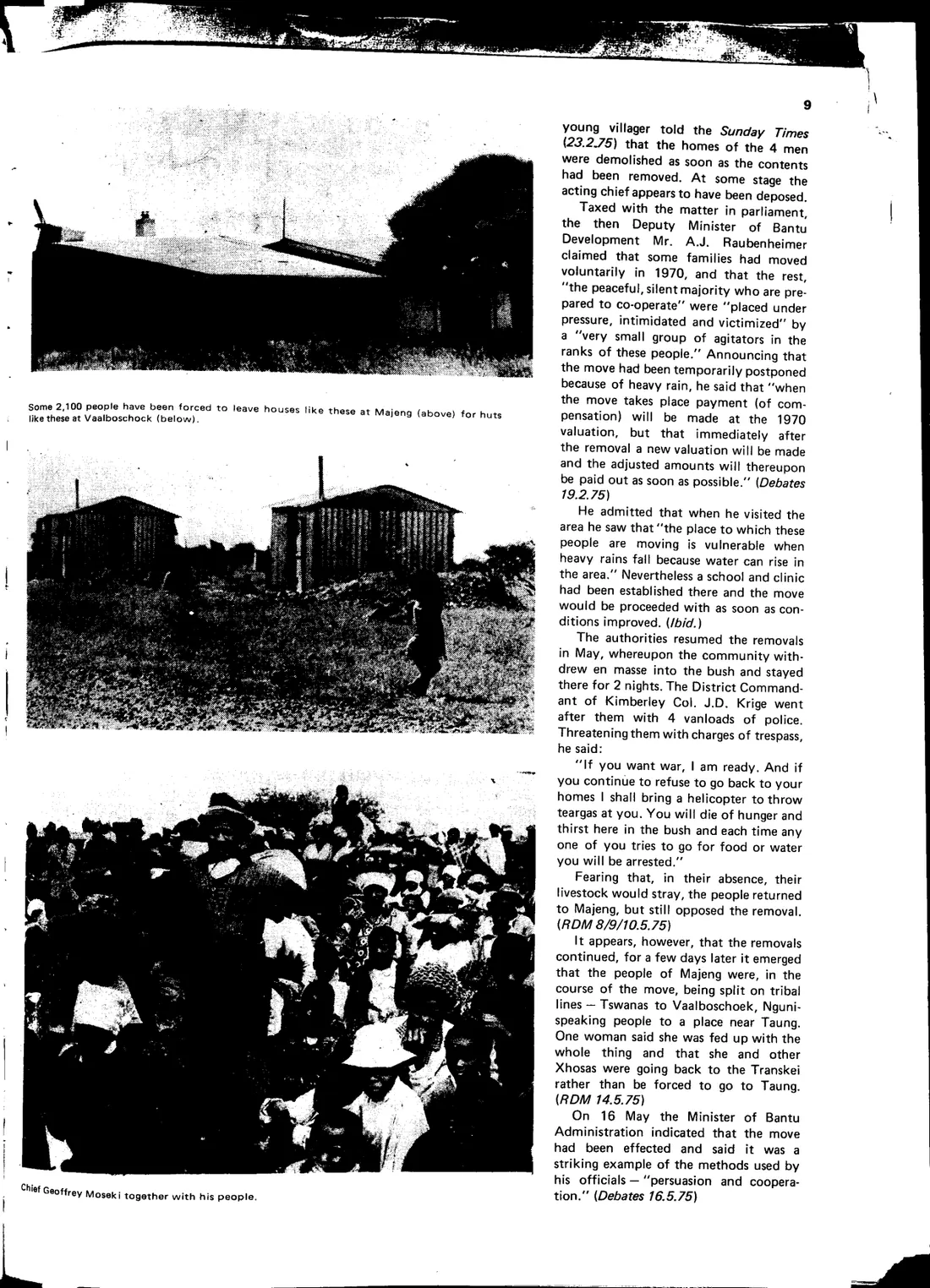
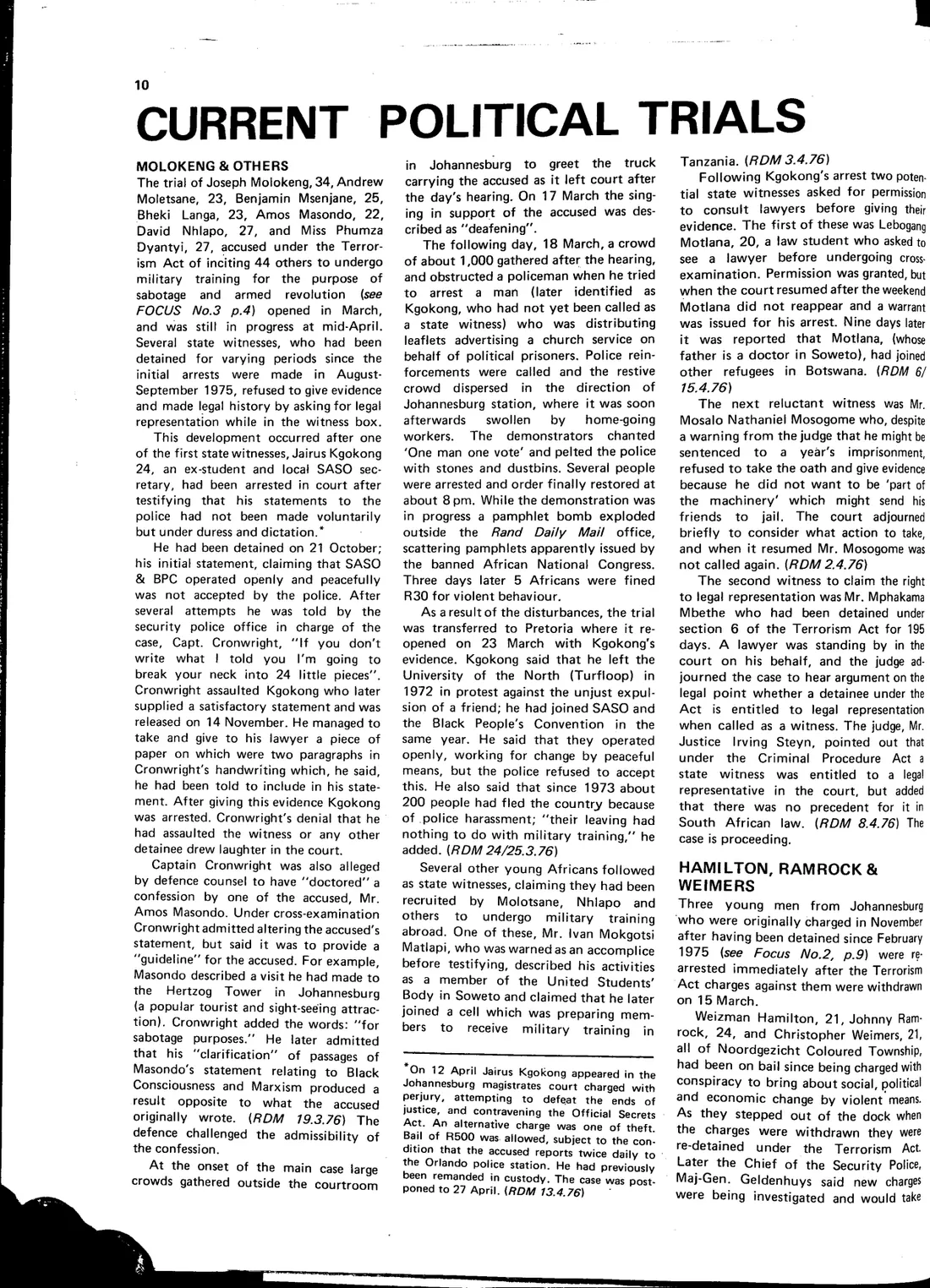
The 2,100 people concerned, comprising 676 families living together under their acting chief Geoffrey Moseki, at Majeng (Mayen), had been ordered by the State President to move to Vaalboschoek.
Orders of this sort, moving settled rural communities from one area to another, are a frequent occurrence. They form part of Pretoria's land consolidation programme which is intended to link up the scattered reserves and thereby reduce the number of territorial fragments into which most of the 'Bantu Homelands' are split. Black-occupied land in predominantly white-owned areas, and (much less common) white-owned pieces of land in predominantly black areas, are designated as black and white "spots" respectively and scheduled for elimination. The limits of this consolidation programme (not yet complete) have been firmly established by the Nationalist government as being the land laid down by the 1936 Native Land & Trust Act. When the distribution envisaged then is completed, the 'homelands' will comprise about 13½% of the country, with the rest being regarded as "white South Africa" in which Africans will have no political or property rights. Because this limit is rigidly applied, the process of consolidation mostly entails for Africans the exchange of moderately productive, developed land for barren and empty land. This was precisely the pattern for the people of Majeng.
The pressure on them started in 1968, when Chief Moseki said that he was arrested for refusing to move and only released after 8 months awaiting trial. In 1971 a school of more than 6,000 pupils was closed down and the teachers and furniture taken to Vaalboschoek. The rest of the community still would not move. Chief Moseki alleged that old age pensions and disability grants were withdrawn, a promised clinic was withheld, and the people were stopped from ploughing their fields.
The decision to move them was confirmed by a parliamentary committee in October 1974 as part of an extensive resettlement and consolidation plan. The committee is made up of white politicians and officials, and its main function is to look after the interests of white farmers and ensure that inconvenience to them is minimised while the Department of Bantu Administration implements the Bantustan blueprint.
The Department, aware that the land at Vaalboschoek is inferior to that at Majeng, offered the people 12,000 hectares in lieu of the 10,000 hectares they were being forced to leave. But Chief Moseki pointed out that there was less grazing than at Majeng, that the ground was stony and unsuitable for crops, and there was less water. The houses at Majeng were built of bricks, stones and mud. The 400 prefabricated dwellings erected at the other place were only three metres square and unsuitable for permanent family accommodation. The people would have to build new homes, at their own expense. At Majeng each family had a well; compensations for their houses and improvements there had not been discussed, he complained. His people would not move; if moved by force, he said, they would walk back to their land.
To effect the move a squad of 100 policemen armed with machine guns and sticks assembled, together with numerous B.A.D. officials and government trucks. A police colonel ordered all pressmen and photographers out of the area. While the entire community prayed in the rain at the ancestral graveyard, the personal belongings of Chief Moseki and 3 other leading men were loaded on to trucks and taken away to Vaalboschoek. There, however, rising water had already caused the collapse of some of the alternative accommodation. A young villager told the Sunday Times (23.2.75) that the homes of the 4 men were demolished as soon as the contents had been removed. At some stage the acting chief appears to have been deposed.
Taxed with the matter in parliament, the then Deputy Minister of Bantu Development Mr. A.J. Raubenheimer claimed that some families had moved voluntarily in 1970, and that the rest, "the peaceful, silent majority who are prepared to co-operate" were "placed under pressure, intimidated and victimized" by a "very small group of agitators in the ranks of these people." Announcing that the move had been temporarily postponed because of heavy rain, he said that "when the move takes place payment (of compensation) will be made at the 1970 valuation, but that immediately after the removal a new valuation will be made and the adjusted amounts will thereupon be paid out as soon as possible."
He admitted that when he visited the area he saw that "the place to which these people are moving is vulnerable when heavy rains fall because water can rise in the area." Nevertheless a school and clinic had been established there and the move would be proceeded with as soon as conditions improved.
The authorities resumed the removals in May, whereupon the community withdrew en masse into the bush and stayed there for 2 nights. The District Commandant of Kimberley Col. J.D. Krige went after them with 4 vanloads of police. Threatening them with charges of trespass, he said: "If you want war, I am ready. And if you continue to refuse to go back to your homes I shall bring a helicopter to throw teargas at you. You will die of hunger and thirst here in the bush and each time any one of you tries to go for food or water you will be arrested."
Fearing that, in their absence, their livestock would stray, the people returned to Majeng, but still opposed the removal. It appears, however, that the removals continued, for a few days later it emerged that the people of Majeng were, in the course of the move, being split on tribal lines - Tswanas to Vaalboschoek, Ngunispeaking people to a place near Taung. One woman said she was fed up with the whole thing and that she and other Xhosas were going back to the Transkei rather than be forced to go to Taung.
On 16 May the Minister of Bantu Administration indicated that the move had been effected and said it was a striking example of the methods used by his officials - "persuasion and cooperation."