There is evidence that the armed forces are under increasing pressure. Official communiques from security force headquarters rarely if ever reveal details of incidents or precise locations, and there are continuing efforts to promote the image of "terrorists" as barely human killers. The corpses of guerillas killed have, for example, been displayed not only to African villagers as a form of intimidation, but also to white civilians. On 12 May, the body of a young guerilla hit in the neck was laid out in the yard of Beitbridge Police Station, to be seen by "many Beitbridge residents, including children and tourists". The regime's Secretary for Internal Affairs recently told a passing-out parade of police recruits that whereas "normal criminals" were still entitled to the protection of the rule of law, "the terrorist, because of his conduct, may be killed on sight".
Official spokesmen, at a press briefing on 3 June, identified the three "operational areas" — "Hurricane", in the north-east, where guerillas were continuing to build up support and form cells among the local population; "Thrasher", adjoining the eastern border around Chipinga, where guerillas appeared to be harassing Europeans to abandon their homes and farms; and "Repulse" in the south-east, where the strategy was one of attacks on road and rail links. Guerilla attacks have occurred in places well outside the official operational areas, for example near West Nicholson, 130 km south east of Bulawayo, and across the Botswana and Zambian borders, while in the east and south-east in particular, the strategy appears to be to harass white economic activity as much as possible. Tea estates in the Eastern Highlands, for example, have had their African labour supply virtually cut off by a campaign of landmining and bushburning along the roads connecting the estates with nearby Tribal Trust Land. On the night of 13 June, the transport workshop of a tea estate was attacked, and buildings and vehicles destroyed.
Specific targets selected by the guerillas include regime-appointed chiefs and African councils set up as part of an official "provincialization" policy. A security force communique issued on 21 May reported that Acting Chief Chimoyo of the Mtoko district east of Salisbury had been killed by guerillas, while on 8 June it was learnt that Chief Mabika, one of 10 chiefs in the Rhodesian Senate, had been abducted from his home district of Bikita in the south-east. Chief Mabika was known as a staunch opponent of the armed struggle. Special precautions have since been introduced by the regime to protect chiefs, particularly those in the Senate and the four recently appointed to Ministerial posts. White civilian targets may also not be entirely random. It was subsequently learnt that the white farmer Gideon Beeking, who was abducted across the Mozambique border from his farm near Cashel on 18 May, had been convicted in 1971 of murdering one of his labourers. He had been sentenced to 3½ years imprisonment, 9 months of which had been suspended.
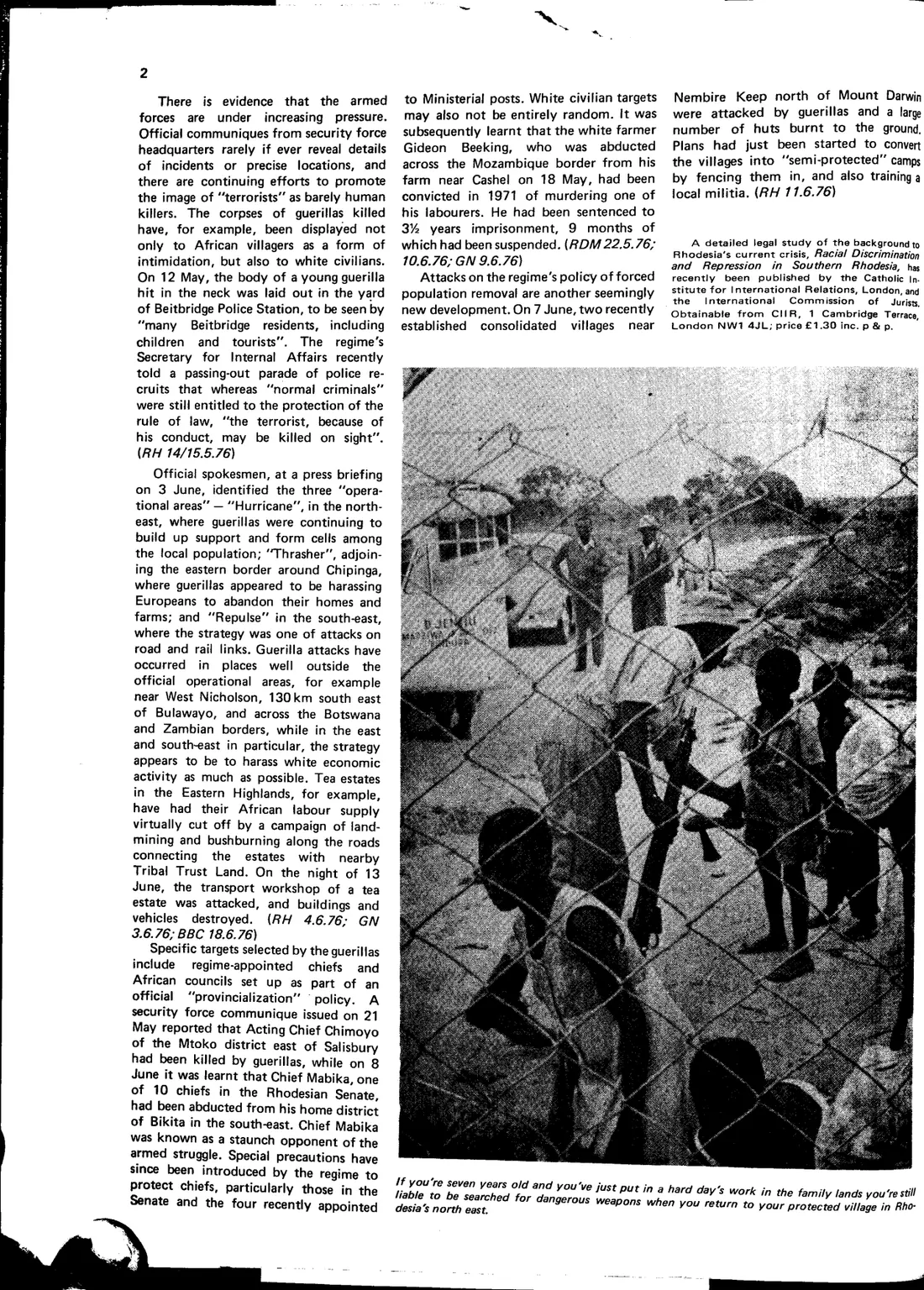
Attacks on the regime's policy of forced population removal are another seemingly new development. On 7 June, two recently established consolidated villages near Nembire Keep north of Mount Darwin were attacked by guerillas and a large number of huts burnt to the ground. Plans had just been started to convert the villages into "semi-protected" camps by fencing them in, and also training a local militia.