On 12 May 1976, AARON MUCHIMBA (31), SWAPO's National Organising Secretary, and HENDRICK SHIKONGO (31), a SWAPO member, were sentenced to death at the close of a three-month trial in Swakopmund Supreme Court. RAUNA NAMBINGA, a nurse in her early twenties from Engela Hospital in Ovamboland, was sentenced to 7 years' imprisonment, and ANNA NGAIHONDIWA, also a nurse, to 5 years. NAIMI NOMBOWO. (18) was acquitted while the sixth accused ANDREAS NANGOLO (56), a shop-keeper, was discharged on 27 April. The court's decision to impose the death penalty for the first time ever under the South African Terrorism Act, and against Namibians, marks the culmination of a countrywide security clampdown in which more than 200 SWAPO members are estimated to have been arrested and detained.
The four found guilty were all convicted under the main charge that they had "endangered the maintenance of law and order" in Namibia by taking part in "terrorist activities" and by providing aid and assistance to people "whose intent was the violent overthrow of the SWA Administration."
The court's determination to discredit SWAPO as a "terrorist" organisation, thereby implicating the defendants through their association with the movement, was made abundantly clear in the closing stages of the trial. Although in only one case, that of Henrik Shikongo, did the charges against the accused relate specifically to the assassination of Chief Filemon Elifas, the ostensible cause of the trial, the prosecution maintained in summing up that it was "obvious" that SWAPO has been responsible for his death. The accused "were members of SWAPO and were therefore familiar with the operations of the organisation."
After judgement had been declared but before sentence was passed Mr Chris Jansen, for the State, obtained permission to call two witnesses to give evidence of "terrorist activities" in Ovamboland and the country as a whole. Colonel Willem Schoon of the Security Police at Oshakati in Ovamboland, an officer who has figured prominently in descriptions of torture provided by witnesses in the trial, presented the court with a dossier of 59 acts of "terrorism" alleged to have taken place in Ovamboland over the period July 1975 to May 1976 and including attacks on South African Defence Force units, abductions, murders of sub-headmen, tribal police and civilians, landmine explosions, robbery and the destruction of property. Schoon maintained that "SWAPO terrorists" were without exception responsible for all 59 incidents, and stated that he and his staff had evidence "to prove that SWAPO is guilty." He did not elaborate.
The second witness, Colonel Carel Coetzee of the Brixton Robbery and Murder Squad in Johannesburg, had been seconded to Namibia to direct the police investigations of the murder of 4 white civilians at the farms Kalkhügel and Okatjiho in December 1975 and February 1976. He told the court that all the murders had been committed by "two terrorists trained abroad", one of whom was now in police custody while the other was still at large. The connection with SWAPO or the trial, if any, was not made clear by press reports.
Despite the fact that all except three of these alleged incidents had taken place several weeks or months after the accused had been arrested and taken into custody by the police, they were taken into account by Justice Strydom, who expressed himself in very strong terms in passing sentence. He said that recent murders in Namibia had been committed by "SWAPO terrorists trained abroad." The 59 incidents listed by Colonel Schoon "had not been the responsibility of strangers, but of trained citizens of South West Africa, acting as terrorists under the Swapo banner." The accused, the Judge went on, had shown no remorse when the list was read out in court. Although Muchimba and Shikongo had no previous convictions, "their ideology — good or bad — had led to acts of terrorism that could not be allowed to continue." "The evil of terrorism must be torn out by the roots, and law and order maintained ... terrorists had no right of existence." Muchimba and Shikongo were guilty by association and the court had no cause why the supreme penalty should not be imposed.
Leaving the dock, Aaron Muchimba and Hendrik Shikongo gave the Black Power salute. Fifteen minutes later, leave to appeal against the convictions of the four accused and the sentences of three of them (the exception being Anna Ngaihondjwa, who had received the minimum punishment of 5 years' imprisonment under the Terrorism Act) was refused. Justice Strydom, turning down the Defence Counsel's application, said that there was no prospect that another court might come to a different conclusion.
Since sentence was passed, further evidence has come to light of gross irregularity in the conduct of the trial, quite apart from the issue of the court's illegal status in the light of international law. Mr Patrick MacEntee, Senior Counsel of the Irish Bar, who attended the trial as an observer for the International Commission of Jurists, has described it as "an oppressive and highly unsatisfactory judicial process", and the sentences as "harsh in the extreme." He regarded the trial as one in which the prosecution evidence was selective and incomplete and conducted primarily "with a view to establishing the guilt of SWAPO rather than that of individual accused persons." "The vast majority of the African witnesses called by the prosecution in this case had been arrested and detained for lengthy periods and were still detained when they gave evidence. Their detention, their total uncertainty about their future liberty, torture and the fear of torture must render the probative value of their evidence suspect."
In addition to the overwhelming evidence of the use of torture by the police, the South African Security Police are now believed to have been heavily involved in mustering evidence and informers for the prosecution. On 2 June, an application was filed in the Windhoek Supreme Court by the legal firm of Lorentz and Bone for a special entry to be made on the record of the Swakopmund Terrorism trial regarding certain "irregular and illegal departures from the rules ... which the law requires for a fair trial," and which had affected the outcome. Lorentz and Bone had acted as instructing attorneys for the defence throughout the hearing. On 2 June and the following day, a series of sworn affidavits from the firm's partners and employees was presented to the Supreme Court, to the effect that Mr Jacobus Smit, an attorney and a partner in Lorentz and Bone, and Ms E.J. Ellis, the firm's switchboard operator, had provided a constant stream of information to the Windhoek Security Police over a period of several months since the trial began. Among documents photostatted by Ms. Ellis and handed to a Captain Nel was a statement by David Meroro, SWAPO's chairman, which had been transmitted from London in code, a telex communication from a firm of attorneys in Zambia, and a sworn statement from Hendrik Shikongo, since sentenced to death. Mr Smit was also alleged to have been in touch at frequent intervals with Nel and other officers of the Security Police, to keep them up to date with developments in the build-up of the defence case. Mr Colin du Preez, another partner in the firm, told the court in a sworn affidavit that during the course of the trial he had been told by the investigating officer Lt. Dippenaar that the Security Police knew everything that Lorentz and Bone had on their files. Other employees of the firm testified to being approached by members of the Security Police with requests for confidential information. Mr Smit and Ms Ellis were also alleged to have passed on information regarding evidence obtained in Ovamboland by Mr David Soggott, a Johannesburg advocate, of irregularities and intimidation in the course of the January 1975 homeland elections.
Once the leaks were discovered, Mr Smit's partnership in Lorentz and Bone was dissolved while Ms Ellis was dismissed. Smit was reported as saying that the information involved was such that "any good citizen of South West African would have conveyed it to the authorities." Ms Ellis also told a colleague that she was not acting as an informer "for herself but for her country and because of her hatred of the Blacks."
Following an initial hearing on 2 June, the defence's application for a special entry was postponed to 16 June. It was still proceeding several days later, following strenuous denials by both the Security Police and Mr Smit and Ms Ellis, that the leaks had occurred. The defence team had meanwhile been strengthened by the arrival of Mr I A Maisels, QC, from Johannesburg. Also on 2 June, application had been made to the Appellate Division of Bloemfontein Supreme Court for leave to appeal against the sentences and convictions handed down in Swakopmund. A ruling on the application was deferred until the Windhoek Supreme Court Judge, Mr Justice Hart, had ruled for or against the special entry application.
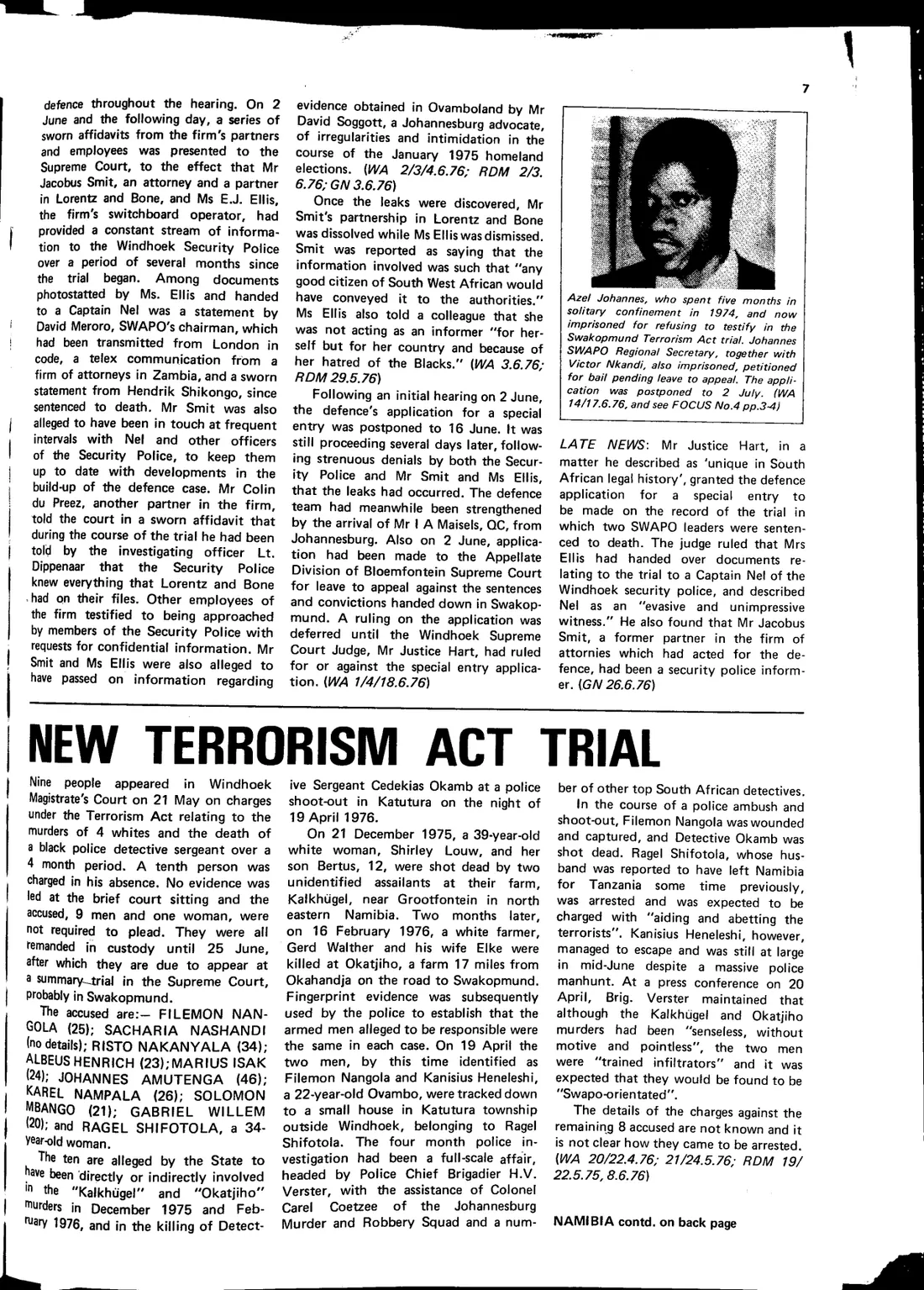
LATE NEWS: Mr Justice Hart, in a matter he described as 'unique in South African legal history', granted the defence application for a special entry to be made on the record of the trial in which two SWAPO leaders were sentenced to death. The judge ruled that Mrs Ellis had handed over documents relating to the trial to a Captain Nel of the Windhoek security police, and described Nel as an "evasive and unimpressive witness." He also found that Mr Jacobus Smit, a former partner in the firm of attorneys which had acted for the defence, had been a security police informer.