CONVICTED POLITICAL PRISONERS
The official figures for the number of convicted political prisoners who were serving sentences as at 1 January 1976 were as follows:
General Law Amendment Act (Sec. 21) (i.e. the 'Sabotage' Act) - 171 (154 Africans, 9 Asians, 5 Whites, 3 Coloureds) Suppression of Communism Act (renamed Internal Security Act) - 5 (4 Africans, 1 White) Unlawful Organisations Act - 2 (both Africans) Terrorism Act - 74 (64 Africans, 4 Asians, 3 Whites, 3 Coloureds) Riotous Assemblies Act - 1 (African)
TOTAL - 253
In 1975 4 persons were convicted under the Suppression of Communism Act (3 Africans, 1 White), 4 under the Terrorism Act (3 Africans, 1 White) and 1 (African) under the Riotous Assemblies Act.
MDLULI: POLICEMEN CHARGED
Four members of the Security Police, two Whites and two Africans, have been charged in the Durban Supreme Court with culpable homicide in connection with the death of Joseph Mdluli, a detainee under the Terrorism Act. They are: Capt. D.F. van Zyl, Lt. A.R.C. Taylor, Dt. Sgt. M.P. Makhanya, and Const. Z. Ngobese. They were remanded to 25 October and released on their own recognizances.
CHILDREN IMPRISONED
A disturbing feature of the police mopping-up operations has been the detention of large numbers of African children in police custody. Early in July the Star revealed that children, some as young as eight, had been held for three weeks at John Vorster Square, the security police HQ in Johannesburg. The Commissioner of Police, General G. Prinsloo, commented: "The children are probably better looked after in a police cell than they would be in a place of safety. It is not unusual to keep juveniles in cells for long periods before trials."
Another senior officer, Brig. J.F. Roos, CID divisional officer, said only 33 children were being held at Vorster Square, the youngest being 15. He added: "What do you think would happen if we let them run around the streets? We would never find them again. Letting them out on bail would be no use – many will not return home anyway. We cannot release them until investigations are complete, and we are working around the clock on those." He refused to disclose the number of children in detention.
The Rand Daily Mail discovered when probing the disappearance of many children that some of those held at Vorster Square (including some aged between 8 and 11) were transferred to a reformatory at Benoni; some were returned to police HQ in the course of investigations e.g. on 24 June 48 children, mostly from Soweto, were taken in police trucks from the reformatory back to Vorster Square. Parents approaching the reformatory to discover the fate of their offspring returned disappointed.
The following week the chief prosecutor of Johannesburg was reported as saying that most of the children held since the riots had been released into the custody of their parents after appearing in court. But Soweto's CID chief Col. Visser could not confirm the number still being held. And while releases were being made, more children were being arrested, e.g. in Alexandra and Middleburg in the third week in July.
The detention of many youngsters caused widespread concern, and stimulated further protests. The Minister of Justice, Mr. Kruger, said the detention of juveniles was being used by agitators seeking to incite new disturbances.
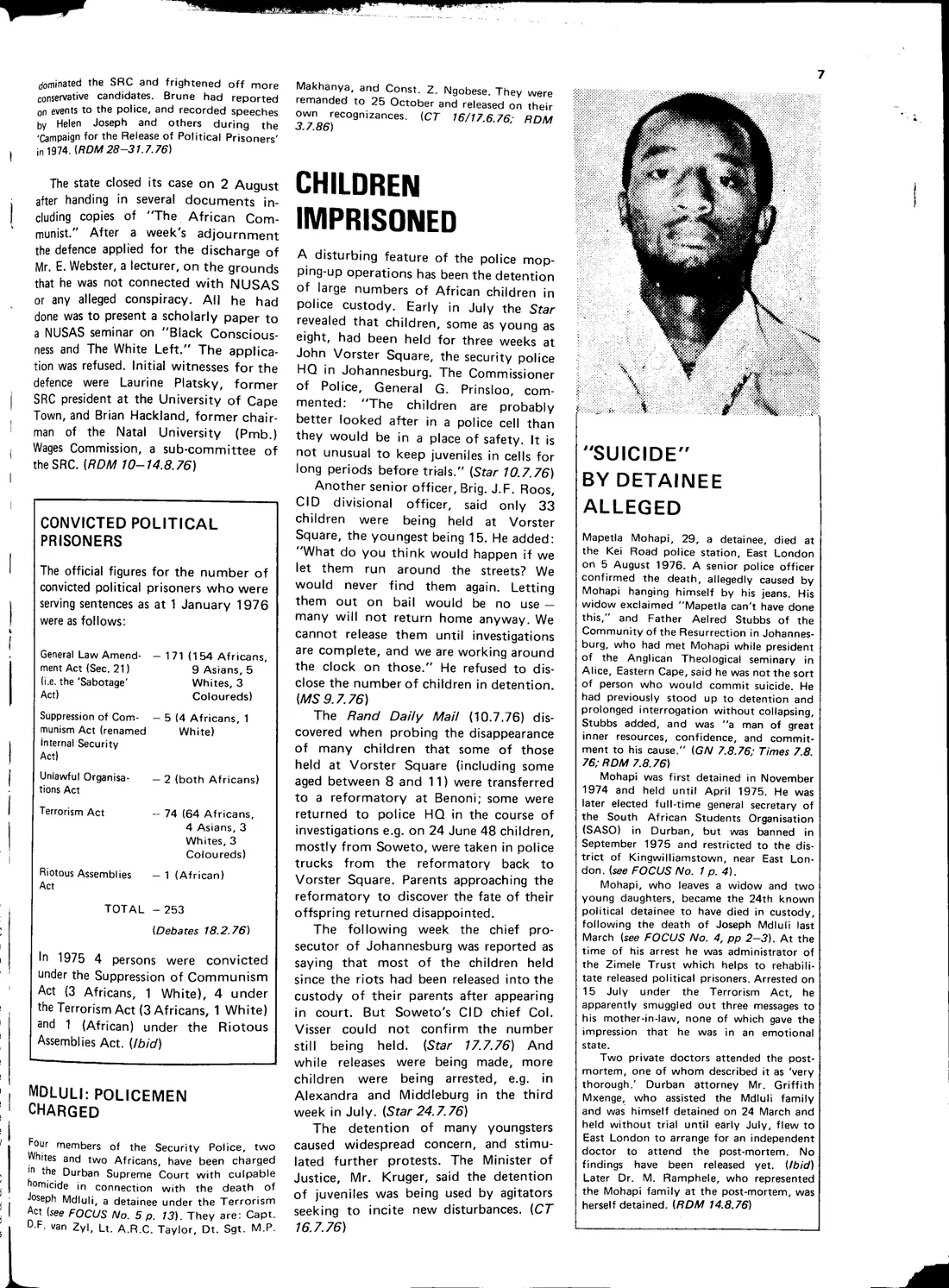
"SUICIDE" BY DETAINEE ALLEGED
Mapetla Mohapi, 29, a detainee, died at the Kei Road police station, East London on 5 August 1976. A senior police officer confirmed the death, allegedly caused by Mohapi hanging himself by his jeans. His widow exclaimed "Mapetla can't have done this," and Father Aelred Stubbs of the Community of the Resurrection in Johannesburg, who had met Mohapi while president of the Anglican Theological seminary in Alice, Eastern Cape, said he was not the sort of person who would commit suicide. He had previously stood up to detention and prolonged interrogation without collapsing, Stubbs added, and was "a man of great inner resources, confidence, and commitment to his cause."
Mohapi was first detained in November 1974 and held until April 1975. He was later elected full-time general secretary of the South African Students Organisation (SASO) in Durban, but was banned in September 1975 and restricted to the district of Kingwilliamstown, near East London.
Mohapi, who leaves a widow and two young daughters, became the 24th known political detainee to have died in custody, following the death of Joseph Mdluli last March. At the time of his arrest he was administrator of the Zimele Trust which helps to rehabilitate released political prisoners. Arrested on 15 July under the Terrorism Act, he apparently smuggled out three messages to his mother-in-law, none of which gave the impression that he was in an emotional state.
Two private doctors attended the post-mortem, one of whom described it as 'very thorough.' Durban attorney Mr. Griffith Mxenge, who assisted the Mdluli family and was himself detained on 24 March and held without trial until early July, flew to East London to arrange for an independent doctor to attend the post-mortem. No findings have been released yet. Later Dr. M. Ramphele, who represented the Mohapi family at the post-mortem, was herself detained.