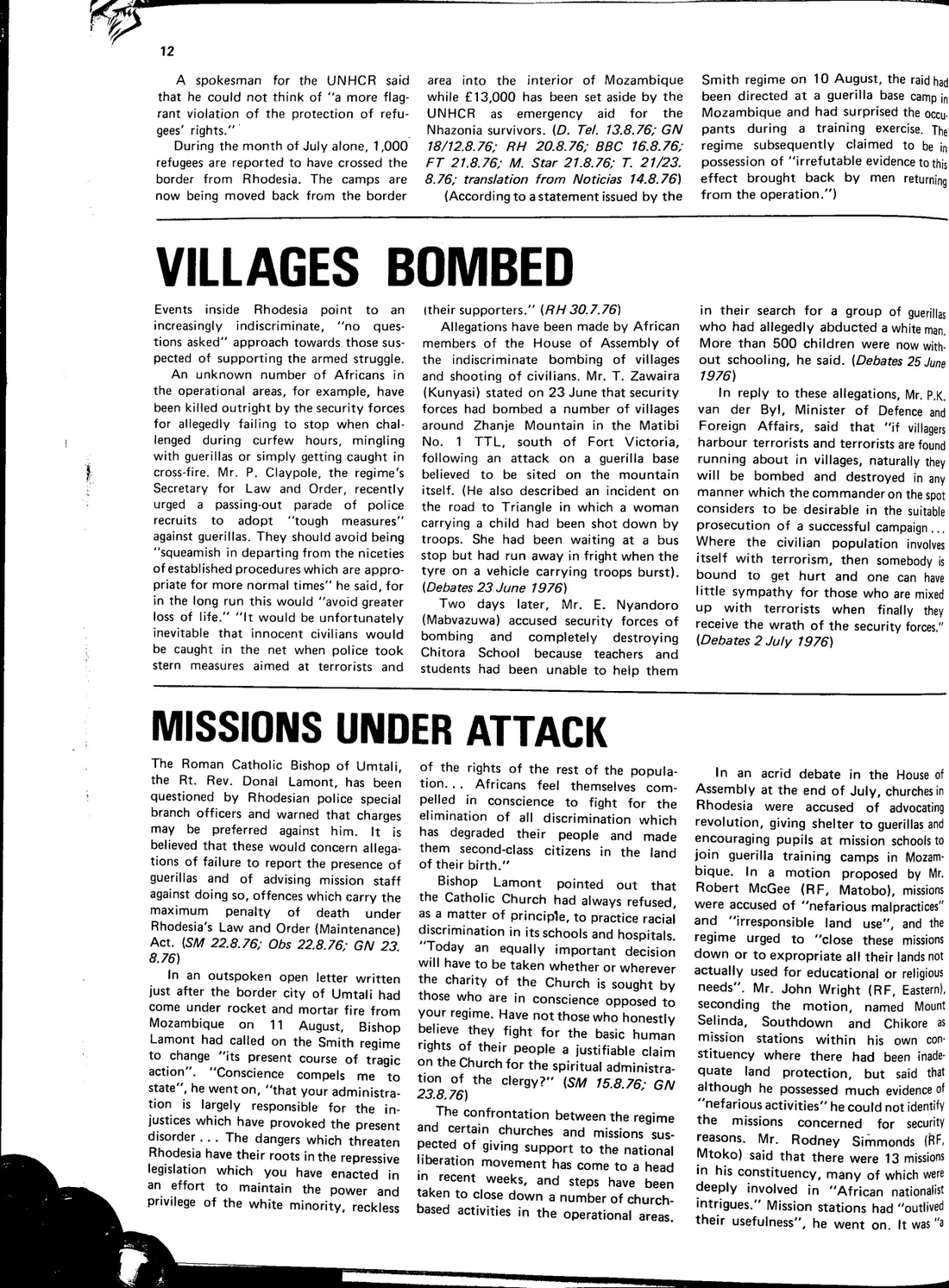
As many as 1,000 people may have been killed by security forces of the Smith regime in an attack on a Zimbabwean refugee camp 40 km inside the Mozambique border on 9 August 1976. The raid, which was reportedly greeted with jubilation by white Rhodesians, has been condemned by the UN High Commissioner for Refugees, Prince Sadruddin Aga Khan, as a "shocking and abominable" atrocity. In a statement from his headquarters in Geneva, the High Commissioner said that "it escapes my understanding as to what those responsible for it thought they were accomplishing."
According to a communique issued on 14 August by the Ministry of National Defence of the People's Republic of Mozambique, and details published in the Maputo newspaper, Noticias, a party of Rhodesian troops in combat vehicles crossed the Rhodesian border through Penhalonga, a zone without border control just north of Umtali, around midnight on Sunday 8 August. (It is not clear exactly how many troops were involved, although the regime's leader, Ian Smith, subsequently remarked in a radio interview that he was "surprised at how few of our Rhodesian forces were involved. It was a comparatively small party." It has been suggested that a squadron of the Special Air Service were involved together with members of the Selous Scouts. Other reports give the figure of 50 soldiers.)
The camp which formed the target of the raid and housed at least 8,000 Zimbabwean refugees was situated at Nhazonia, Barue District, in Manica Province and about 75 km from Chimoio, the provincial capital. The troops, traveling first in the direction of Mavonde, covered more than 69 km in reaching the camp. 17 km from their destination, they reached a bridge across the Pungoe river on the trunk road from Tete to Chimoio, and a detachment remained behind on guard, mining the bridge to cover the retreat.
According to later witnesses, the Rhodesian soldiers wore Mozambican uniforms, carried the same type of weapons as the Mozambican forces and drove vehicles with Mozambican registration numbers, including armoured cars. The party contained both black and white troops, the latter having their faces blackened. A survivor, an elderly man, testified that the soldiers were singing revolutionary songs and shouting "Viva Frelimo!" as they approached Nhazonia camp at about 7 am on the Monday morning. "The people approached them, the children jumping on to the cars. We thought they were Frelimo because they had the same uniforms." The people were told by the intruders to fetch their leaders. "Some of us moved to point out the houses where those in charge were. It was at that point that they began to fire on us." "Those who were nearest fell. They died right there. Then they began to pursue those who were running away towards the river. They got out of the vehicles firing continuously. On the road the vehicles crushed the bodies and everything that was in their way. Many people died at the river, when they were trying to cross it to escape into the bush, above all, children, old people, women and those who didn't know how to swim." The huts of the camp were fired, burning people inside and incinerating many corpses. On their retreat the raiding party blew up the Pungoe river bridge and opened fire on two civilian vehicles crossing it, killing 6 people, including a Spanish priest, Father Castro, a member of the Burgos Fathers.
Members of the Mozambique Provincial Health Service who visited Nhazonia camp after the attack recovered an initial 620 bodies, which were buried in mass graves. Many others were believed to have fled wounded into the bush and died there. Over 300 wounded had been admitted to Chimoio hospital by Thursday evening, 12 August, and others to smaller hospitals elsewhere.
On 13 August, Mr. Hugo Idoyaga, representative in Mozambique of the UN High Commissioner for Refugees (UNHCR), reported to his headquarters that he had visited Nhazonia camp 2 days previously and found it completely destroyed. He had been shown 10 mass graves in which men, women and children were buried and he had also seen 500 wounded refugees. He confirmed that the camp was one of 3 settlements in Mozambique for refugees from Rhodesia and supported by his UN agency. On 28 May 1976 he had visited the camp and had reported that it was purely for refugees, with no sign of military activity.
A spokesman for the UNHCR said that he could not think of "a more flagrant violation of the protection of refugees' rights."
During the month of July alone, 1,000 refugees are reported to have crossed the border from Rhodesia. The camps are now being moved back from the border area into the interior of Mozambique while £13,000 has been set aside by the UNHCR as emergency aid for the Nhazonia survivors.
(According to a statement issued by the Smith regime on 10 August, the raid had been directed at a guerilla base camp in Mozambique and had surprised the occupants during a training exercise. The regime subsequently claimed to be in possession of "irrefutable evidence to this effect brought back by men returning from the operation.")