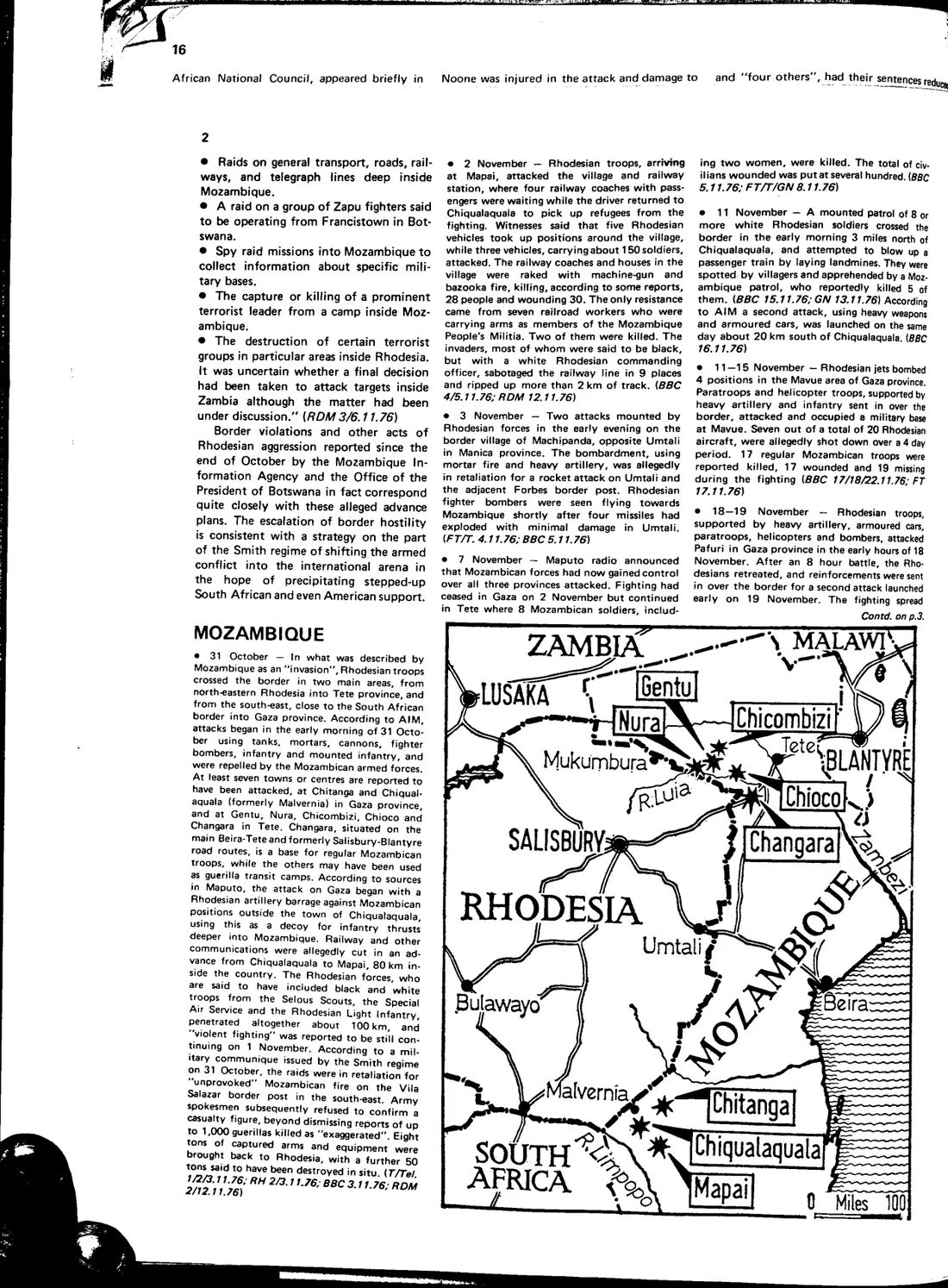
According to reports from the official Mozambique Information Agency (AIM), Rhodesian security forces have violated the border and attacked civilian and military targets inside Mozambique on numerous occasions since the opening of the Geneva Conference at the end of October. The scale of these border raids, which most frequently have taken the form of airborne bombing strikes supported by heavily armed ground reinforcements, appears to have increased dramatically from the relatively small commando-type operation, such as that mounted against the Nhazonia refugee camp in August, to full pitched battles with regular Mozambican forces. Up to 400 Rhodesian troops were estimated to have been deployed in an operation reported towards the end of November.
The Smith regime has on various occasions denied that such engagements with Frelimo troops have taken place at all, dismissing the AIM reports as fanciful pointers to what it maintains is a disturbed and unstable state of affairs within Mozambique itself. However, it has consistently upheld its rights under "international law" on the one hand, to take "appropriate retaliatory action" against Mozambican troops allegedly responsible for attacking border posts and other Rhodesian targets with rockets and mortar bombs from across the border, and on the other, to engage in "hot pursuit" operations against guerillas of the Zimbabwean liberation movement. A Rhodesian Assistant Commissioner, speaking at a press conference after one such raid, declared that "it is not our intention to zap Frelimo at all, though if anyone gets in our way they will get what's coming to them."
This increasingly aggressive policy has been necessitated, according to official spokesmen for the regime, by the liberation movement's decision to step up the armed struggle as a complement to the Geneva talks, and in particular, to avert a "big push" being planned by the guerilla commanders for the end of 1976. Since at least early December, when it was revealed that a fourth military front, "Operation Tangent", had been declared along Rhodesia's entire western border with Botswana from Kazangula in the north west down to Beit Bridge in the south, the Rhodesian Midlands have been the only part of the country officially free from guerilla incursions. The Botswana border, too, has been the scene of increasingly serious violations by Rhodesian troops, culminating shortly before Christmas in an armed clash with members of the Botswana Mobile Police unit.
There is evidence, however, that ambitious plans for wide ranging strikes not only into Mozambique and Botswana, but even into Zambia, were worked out by the Smith regime well in advance of the Geneva Conference and designed to coincide with it. According to reports published in the South African Rand Daily Mail at the beginning of November, a special correspondent, Mr. J.H.P. Serfontein, became aware of the plans while on a visit to Rhodesia on or before 14 October. It was thought that the strikes — details of which were forwarded to the Rand Daily Mail but which its editors decided to withhold for almost three weeks — would be undertaken by special Rhodesian forces such as the Selous Scouts and anti-foreign groups operating from within Rhodesia, rather than by regular army units. They were "expected to include the following:
- Attacks from Rhodesia on targets inside Mozambique and not far from the * Raids on general transport, roads, railways, and telegraph lines deep inside Mozambique. * A raid on a group of Zapu fighters said to be operating from Francistown in Botswana. * Spy raid missions into Mozambique to collect information about specific military bases. * The capture or killing of a prominent terrorist leader from a camp inside Mozambique. * The destruction of certain terrorist groups in particular areas inside Rhodesia. It was uncertain whether a final decision had been taken to attack targets inside Zambia although the matter had been under discussion.
Border violations and other acts of Rhodesian aggression reported since the end of October by the Mozambique Information Agency and the Office of the President of Botswana in fact correspond quite closely with these alleged advance plans. The escalation of border hostility is consistent with a strategy on the part of the Smith regime of shifting the armed conflict into the international arena in the hope of precipitating stepped-up South African and even American support.