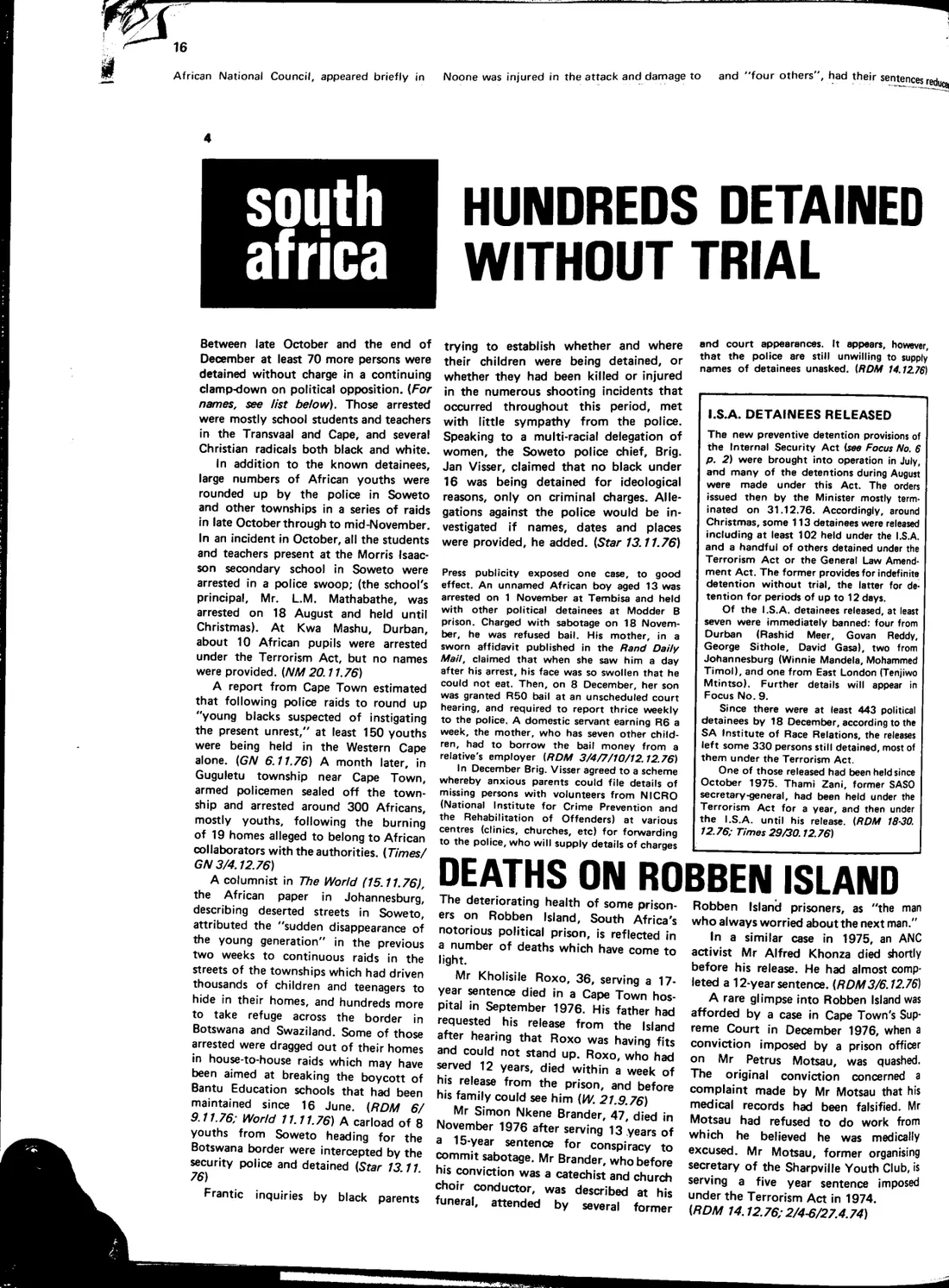
Between late October and the end of December at least 70 more persons were detained without charge in a continuing clamp-down on political opposition. Those arrested were mostly school students and teachers in the Transvaal and Cape, and several Christian radicals both black and white.
In addition to the known detainees, large numbers of African youths were rounded up by the police in Soweto and other townships in a series of raids in late October through to mid-November. In an incident in October, all the students and teachers present at the Morris Isaacson secondary school in Soweto were arrested in a police swoop; (the school's principal, Mr. L.M. Mathabathe, was arrested on 18 August and held until Christmas). At Kwa Mashu, Durban, about 10 African pupils were arrested under the Terrorism Act, but no names were provided.
A report from Cape Town estimated that following police raids to round up "young blacks suspected of instigating the present unrest," at least 150 youths were being held in the Western Cape alone. A month later, in Guguletu township near Cape Town, armed policemen sealed off the township and arrested around 300 Africans, mostly youths, following the burning of 19 homes alleged to belong to African collaborators with the authorities.
A columnist in The World, the African paper in Johannesburg, describing deserted streets in Soweto, attributed the "sudden disappearance of the young generation" in the previous two weeks to continuous raids in the streets of the townships which had driven thousands of children and teenagers to hide in their homes, and hundreds more to take refuge across the border in Botswana and Swaziland. Some of those arrested were dragged out of their homes in house-to-house raids which may have been aimed at breaking the boycott of Bantu Education schools that had been maintained since 16 June. A carload of 8 youths from Soweto heading for the Botswana border were intercepted by the security police and detained.
Frantic inquiries by black parents trying to establish whether and where their children were being detained, or whether they had been killed or injured in the numerous shooting incidents that occurred throughout this period, met with little sympathy from the police. Speaking to a multi-racial delegation of women, the Soweto police chief, Brig. Jan Visser, claimed that no black under 16 was being detained for ideological reasons, only on criminal charges. Allegations against the police would be investigated if names, dates and places were provided, he added.
Press publicity exposed one case, to good effect. An unnamed African boy aged 13 was arrested on 1 November at Tembisa and held with other political detainees at Modder B prison. Charged with sabotage on 18 November, he was refused bail. His mother, in a sworn affidavit published in the Rand Daily Mail, claimed that when she saw him a day after his arrest, his face was so swollen that he could not eat. Then, on 8 December, her son was granted R50 bail at an unscheduled court hearing, and required to report thrice weekly to the police. A domestic servant earning R6 a week, the mother, who has seven other children, had to borrow the bail money from a relative's employer.
In December Brig. Visser agreed to a scheme whereby anxious parents could file details of missing persons with volunteers from NICRO (National Institute for Crime Prevention and the Rehabilitation of Offenders) at various centres (clinics, churches, etc) for forwarding to the police, who will supply details of charges and court appearances. It appears, however, that the police are still unwilling to supply names of detainees unasked.
I.S.A. DETAINES RELEASED The new preventive detention provisions of the Internal Security Act were brought into operation in July, and many of the detentions during August were made under this Act. The orders issued then by the Minister mostly terminated on 31.12.76. Accordingly, around Christmas, some 113 detainees were released including at least 102 held under the I.S.A. and a handful of others detained under the Terrorism Act or the General Law Amendment Act. The former provides for indefinite detention without trial, the latter for detention for periods of up to 12 days.
Of the I.S.A. detainees released, at least seven were immediately banned: four from Durban (Rashid Meer, Govan Reddy, George Sithole, David Gasa), two from Johannesburg (Winnie Mandela, Mohammed Timol), and one from East London (Tenjiwo Mtintso). Further details will appear in Focus No. 9.
Since there were at least 443 political detainees by 18 December, according to the SA Institute of Race Relations, the releases left some 330 persons still detained, most of them under the Terrorism Act.
One of those released had been held since October 1975. Thami Zani, former SASO secretary-general, had been held under the Terrorism Act for a year, and then under the I.S.A. until his release.