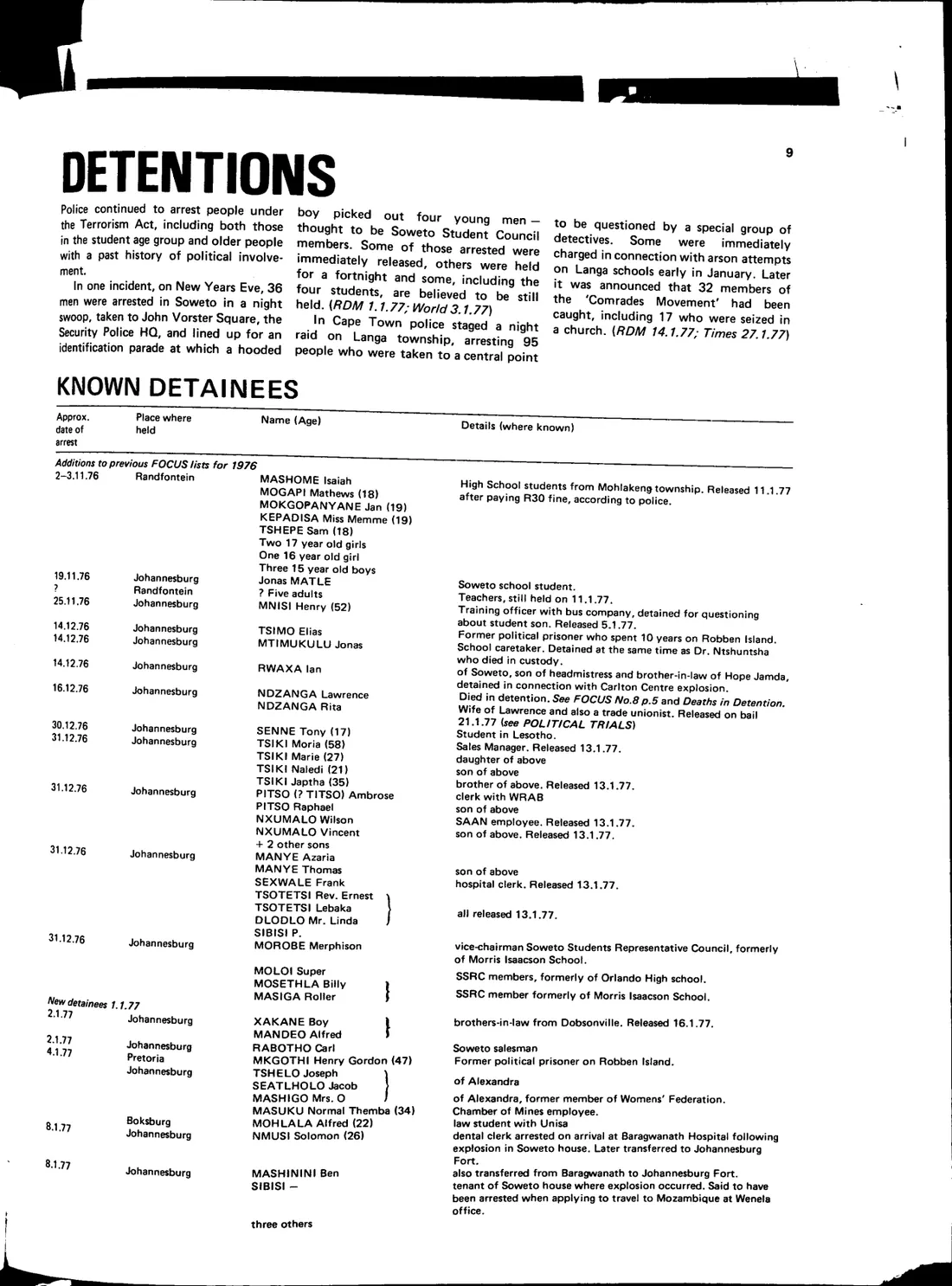
Police continued to arrest people under the Terrorism Act, including both those in the student age group and older people with a past history of political involvement.
In one incident, on New Years Eve, 36 men were arrested in Soweto in a night swoop, taken to John Vorster Square, the Security Police HQ, and lined up for an identification parade at which a hooded boy picked out four young men – thought to be Soweto Student Council members. Some of those arrested were immediately released, others were held for a fortnight and some, including the four students, are believed to be still held.
In Cape Town police staged a night raid on Langa township, arresting 95 people who were taken to a central point to be questioned by a special group of detectives. Some were immediately charged in connection with arson attempts on Langa schools early in January. Later it was announced that 32 members of the 'Comrades Movement' had been caught, including 17 who were seized in a church.
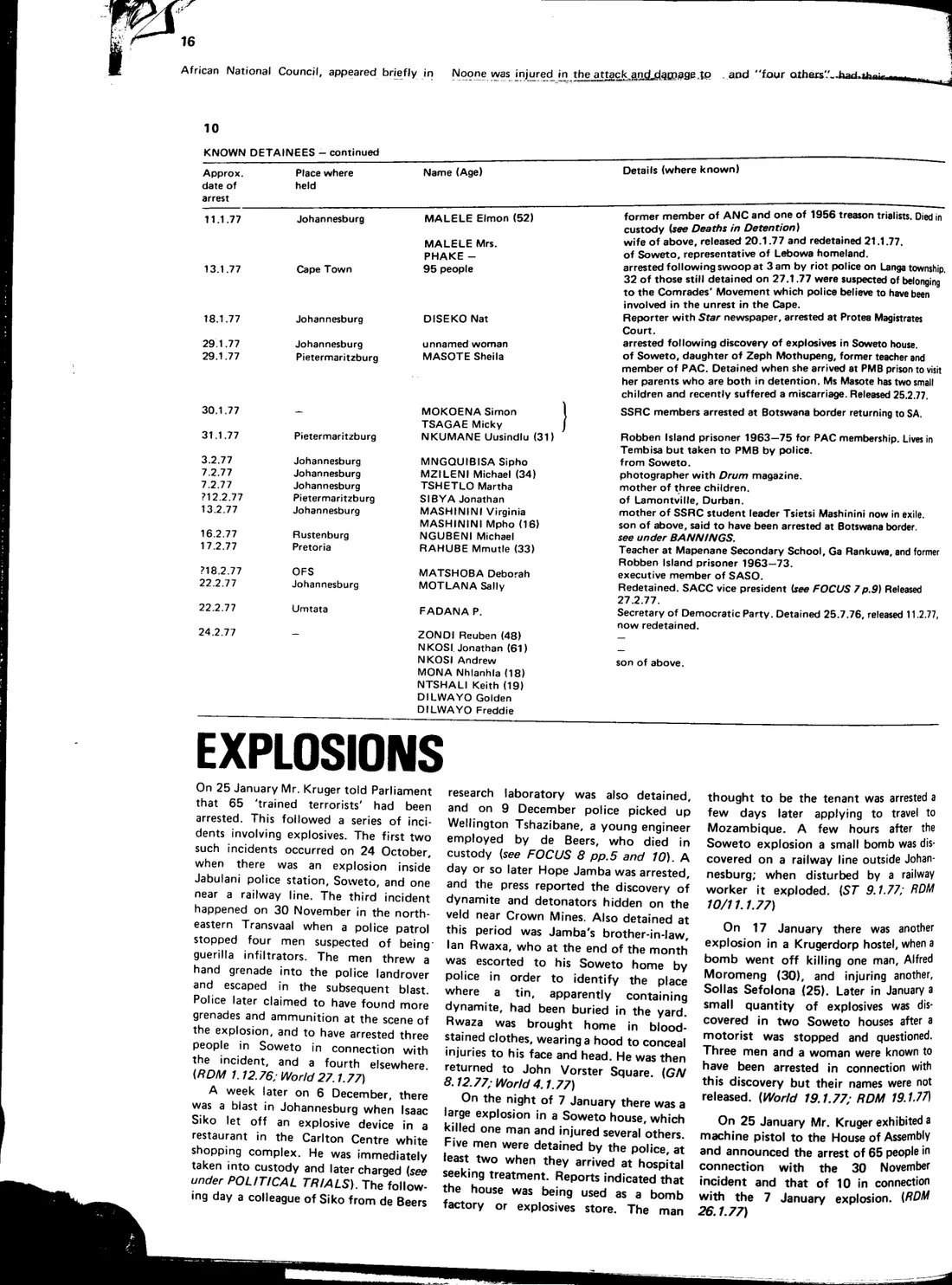
[Table of Known Detainees omitted for brevity]
On 25 January Mr. Kruger told Parliament that 65 'trained terrorists' had been arrested. This followed a series of incidents involving explosives. The first two such incidents occurred on 24 October, when there was an explosion inside Jabulani police station, Soweto, and one near a railway line. The third incident happened on 30 November in the northeastern Transvaal when a police patrol stopped four men suspected of being guerilla infiltrators. The men threw a hand grenade into the police landrover and escaped in the subsequent blast. Police later claimed to have found more grenades and ammunition at the scene of the explosion, and to have arrested three people in Soweto in connection with the incident, and a fourth elsewhere.
A week later on 6 December, there was a blast in Johannesburg when Isaac Siko let off an explosive device in a restaurant in the Carlton Centre white shopping complex. He was immediately taken into custody and later charged. The following day a colleague of Siko from de Beers research laboratory was also detained, and on 9 December police picked up Wellington Tshazibane, a young engineer employed by de Beers, who died in custody. A day or so later Hope Jamba was arrested, and the press reported the discovery of dynamite and detonators hidden on the veld near Crown Mines. Also detained at this period was Jamba's brother-in-law, Ian Rwaxa, who at the end of the month was escorted to his Soweto home by police in order to identify the place where a tin, apparently containing dynamite, had been buried in the yard. Rwaza was brought home in blood-stained clothes, wearing a hood to conceal injuries to his face and head. He was then returned to John Vorster Square.
On the night of 7 January there was a large explosion in a Soweto house, which killed one man and injured several others. Five men were detained by the police, at least two when they arrived at hospital seeking treatment. Reports indicated that the house was being used as a bomb factory or explosives store. The man thought to be the tenant was arrested a few days later applying to travel to Mozambique. A few hours after the Soweto explosion a small bomb was discovered on a railway line outside Johannesburg; when disturbed by a railway worker it exploded.
On 17 January there was another explosion in a Krugerdorp hostel, when a bomb went off killing one man, Alfred Moromeng (30), and injuring another, Sollas Sefolona (25). Later in January a small quantity of explosives was discovered in two Soweto houses after a motorist was stopped and questioned. Three men and a woman were known to have been arrested in connection with this discovery but their names were not released.
On 25 January Mr. Kruger exhibited a machine pistol to the House of Assembly and announced the arrest of 65 people in connection with the 30 November incident and that of 10 in connection with the 7 January explosion.