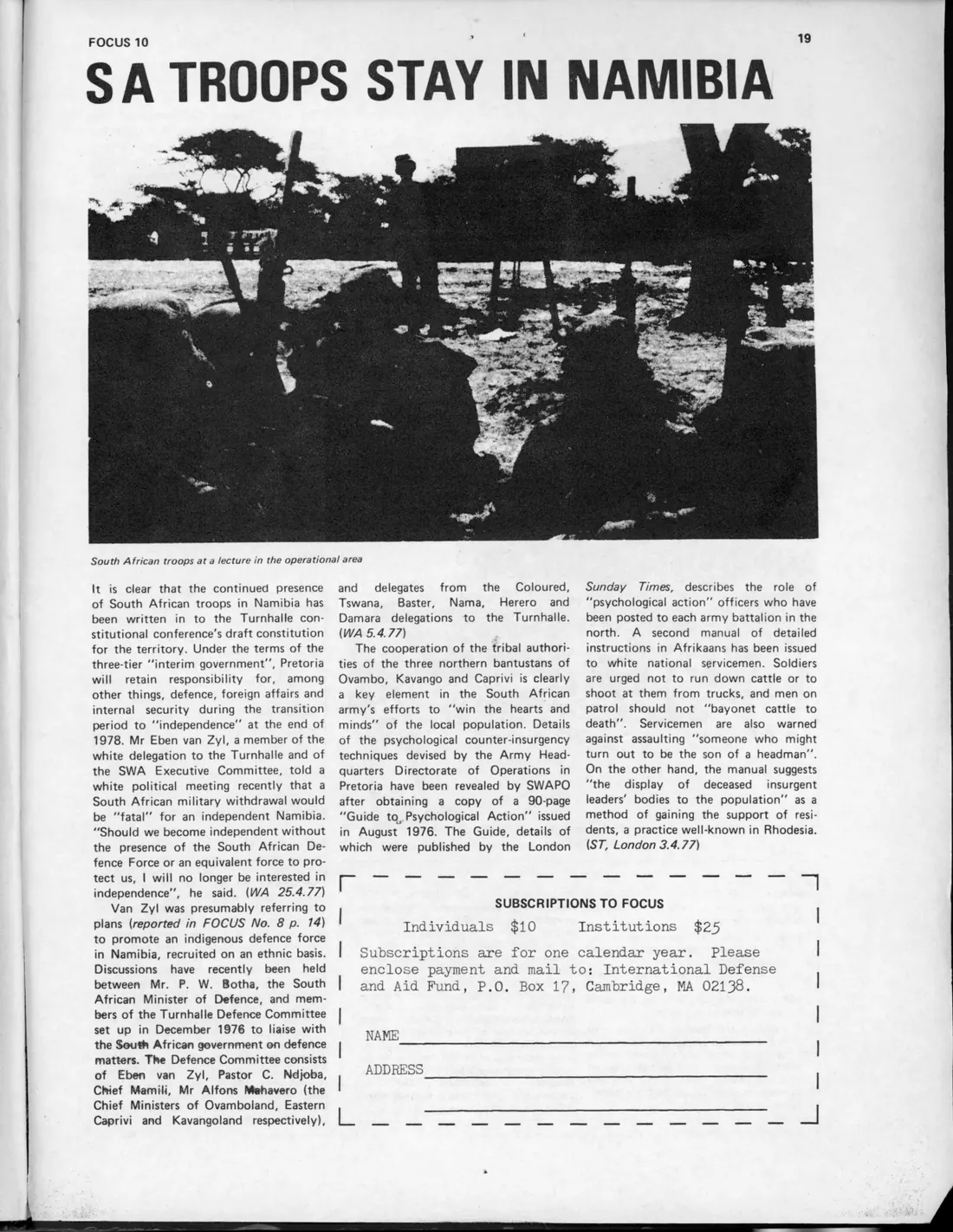
It is clear that the continued presence of South African troops in Namibia has been written in to the Turnhalle constitutional conference's draft constitution for the territory. Under the terms of the three-tier "interim government", Pretoria will retain responsibility for, among other things, defence, foreign affairs and internal security during the transition period to "independence" at the end of 1978. Mr Eben van Zyl, a member of the white delegation to the Turnhalle and of the SWA Executive Committee, told a white political meeting recently that a South African military withdrawal would be "fatal" for an independent Namibia. "Should we become independent without the presence of the South African Defence Force or an equivalent force to protect us, I will no longer be interested in independence", he said.
Van Zyl was presumably referring to plans to promote an indigenous defence force in Namibia, recruited on an ethnic basis. Discussions have recently been held between Mr. P. W. Botha, the South African Minister of Defence, and members of the Turnhalle Defence Committee set up in December 1976 to liaise with the South African government on defence matters. The Defence Committee consists of Eben van Zyl, Pastor C. Ndjoba, Chief Mamili, Mr Alfons Mahavero (the Chief Ministers of Ovamboland, Eastern Caprivi and Kavangoland respectively), and delegates from the Coloured, Tswana, Baster, Nama, Herero and Damara delegations to the Turnhalle.
The cooperation of the tribal authorities of the three northern bantustans of Ovambo, Kavango and Caprivi is clearly a key element in the South African army's efforts to "win the hearts and minds" of the local population. Details of the psychological counter-insurgency techniques devised by the Army Headquarters Directorate of Operations in Pretoria have been revealed by SWAPO after obtaining a copy of a 90-page "Guide to Psychological Action" issued in August 1976. The Guide, details of which were published by the London Sunday Times, describes the role of "psychological action" officers who have been posted to each army battalion in the north. A second manual of detailed instructions in Afrikaans has been issued to white national servicemen. Soldiers are urged not to run down cattle or to shoot at them from trucks, and men on patrol should not "bayonet cattle to death". Servicemen are also warned against assaulting "someone who might turn out to be the son of a headman". On the other hand, the manual suggests "the display of deceased insurgent leaders' bodies to the population" as a method of gaining the support of residents, a practice well-known in Rhodesia.