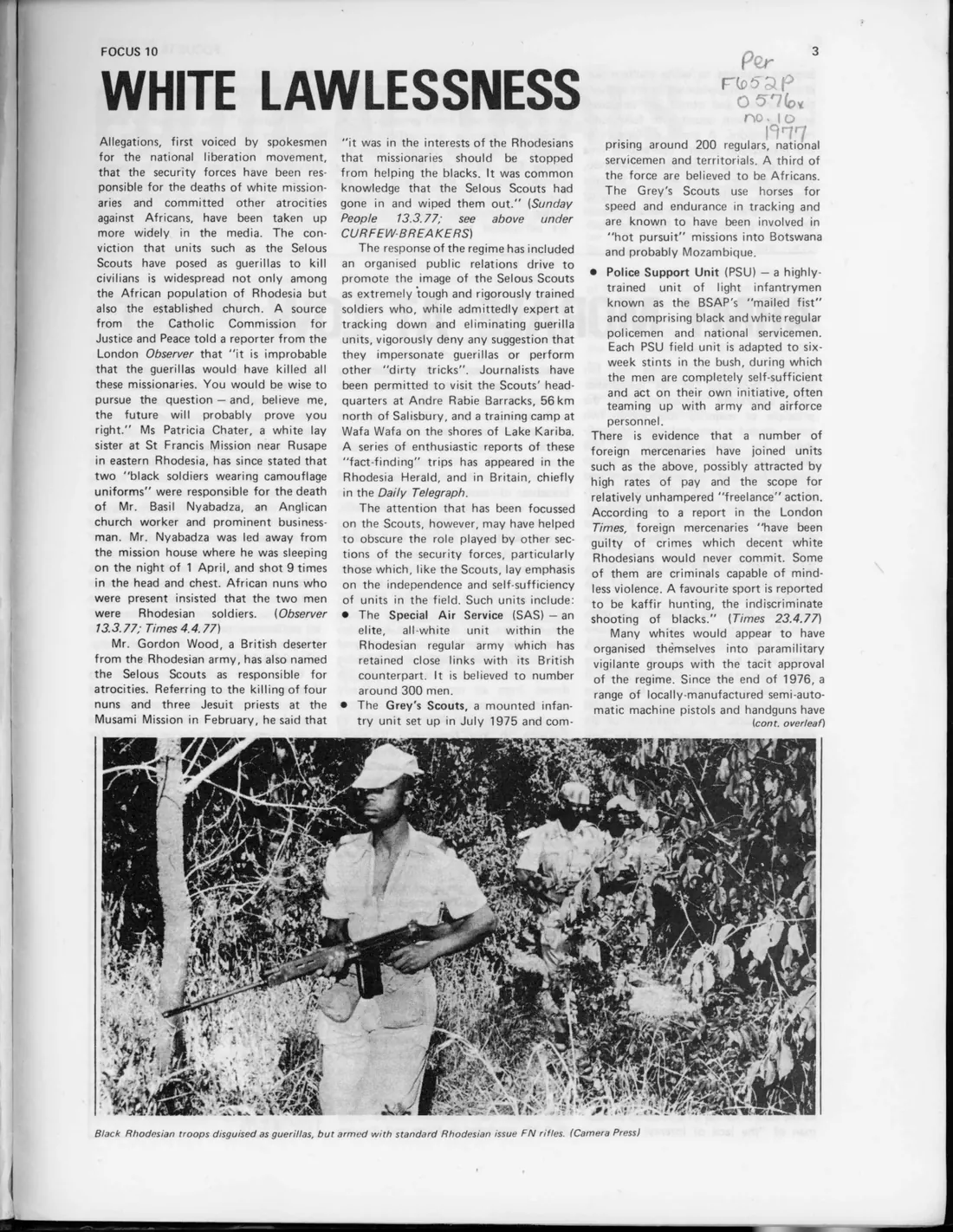
Allegations, first voiced by spokesmen for the national liberation movement, that the security forces have been responsible for the deaths of white missionaries and committed other atrocities against Africans, have been taken up more widely in the media. The conviction that units such as the Selous Scouts have posed as guerillas to kill civilians is widespread not only among the African population of Rhodesia but also the established church. A source from the Catholic Commission for Justice and Peace told a reporter from the London Observer that "it is improbable that the guerillas would have killed all these missionaries. You would be wise to pursue the question - and, believe me, the future will probably prove you right." Ms Patricia Chater, a white lay sister at St Francis Mission near Rusape in eastern Rhodesia, has since stated that two "black soldiers wearing camouflage uniforms" were responsible for the death of Mr. Basil Nyabadza, an Anglican church worker and prominent businessman. Mr. Nyabadza was led away from the mission house where he was sleeping on the night of 1 April, and shot 9 times in the head and chest. African nuns who were present insisted that the two men were Rhodesian soldiers.
Mr. Gordon Wood, a British deserter from the Rhodesian army, has also named the Selous Scouts as responsible for atrocities. Referring to the killing of four nuns and three Jesuit priests at the Musami Mission in February, he said that "it was in the interests of the Rhodesians that missionaries should be stopped from helping the blacks. It was common knowledge that the Selous Scouts had gone in and wiped them out."
The response of the regime has included an organised public relations drive to promote the image of the Selous Scouts as extremely tough and rigorously trained soldiers who, while admittedly expert at tracking down and eliminating guerilla units, vigorously deny any suggestion that they impersonate guerillas or perform other "dirty tricks". Journalists have been permitted to visit the Scouts' headquarters at Andre Rabie Barracks, 56 km north of Salisbury, and a training camp at Wafa Wafa on the shores of Lake Kariba. A series of enthusiastic reports of these "fact-finding" trips has appeared in the Rhodesia Herald, and in Britain, chiefly in the Daily Telegraph.
The attention that has been focussed on the Scouts, however, may have helped to obscure the role played by other sections of the security forces, particularly those which, like the Scouts, lay emphasis on the independence and self-sufficiency of units in the field. Such units include: * The Special Air Service (SAS) - an elite, all-white unit within the Rhodesian regular army which has retained close links with its British counterpart. It is believed to number around 300 men. * The Grey's Scouts, a mounted infantry unit set up in July 1975 and comprising around 200 regulars, national servicemen and territorial units. A third of the force are believed to be Africans. The Grey's Scouts use horses for speed and endurance in tracking and are known to have been involved in "hot pursuit" missions into Botswana and probably Mozambique. * Police Support Unit (PSU) - a highly-trained unit of light infantrymen known as the BSAP's "mailed fist" and comprising black and white regular policemen and national servicemen. Each PSU field unit is adapted to six-week stints in the bush, during which the men are completely self-sufficient and act on their own initiative, often teaming up with army and airforce personnel.
There is evidence that a number of foreign mercenaries have joined units such as the above, possibly attracted by high rates of pay and the scope for relatively unhampered "freelance" action. According to a report in the London Times, foreign mercenaries "have been guilty of crimes which decent white Rhodesians would never commit. Some of them are criminals capable of mindless violence. A favourite sport is reported to be kaffir hunting, the indiscriminate shooting of blacks."
Many whites would appear to have organised themselves into paramilitary vigilante groups with the tacit approval of the regime. Since the end of 1976, a range of locally-manufactured semi-automatic machine pistols and handguns have become available to white civilians purchasers, and on application to the authorities, farmers and others in "sensitive" areas have been issued with fully automatic weapons. A group of farmers in the Manicaland eastern operational area have formed a motorbike commando, known as the "Hell's Angels", to take immediate offensive action against guerillas before the regular security forces arrive on the scene. In February, "off-duty territorial soldiers and five men from a Police Anti-Terrorist Unit (PATU)" were reported by the Rhodesia Herald to have "fired on a small group of armed Africans during a semi-official sortie against rustlers". 25 villagers from the Soswe TTL, south of Marandellas, were handed over by this "posse" to the Police Special Branch for questioning. Police had previously given white ranchers permission to chase cattle thieves.
As previously reported in FOCUS, there have been hints that black "paranuclear groups" have been set up by the regime. In the Salisbury townships, for example, black recruits to the Crime Prevention Unit are known to operate in an independent and undisciplined fashion. It is possible that attempts have been made through the chiefs to promote vigilante groups in the rural areas.