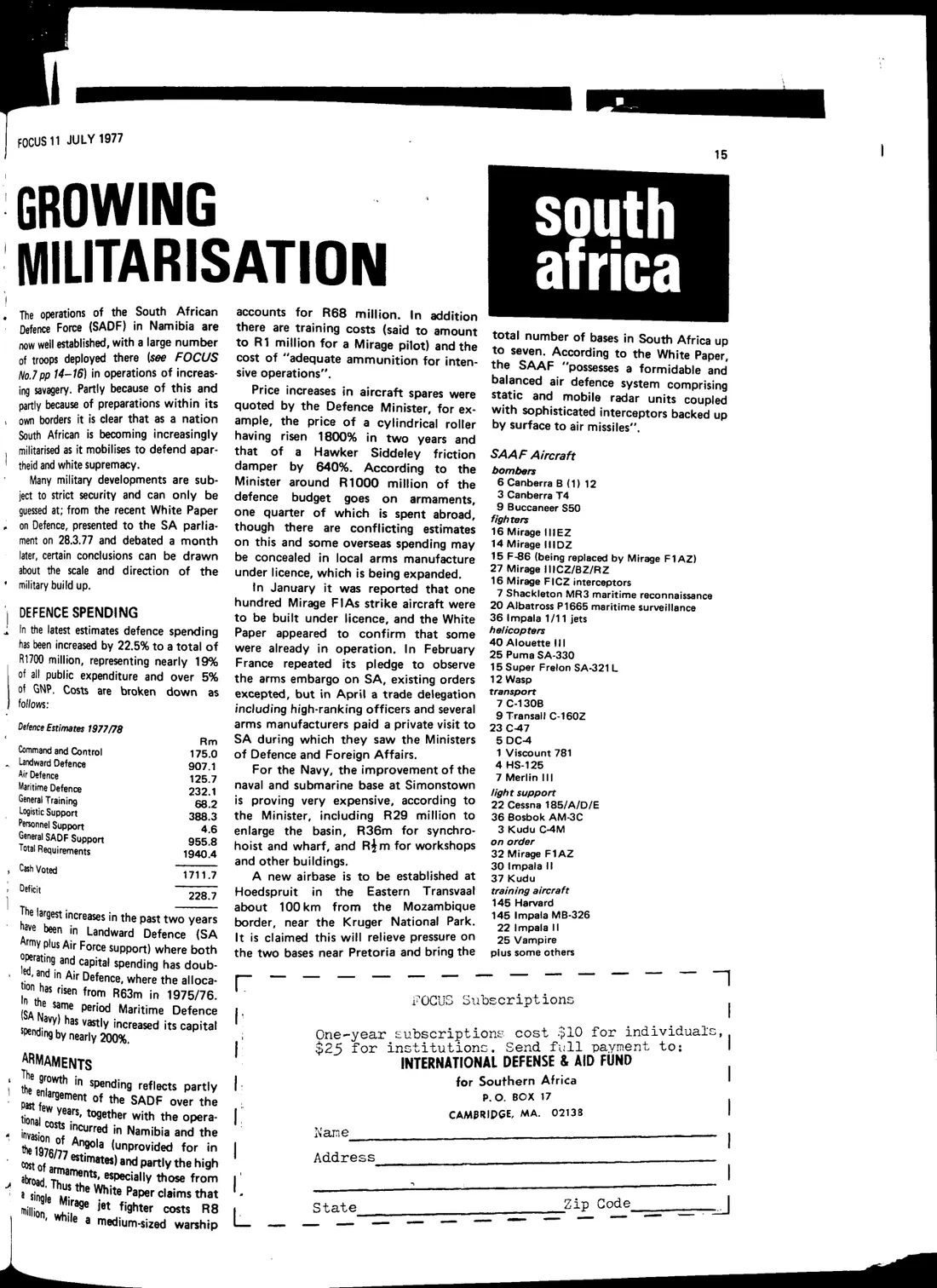
The operations of the South African Defence Force (SADF) in Namibia are now well established, with a large number of troops deployed there in operations of increasing savagery. Partly because of this and partly because of preparations within its own borders it is clear that as a nation South African is becoming increasingly militarised as it mobilises to defend apartheid and white supremacy.
DEFENCE SPENDING In the latest estimates defence spending has been increased by 22.5% to a total of R1700 million, representing nearly 19% of all public expenditure and over 5% of GNP. The largest increases in the past two years have been in Landward Defence (SA Army plus Air Force support) where both operating and capital spending has doubled, and in Air Defence, where the allocation has risen from R63m in 1975/76. In the same period Maritime Defence (SA Navy) has vastly increased its capital spending by nearly 200%.
ARMAMENTS The growth in spending reflects partly the enlargement of the SADF over the past few years, together with the operational costs incurred in Namibia and the invasion of Angola and partly the high cost of armaments, especially those from abroad. In January it was reported that one hundred Mirage F1As strike aircraft were to be built under licence. For the Navy, the improvement of the naval and submarine base at Simonstown is proving very expensive. A new airbase is to be established at Hoedspruit in the Eastern Transvaal about 100km from the Mozambique border, near the Kruger National Park.
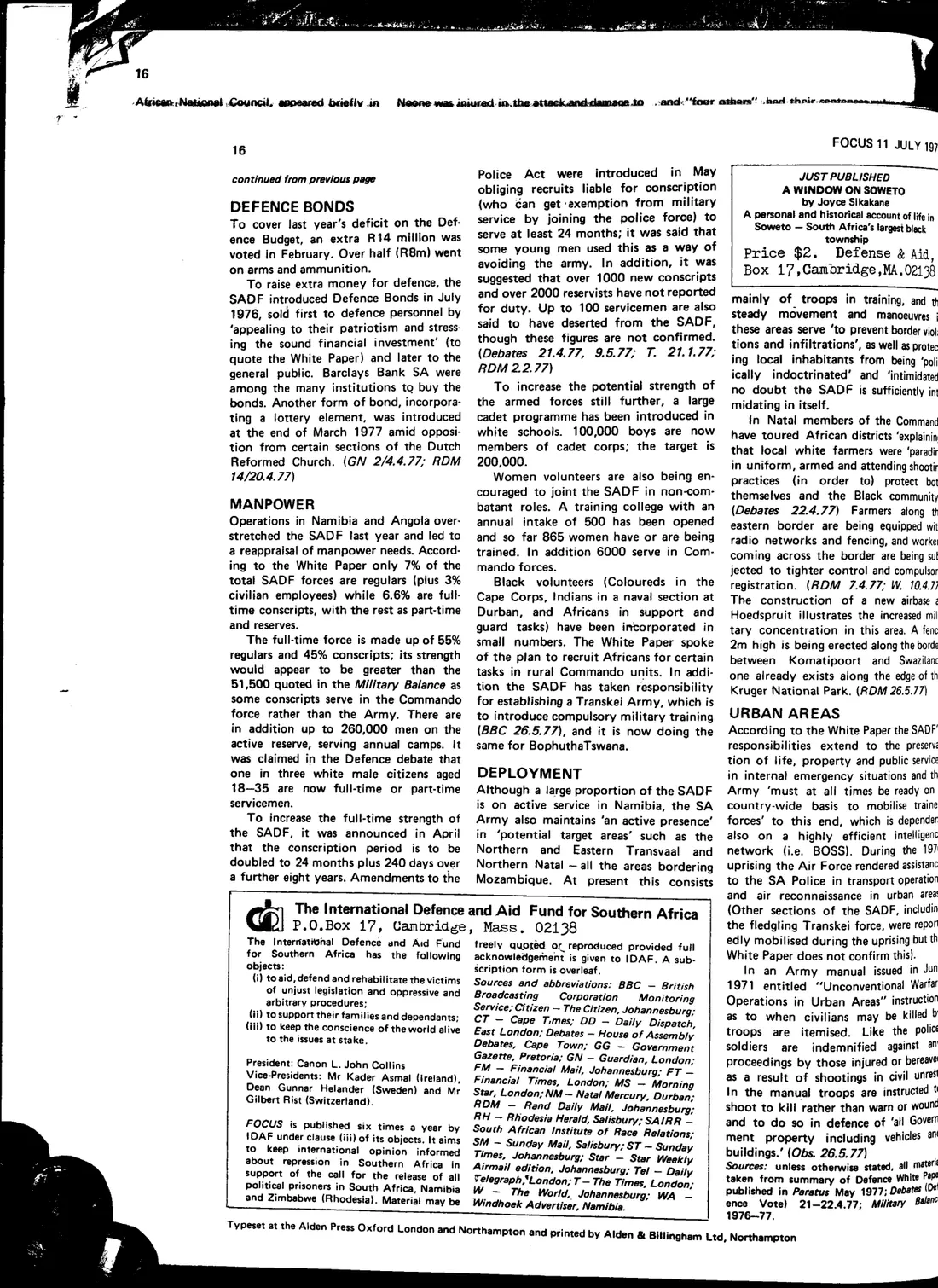
DEFENCE BONDS To cover last year's deficit on the Defence Budget, an extra R14 million was voted in February. To raise extra money for defence, the SADF introduced Defence Bonds in July 1976, sold first to defence personnel and later to the general public. Another form of bond, incorporating a lottery element, was introduced at the end of March 1977 amid opposition from certain sections of the Dutch Reformed Church.
MANPOWER Operations in Namibia and Angola overstretched the SADF last year and led to a reappraisal of manpower needs. According to the White Paper only 7% of the total SADF forces are regulars while 6.6% are full-time conscripts, with the rest as part-time and reserves. To increase the full-time strength of the SADF, it was announced in April that the conscription period is to be doubled to 24 months plus 240 days over a further eight years. Amendments to the Police Act were introduced in May obliging recruits liable for conscription to serve at least 24 months. To increase the potential strength of the armed forces still further, a large cadet programme has been introduced in white schools. Women volunteers are also being encouraged to join the SADF in non-combatant roles. Black volunteers have been incorporated in small numbers. The SADF has taken responsibility for establishing a Transkei Army, and it is now doing the same for BophuthaTswana.
DEPLOYMENT Although a large proportion of the SADF is on active service in Namibia, the SA Army also maintains 'an active presence' in 'potential target areas' such as the Northern and Eastern Transvaal and Northern Natal - all the areas bordering Mozambique. Farmers along the eastern border are being equipped with radio networks and fencing, and workers coming across the border are being subjected to tighter control and compulsory registration.
URBAN AREAS According to the White Paper the SADF responsibilities extend to the preservation of life, property and public service in internal emergency situations and the Army 'must at all times be ready on country-wide basis to mobilise train forces' to this end, which is dependent also on a highly efficient intelligence network (i.e. BOSS). In an Army manual issued in June 1971 entitled "Unconventional Warfare in Urban Areas" instruction as to when civilians may be killed by troops are itemised. Like the police soldiers are indemnified against any proceedings by those injured or bereaved as a result of shootings in civil unrest.