While the details of the agreement for Namibia's transition to independence reached in May and June between Vorster and the envoys of the five Western members of the United Nations Security Council are by no means entirely clear, it seems certain that they fall far short of the demands of the UN as set out in Resolution 385 of 30 January 1976, and of SWAPO itself. South Africa has supposedly abandoned the Turnhalle plan for an interim government in the territory, but on other issues, notably the continuing presence of up to 50,000 South African troops, the South African Police and other security and intelligence services, few or no concessions appear to have been made.
Continuing political repression in Namibia lends support to SWAPO's position that "elections free from daily intimidation and brutality on the part of the authorities will never be held until the South African troops are withdrawn". A number of Namibians have in recent weeks appeared before South African courts on charges under the Terrorism Act connected with guerilla activity.
BENJAMIN UULENGA The trial of BENJAMIN CHRISPUS UULENGA (also spelt VULENGA) on charges under the Terrorism Act continued before the Windhoek Supreme Court during the first weeks of May. Uulenga, who was born in Ovamboland in 1952 and had allegedly trained in Angola, Zaire and the Soviet Union, pleaded not guilty of intent to break law and order in Namibia and of possession of arms and ammunition including an AK-47 rifle, magazines, cartridges and rocket launchers. According to the charge sheet and evidence submitted by state witnesses, Uulenga had crossed the border from Angola into northern Namibia around June 1976, in the company of about 16 other guerillas. They had obtained food from farmworkers in the Tsumeb district and by stealing livestock, before realising that they were being followed by a South African military unit and splitting up. Uulenga's group, consisting of five men, had set an ambush for the police on the farm "Danevis Suid" and had then, at the farm "Malta", been involved in an encounter with the military. Three of the guerillas had been killed while Uulenga, who had been apprehended while shooting at a South African Puma helicopter, had been badly wounded in the left leg and hip. He had been treated at Grootfontein military base by having a steel pin inserted, followed by three months of traction, before his trial.
On 2 May, Advocate R. Johnstone, Counsel for the Defence, led argument that Uulenga qualified on four relevant points to be regarded as a prisoner of war. On 10 May, however, Uulenga, who was not himself called to give evidence, was found guilty of all charges by Mr. Justice J.J. Strydom. Sentence was postponed until 23 May 1977, and then again to 13 July. A demonstration of around 80 SWAPO supporters gathered outside the Supreme Court on the day sentence was passed.
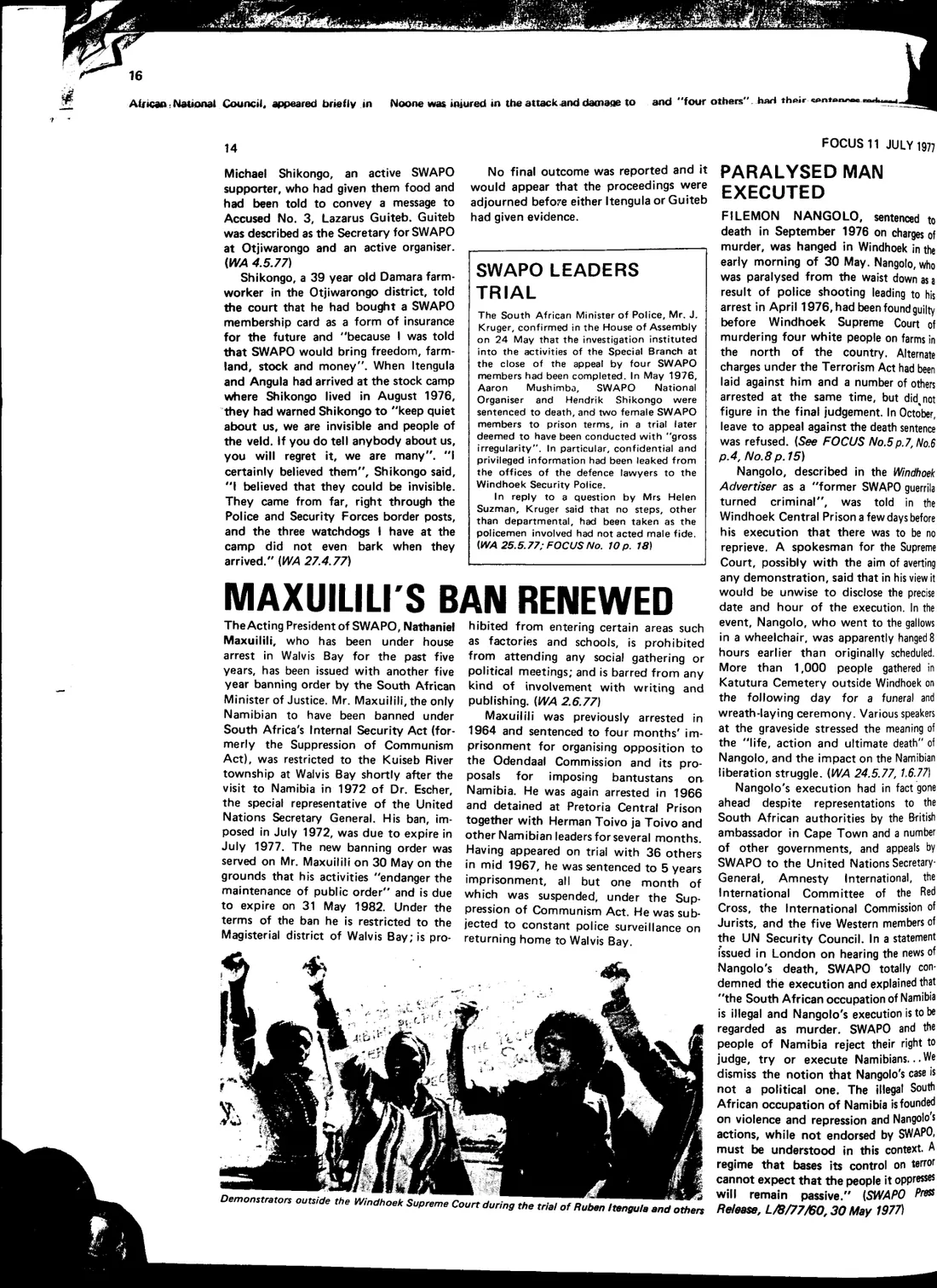
ITENGULA, SHIKONGO and GUITEB The trial before the Windhoek Supreme Court of RUBEN ITENGULA, MICHAEL SHIKONGO and LAZARUS GUITEB, SWAPO Secretary at Otjiwarongo, on charges under the Terrorism Act, had apparently reached no definite conclusion by the end of June. As in the case of Benjamin Uulenga, the three accused had appeared briefly before the Windhoek Supreme Court in February and again at the end of April. On 3 May, when the summary trial resumed, SWAPO supporters packed the public gallery and demonstrated outside singing SWAPO songs and carrying banners. According to the charge sheet and Advocate F.H.van Zyl, for the State, Itengula had crossed the border from Angola into Ovamboland in 1976 in the company of another SWAPO guerilla, Johnny Angula, who was later shot dead by South African police. They had allegedly told farmworkers that they were freedom fighters and had later met up with Accused No. 2, Michael Shikongo, an active SWAPO supporter, who had given them food and had been told to convey a message to Accused No. 3, Lazarus Guiteb. Guiteb was described as the Secretary for SWAPO at Otjiwarongo and an active organiser.
MAXUILILI'S BAN RENEWED The Acting President of SWAPO, Nathaniel Maxuilili, who has been under house arrest in Walvis Bay for the past five years, has been issued with another five year banning order by the South African Minister of Justice. Mr. Maxuilili, the only Namibian to have been banned under South Africa's Internal Security Act, was restricted to the Kuiseb River township at Walvis Bay shortly after the visit to Namibia in 1972 of Dr. Escher, the special representative of the United Nations Secretary General. His ban, imposed in July 1972, was due to expire in July 1977. The new banning order was served on Mr. Maxuilili on 30 May on the grounds that his activities "endanger the maintenance of public order" and is due to expire on 31 May 1982.
PARALYSED MAN EXECUTED FILEMON NANGOLO, sentenced to death in September 1976 on charges of murder, was hanged in Windhoek in the early morning of 30 May. Nangolo, who was paralysed from the waist down as a result of police shooting leading to his arrest in April 1976, had been found guilty before Windhoek Supreme Court of murdering four white people on farms in the north of the country. Nangolo, described in the Windhoek Advertiser as a "former SWAPO guerrilla turned criminal", was told in the Windhoek Central Prison a few days before his execution that there was to be no reprieve. In the event, Nangolo, who went to the gallows in a wheelchair, was apparently hanged 8 hours earlier than originally scheduled. More than 1,000 people gathered in Katutura Cemetery outside Windhoek on the following day for a funeral and wreath-laying ceremony.