GWAMANDA On 2 June Bongizipho Leadus GWAMANDA, a 22 year old student from Pietermaritzburg was convicted of furthering the aims of the African National Congress and sentenced to 3 years imprisonment. Gwamanda was alleged to have prepared subversive pamphlets containing instructions for making petrol bombs, grenades and explosives, and to have played an ANC record to people in New Hanover and Pietermaritzburg.
ISAAC SEKO The trial of Isaac Mohlolo SEKO (27) accused of causing an explosion at the Carlton Centre Johannesburg on 7 December took place in May. It was alleged that Seko took two smouldering sticks of dynamite into the Carlton Centre restaurant, where they exploded, blowing off Seko's right hand and causing other lesser injuries and damage. It was further alleged that Seko had helped to cause an explosion at the surgery of Dr. Jack Goldberg in Klipspruit, on the edge of Soweto, on 5 November, when damage was caused but no one was injured. Two pamphlets on black liberation were found at Seko's house, together with notes on how to manufacture explosives.
Johannes Mofokeng, a colleague of Seko's at de Beers diamond research laboratory, gave evidence for the state to the effect that he had supplied Seko with the chemicals to make the explosives. Another witness was Cecil Fikile Mavuso who described how he, Seko and a third man named George Phahle, who has left the country, were shown how to use dynamite and other explosives by Wellington Tshazibane, another de Beers employee who died in police custody after being arrested on 9 December. The four men then proceeded to blow up the Goldberg surgery by throwing explosives through the windows.
Seko declined to give evidence but read a long statement in which he outlined the history of his life and claimed that what he had done "was with the highest patriotic motives for the good of all my people and, I believe, for the good of white South Africans as well". He said he had never supported any political organisations and had taken no direct interest in politics, but the events of 1976 in Soweto, particularly the killing of schoolchildren, had had an enormous impact on him. He tried to resist calls to join in the protests and attacks on Bantu Administration buildings, being "pulled one way by a wish to help my people and another way because I knew we could never win." The decisive event as far as he was concerned had been the funeral of Jacob Mashabane on 24 October when police had fired on mourners, killing seven and injuring 50, Seko and others had been ordered at gunpoint to carry the dead and wounded into vehicles. The following day, he said, "I decided to commit myself fully to the cause of the Black people" and left his work. He did not admit to causing the explosions.
Seko was convicted and sentenced to 12 years for the Carlton Centre blast, seven years for the surgery explosion and 5 years for possessing explosives. The two lesser sentences are to run concurrently.
SHUBANE JAILED RITA NDZANGA FREED The case of Khehla SHUBANE and Rita NDZANGA, accused under the Terrorism Act with recruiting students for military training opened at Springs in May. On 9 June Shubane, a 21-year old law student from Soweto, formerly of the University of the North, was convicted and jailed for five years. Mrs. Ndzanga, whose husband Lawrence was indicted on the same charges but died in police custody was acquitted by the court. It was alleged in court that eleven young people who wished to leave South Africa in the wake of the 1976 disturbances had been collected together by Shubane and Ndzanga in October to be taken across the border into Botswana. Shubane and the students, several of whom gave evidence, were arrested at Mafeking on 10 November. Shubane made a statement to the court concerning the oppression and discrimination suffered by black people in South Africa. The judge said his offense was regarded as equivalent to treason and refused him leave to appeal. Rita Ndzanga was acquitted on 26 May for lack of evidence.
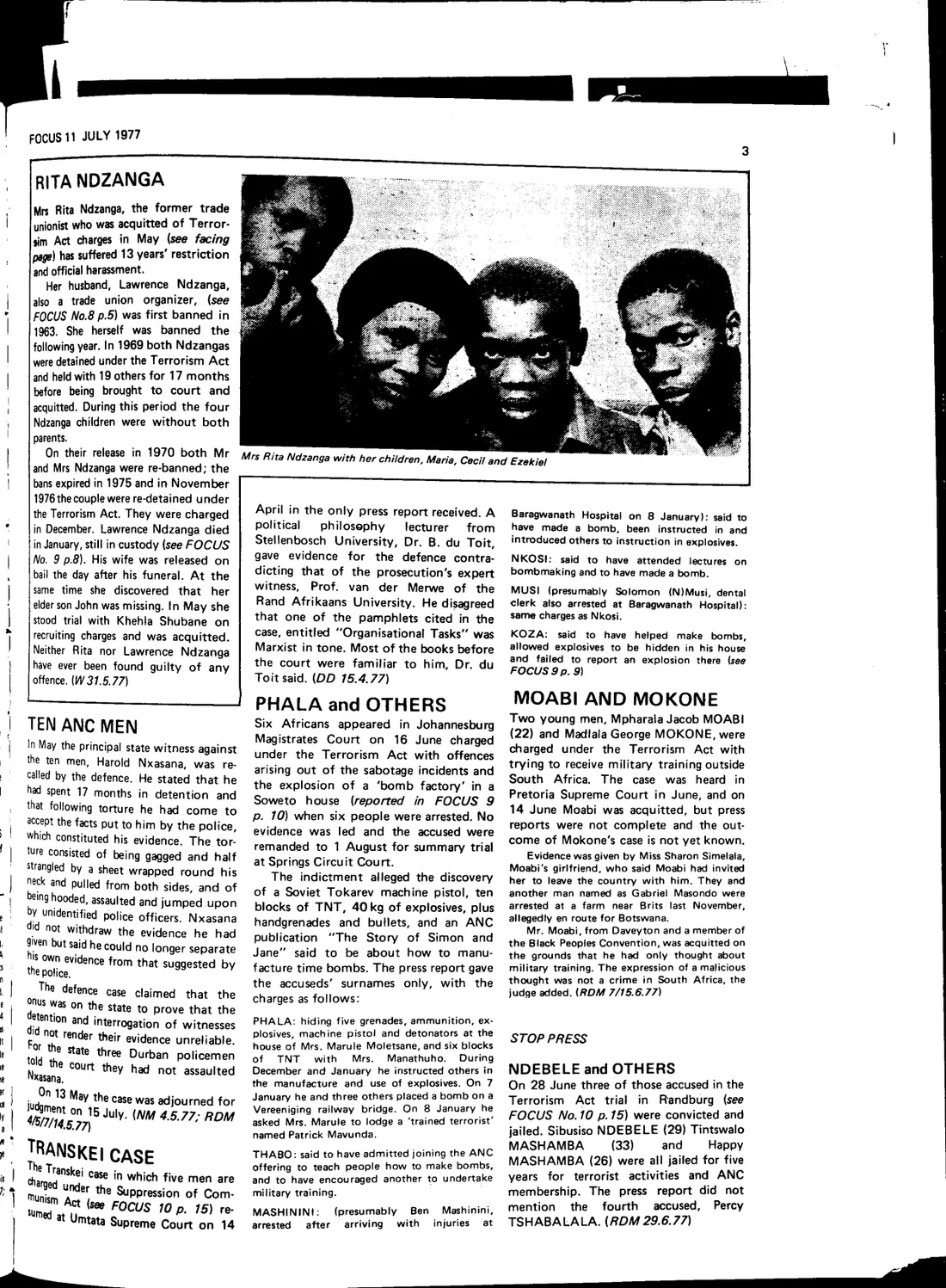
RITA NDZANGA Mrs Rita Ndzanga, the former trade unionist who was acquitted of Terrorism Act charges in May has suffered 13 years' restriction and official harassment. Her husband, Lawrence Ndzanga, also a trade union organizer, was first banned in 1963. She herself was banned the following year. In 1969 both Ndzangas were detained under the Terrorism Act and held with 19 others for 17 months before being brought to court and acquitted. During this period the four Ndzanga children were without both parents. On their release in 1970 both Mr and Mrs Ndzanga were re-banned; the bans expired in 1975 and in November 1976 the couple were re-detained under the Terrorism Act. They were charged in December. Lawrence Ndzanga died in January, still in custody. His wife was released on bail the day after his funeral. At the same time she discovered that her elder son John was missing. In May she stood trial with Khehla Shubane on recruiting charges and was acquitted. Neither Rita nor Lawrence Ndzanga have ever been found guilty of any offence.
PHALA and OTHERS Six Africans appeared in Johannesburg Magistrates Court on 16 June charged under the Terrorism Act with offences arising out of the sabotage incidents and the explosion of a 'bomb factory' in a Soweto house when six people were arrested. No evidence was led and the accused were remanded to 1 August for summary trial at Springs Circuit Court. The indictment alleged the discovery of a Soviet Tokarev machine pistol, ten blocks of TNT, 40 kg of explosives, plus handgrenades and bullets, and an ANC publication "The Story of Simon and Jane" said to be about how to manufacture time bombs. The press report gave the accused's surnames only, with the charges as follows: PHALA: hiding five grenades, ammunition, explosives, machine pistol and detonators at the house of Mrs. Marule Moletsane, and six blocks of TNT with Mrs. Manathuho. During December and January he instructed others in the manufacture and use of explosives. On 7 January he and three others placed a bomb on a Vereeniging railway bridge. On 8 January he asked Mrs. Marule to lodge a 'trained terrorist' named Patrick Mavunda. THABO: said to have admitted joining the ANC offering to teach people how to make bombs, and to have encouraged another to undertake military training. MASHININI: (presumably Ben Mashinini, arrested after arriving with injuries at Baragwanath Hospital on 8 January): said to have made a bomb, been instructed in and introduced others to instruction in explosives. NKOSI: said to have attended lectures on bombmaking and to have made a bomb. MUSI (presumably Solomon (N)Musi, dental clerk also arrested at Baragwanath Hospital): same charges as Nkosi. KOZA: said to have helped make bombs, allowed explosives to be hidden in his house and failed to report an explosion there.
MOABI AND MOKONE Two young men, Mpharala Jacob MOABI (22) and Madlala George MOKONE, were charged under the Terrorism Act with trying to receive military training outside South Africa. The case was heard in Pretoria Supreme Court in June, and on 14 June Moabi was acquitted, but press reports were not complete and the outcome of Mokone's case is not yet known. Evidence was given by Miss Sharon Simelala, Moabi's girlfriend, who said Moabi had invited her to leave the country with him. They and another man named as Gabriel Masondo were arrested at a farm near Brits last November, allegedly en route for Botswana. Mr. Moabi, from Daveyton and a member of the Black Peoples Convention, was acquitted on the grounds that he had only thought about military training. The expression of a malicious thought was not a crime in South Africa, the judge added.
NDEBELE and OTHERS On 28 June three of those accused in the Terrorism Act trial in Randburg were convicted and jailed. Sibusiso NDEBELE (29) Tintswalo MASHAMBA (33) and Happy MASHAMBA (26) were all jailed for five years for terrorist activities and ANC membership. The press report did not mention the fourth accused, Percy TSHABALALA.
TEN ANC MEN In May the principal state witness against the ten men, Harold Nxasana, was recalled by the defence. He stated that he had spent 17 months in detention and that following torture he had come to accept the facts put to him by the police, which constituted his evidence. The torture consisted of being gagged and half strangled by a sheet wrapped round his neck and pulled from both sides, and of being hooded, assaulted and jumped upon by unidentified police officers. Nxasana did not withdraw the evidence he had given but said he could no longer separate his own evidence from that suggested by the police. The defence case claimed that the onus was on the state to prove that the detention and interrogation of witnesses did not render their evidence unreliable. For the state three Durban policemen told the court they had not assaulted Nxasana. On 13 May the case was adjourned for judgment on 15 July.
TRANSKEI CASE The Transkei case in which five men are charged under the Suppression of Communism Act resumed at Umtata Supreme Court on 14.