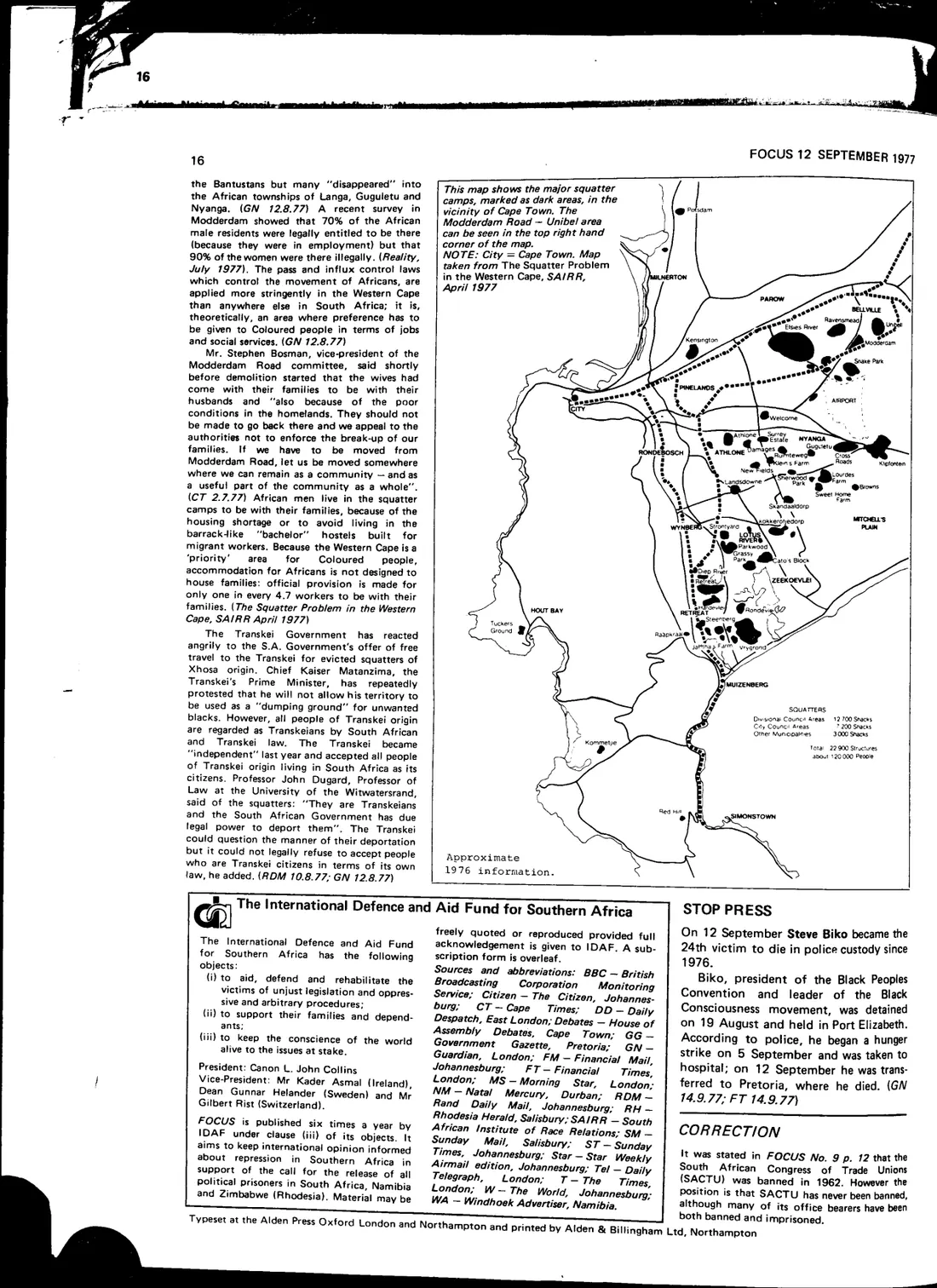
When a Progressive Reform Party spokesman, Dr. F. van Zyl Slabbert, predicted in the House of Assembly in April that with the Prevention of Illegal Squatting Bill the Minister of Community Development was declaring an "open season on squatters", his prophecy was soon vindicated. The bill became law in early May, and in August demolition of the Modderdam Road-Unibel squatters' complex, housing 20-30,000 people, began. This appears to be the first step in the removal of the estimated nearly 300,000 African and Coloured people living in the over 50 different squatter settlements in the Cape Peninsula area.
By 12 August bulldozers had demolished the last shocks of Modderdam Road squatters' camp after a five-day operation that left 10,000 people homeless. It was the first stage in the demolition of the entire Modderdam, Unibel and Werkgenot squatter complex.
During the demolition, which was vigorously opposed by the Modderdam Road squatters' executive committee as well as many welfare bodies, police used dogs and tear gas to disperse the crowds. Several people were bitten by dogs when police broke up chanting crowds on 8 August. On 10 August about 100 whites from several different organisations joined the evicted squatters in a passive protest. Police used tear gas to disperse the crowd of protesters, mostly Africans, singing hymns in the Xhosa language. The following day an Anglican priest, Rev. David Russell, and two white social workers were arrested at the camp when they lay down in the path of a bulldozer.
A handful of Coloured squatters moved before demolition to Rifle Range camp where the Department of Coloured Affairs said they could go, but the vast bulk of the squatters in this particular camp were African. These Xhosa-speaking Africans, most of whom are in the Western Cape "illegally", have no legal place to go except to return to the poverty-stricken Transkei and Ciskei. The government has offered them free return rail tickets to the Bantustans but many "disappeared" into the African townships of Langa, Guguletu and Nyanga. A recent survey in Modderdam showed that 70% of the African male residents were legally entitled to be there (because they were in employment) but that 90% of the women were there illegally. The pass and influx control laws which control the movement of Africans, are applied more stringently in the Western Cape than anywhere else in South Africa; it is, theoretically, an area where preference has to be given to Coloured people in terms of jobs and social services.
Mr. Stephen Bosman, vice-president of the Modderdam Road committee, said shortly before demolition started that the wives had come with their families to be with their husbands and "also because of the poor conditions in the homelands. They should not be made to go back there and we appeal to the authorities not to enforce the break-up of our families. If we have to be moved from Modderdam Road, let us be moved somewhere where we can remain as a community - and as a useful part of the community as a whole". African men live in the squatter camps to be with their families, because of the housing shortage or to avoid living in the barrack-like "bachelor" hostels built for migrant workers. Because the Western Cape is a 'priority' area for Coloured people, accommodation for Africans is not designed to house families: official provision is made for only one in every 4.7 workers to be with their families.
The Transkei Government has reacted angrily to the S.A. Government's offer of free travel to the Transkei for evicted squatters of Xhosa origin. Chief Kaiser Matanzima, the Transkei's Prime Minister, has repeatedly protested that he will not allow his territory to be used as a "dumping ground" for unwanted blacks. However, all people of Transkei origin are regarded as Transkeians by South African and Transkei law. The Transkei became "independent" last year and accepted all people of Transkei origin living in South Africa as its citizens. Professor John Dugard, Professor of Law at the University of the Witwatersrand, said of the squatters: "They are Transkeians and the South African Government has due legal power to deport them". The Transkei could question the manner of their deportation but it could not legally refuse to accept people who are Transkei citizens in terms of its own law, he added.