At least eleven executions are believed to have been carried out by the Smith regime since the beginning of July. Those known to have been hanged in Salisbury prison include two leading officials of the African National Council of Zimbabwe (ANC/Z), ROBERT BHEBE and PAINOS ZEHAMA. Strenuous but ultimately unsuccessful efforts had been made by international solidarity organisations to save the lives of the two men.
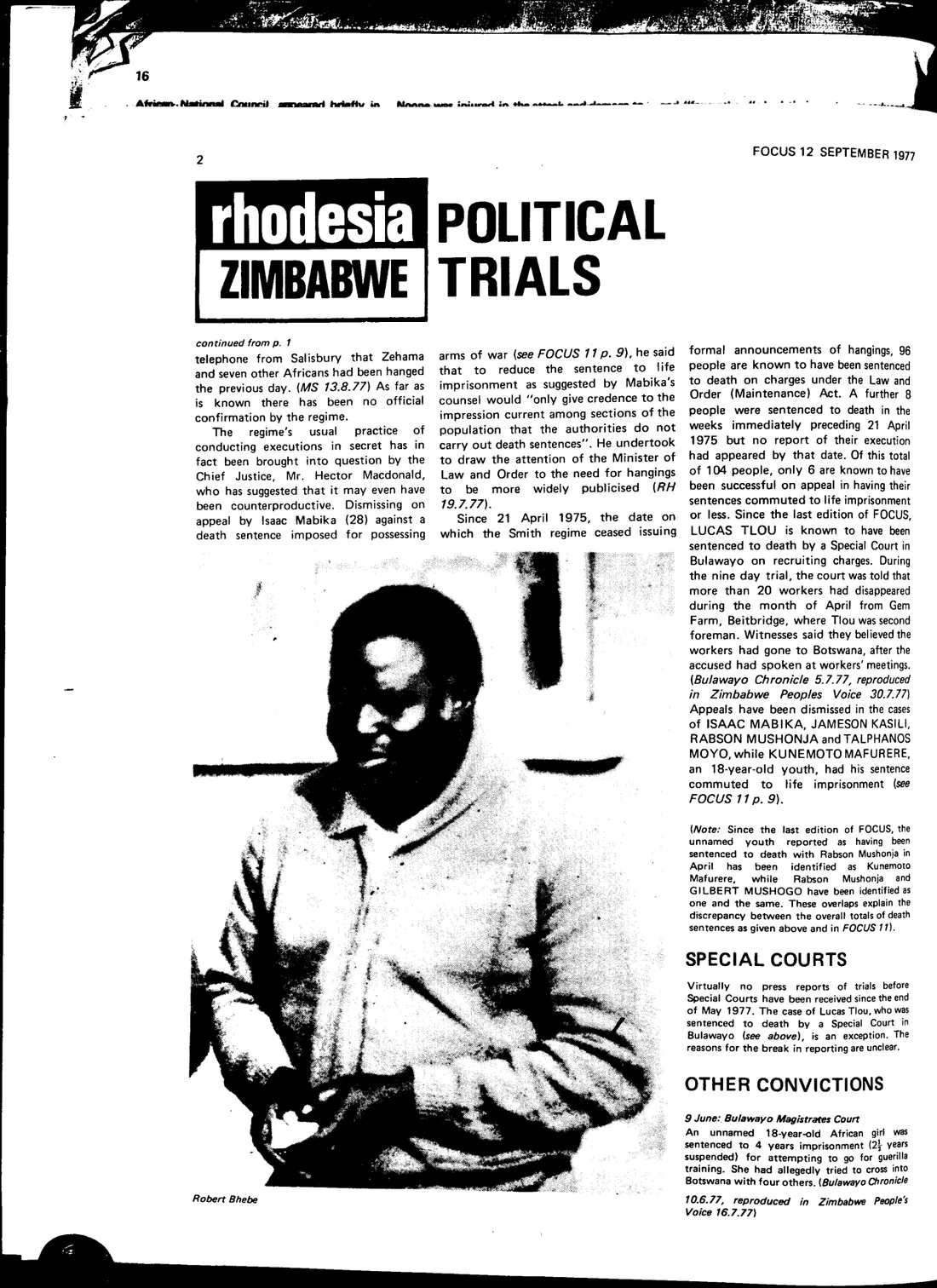
Robert Bhebe, a deputy provincial secretary of the ANC(Z) in Umtali at the time of his arrest and trial, had a long history of involvement in the nationalist cause. He spent several years in detention, including a period of 17 months in solitary confinement at the Buffalo Range prison camp in the early 1970's. He is believed to have suffered interrogation and torture.
At the end of 1974, Bhebe was released by the regime to take part in talks in Lusaka, along with other nationalists. He subsequently moved to Umtali with his family to start a pig and poultry co-operative scheme, having undertaken a Society of Friends agricultural training course. On 10 March 1977 he was sentenced to death by a Special Court in Umtali on conviction of recruiting or encouraging others to go for guerilla training. According to the evidence before the court, Bhebe had directed four people from Inyazura to the ANC(Z) office in Bulawayo, from where they would be sent on to Botswana. His appeal was dismissed by the Chief Justice, Mr. Hector Macdonald, in June. A petition for clemency to the regime's President, Mr. John Wrathall, was also turned down.
Subsequent attempts to save Robert Bhebe's life included a request from Mr. Shridath Ramphal, the Commonwealth Secretary-General, to the International Committee of the Red Cross to "use its good offices" to prevent "the clandestine execution of Zimbabwean nationalists by the illegal regime". A joint delegation to the British government from IDAF, British Anti-Apartheid Movement, Amnesty International and the United Nations Association was received by the Under Secretary of State for Foreign and Commonwealth Affairs on 28 July.
On Wednesday morning, 13 July, however, relatives of Robert Bhebe were informed when they arrived at Salisbury prison to visit him that he had already been hanged. The execution was confirmed on 15 July by the regime's Secretary for the Ministry of Justice, Mr. M.F. Garnett. (With the exception of the hanging of eight supporters of Bishop Muzorewa in January 1977, when a public announcement was made, this is the first time that the regime has officially confirmed an execution since April 1975).
It is believed that two other Africans were hanged together with Robert Bhebe, although the regime refused to confirm this.
Painos Zehama, who was executed a month after Bhebe, was the central provincial organising secretary of the ANC(Z) and a full-time employee at the ANC(Z), office in Highfield, Salisbury. He was sentenced to death by the High Court in Salisbury on 26 April 1977, on conviction of recruiting for guerilla training. His appeal was dismissed in July by Chief Justice Macdonald, and as in Bhebe's case, an unsuccessful petition for mercy was addressed to the Rhodesian President. On 12 August 1977, the London office of ZAPU received news by telephone from Salisbury that Zehama and seven other Africans had been hanged the previous day. As far as is known there has been no official confirmation by the regime.
The regime's usual practice of conducting executions in secret has in fact been brought into question by the Chief Justice, Mr. Hector Macdonald, who has suggested that it may even have been counterproductive. Dismissing on appeal by Isaac Mabika (28) against a death sentence imposed for possessing arms of war, he said that to reduce the sentence to life imprisonment as suggested by Mabika's counsel would "only give credence to the impression current among sections of the population that the authorities do not carry out death sentences". He undertook to draw the attention of the Minister of Law and Order to the need for hangings to be more widely publicised.
Since 21 April 1975, the date on which the Smith regime ceased issuing formal announcements of hangings, 96 people are known to have been sentenced to death on charges under the Law and Order (Maintenance) Act. A further 8 people were sentenced to death in the weeks immediately preceding 21 April 1975 but no report of their execution had appeared by that date. Of this total of 104 people, only 6 are known to have been successful on appeal in having their sentences commuted to life imprisonment or less. Since the last edition of FOCUS, LUCAS TLOU is known to have been sentenced to death by a Special Court in Bulawayo on recruiting charges. During the nine day trial, the court was told that more than 20 workers had disappeared during the month of April from Gem Farm, Beitbridge, where Tlou was second foreman. Witnesses said they believed the workers had gone to Botswana, after the accused had spoken at workers' meetings. Appeals have been dismissed in the cases of ISAAC MABIKA, JAMESON KASILI, RABSON MUSHONJA and TALPHANOS MOYO, while KUNEMOTO MAFURERE, an 18-year-old youth, had his sentence commuted to life imprisonment.
(Note: Since the last edition of FOCUS, the unnamed youth reported as having been sentenced to death with Rabson Mushonja in April has been identified as Kunemoto Mafurere, while Rabson Mushonja and GILBERT MUSHOGO have been identified as one and the same. These overlaps explain the discrepancy between the overall totals of death sentences as given above and in FOCUS 11).