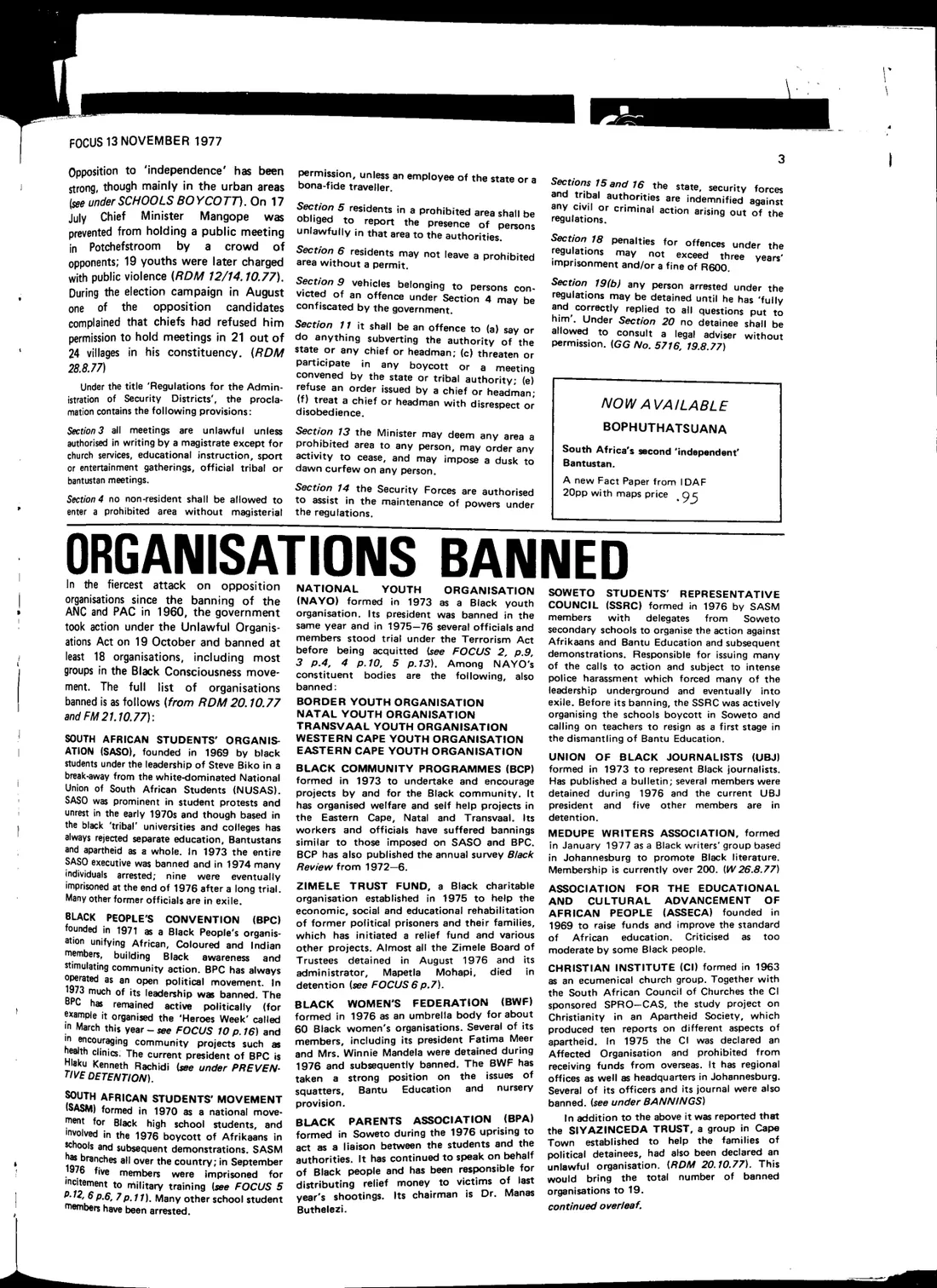
In the fiercest attack on opposition organisations since the banning of the ANC and PAC in 1960, the government took action under the Unlawful Organisations Act on 19 October and banned at least 18 organisations, including most groups in the Black Consciousness movement. The full list of organisations banned is as follows (from RDM 20.10.77 and FM 21.10.77):
SOUTH AFRICAN STUDENTS' ORGANISATION (SASO), founded in 1969 by black students under the leadership of Steve Biko in a break-away from the white-dominated National Union of South African Students (NUSAS). SASO was prominent in student protests and unrest in the early 1970s and though based in the black 'tribal' universities and colleges has always rejected separate education, Bantustans and apartheid as a whole. In 1973 the entire SASO executive was banned and in 1974 many individuals arrested; nine were eventually imprisoned at the end of 1976 after a long trial. Many other former officials are in exile.
BLACK PEOPLE'S CONVENTION (BPC) founded in 1971 as a Black People's organisation unifying African, Coloured and Indian members, building Black awareness and stimulating community action. BPC has always operated as an open political movement. In 1973 much of its leadership was banned. The BPC has remained active politically (for example it organised the 'Heroes Week' called in March this year - see FOCUS 10 p.16) and in encouraging community projects such as health clinics. The current president of BPC is Hlaku Kenneth Rachidi (see under PREVENTIVE DETENTION).
SOUTH AFRICAN STUDENTS' MOVEMENT (SASM) formed in 1970 as a national movement for Black high school students, and involved in the 1976 boycott of Afrikaans in schools and subsequent demonstrations. SASM has branches all over the country; in September 1976 five members were imprisoned for incitement to military training (see FOCUS 5 p.12, 6 p.6, 7 p.11). Many other school student members have been arrested.
NATIONAL YOUTH ORGANISATION (NAYO) formed in 1973 as a Black youth organisation. Its president was banned in the same year and in 1975-76 several officials and members stood trial under the Terrorism Act before being acquitted (see FOCUS 2, p.9, 3 p.4, 4 p.10, 5 p.13). Among NAYO's constituent bodies are the following, also banned:
BORDER YOUTH ORGANISATION NATAL YOUTH ORGANISATION TRANSVAAL YOUTH ORGANISATION WESTERN CAPE YOUTH ORGANISATION EASTERN CAPE YOUTH ORGANISATION
BLACK COMMUNITY PROGRAMMES (BCP) formed in 1973 to undertake and encourage projects by and for the Black community. It has organised welfare and self help projects in the Eastern Cape, Natal and Transvaal. Its workers and officials have suffered bannings similar to those imposed on SASO and BPC. BCP has also published the annual survey Black Review from 1972-6.
ZIMELE TRUST FUND, a Black charitable organisation established in 1975 to help the economic, social and educational rehabilitation of former political prisoners and their families, which has initiated a relief fund and various other projects. Almost all the Zimele Board of Trustees detained in August 1976 and its administrator, Mapeta Mohapi, died in detention (see FOCUS 6 p.7).
BLACK WOMEN'S FEDERATION (BWF) formed in 1976 as an umbrella body for about 60 Black women's organisations. Several of its members, including its president Fatima Meer and Mrs. Winnie Mandela were detained during 1976 and subsequently banned. The BWF has taken a strong position on the issues of squatters, Bantu Education and nursery provision.
BLACK PARENTS ASSOCIATION (BPA) formed in Soweto during the 1976 uprising to act as a liaison between the students and the authorities. It has continued to speak on behalf of Black people and has been responsible for distributing relief money to victims of last year's shootings. Its chairman is Dr. Manas Buthelezi.
SOWETO STUDENTS' REPRESENTATIVE COUNCIL (SSRC) formed in 1976 by SASM members with delegates from Soweto secondary schools to organise the action against Afrikaans and Bantu Education and subsequent demonstrations. Responsible for issuing many of the calls to action and subject to intense police harassment which forced many of the leadership underground and eventually into exile. Before its banning, the SSRC was actively organising the schools boycott in Soweto and calling on teachers to resign as a first stage in the dismantling of Bantu Education.
UNION OF BLACK JOURNALISTS (UBJ) formed in 1973 to represent Black journalists. Has published a bulletin; several members were detained during 1976 and the current UBJ president and five other members are in detention.
MEDUPE WRITERS ASSOCIATION, formed in January 1977 as a Black writers' group based in Johannesburg to promote Black literature. Membership is currently over 200. (W 26.8.77)
ASSOCIATION FOR THE EDUCATIONAL AND CULTURAL ADVANCEMENT OF AFRICAN PEOPLE (ASSECA) founded in 1969 to raise funds and improve the standard of African education. Criticised as too moderate by some Black people.
CHRISTIAN INSTITUTE (CI) formed in 1963 as an ecumenical church group. Together with the South African Council of Churches the CI sponsored SPRO-CAS, the study project on Christianity in an Apartheid Society, which produced ten reports on different aspects of apartheid. In 1975 the CI was declared an Affected Organisation and prohibited from receiving funds from overseas. It has regional offices as well as headquarters in Johannesburg. Several of its officers and its journal were also banned. (see under BANNINGS)
In addition to the above it was reported that the SIYAZINCEDA TRUST, a group in Cape Town established to help the families of political detainees, had also been declared an unlawful organisation. (RDM 20.10.77). This would bring the total number of banned organisations to 19.
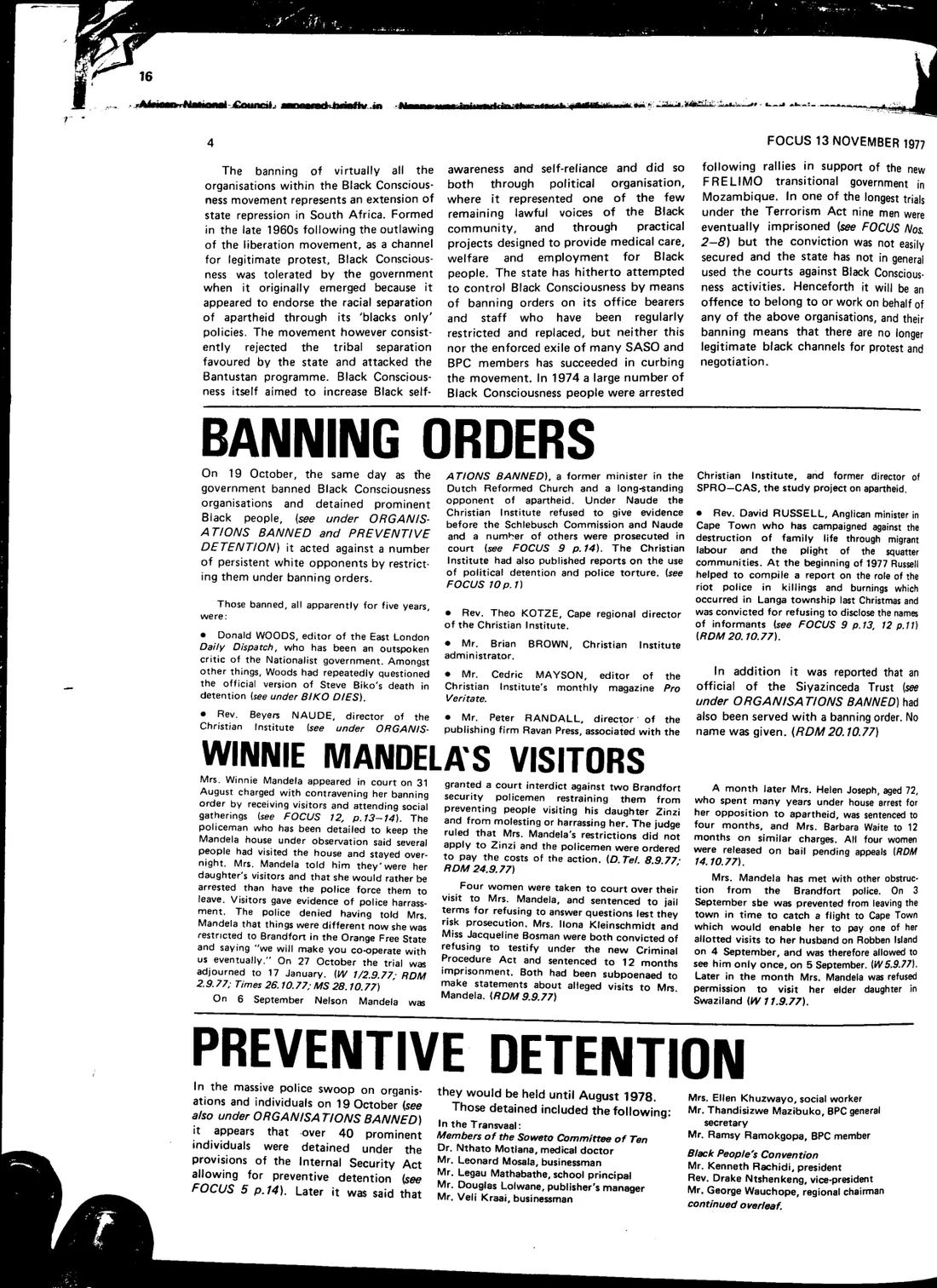
The banning of virtually all the organisations within the Black Consciousness movement represents an extension of state repression in South Africa. Formed in the late 1960s following the outlawing of the liberation movement, as a channel for legitimate protest, Black Consciousness was tolerated by the government when it originally emerged because it appeared to endorse the racial separation of apartheid through its 'blacks only' policies. The movement however consistently rejected the tribal separation favoured by the state and attacked the Bantustan programme. Black Consciousness itself aimed to increase Black self-awareness and self-reliance and did so both through political organisation, where it represented one of the few remaining lawful voices of the Black community, and through practical projects designed to provide medical care, welfare and employment for Black people. The state has hitherto attempted to control Black Consciousness by means of banning orders on its office bearers and staff who have been regularly restricted and replaced, but neither this nor the enforced exile of many SASO and BPC members has succeeded in curbing the movement. In 1974 a large number of Black Consciousness people were arrested following rallies in support of the new FRELIMO transitional government in Mozambique. In one of the longest trials under the Terrorism Act nine men were eventually imprisoned (see FOCUS Nos. 2-8) but the conviction was not easily secured and the state has not in general used the courts against Black Consciousness activities. Henceforth it will be an offence to belong to or work on behalf of any of the above organisations, and their banning means that there are no longer legitimate black channels for protest and negotiation.