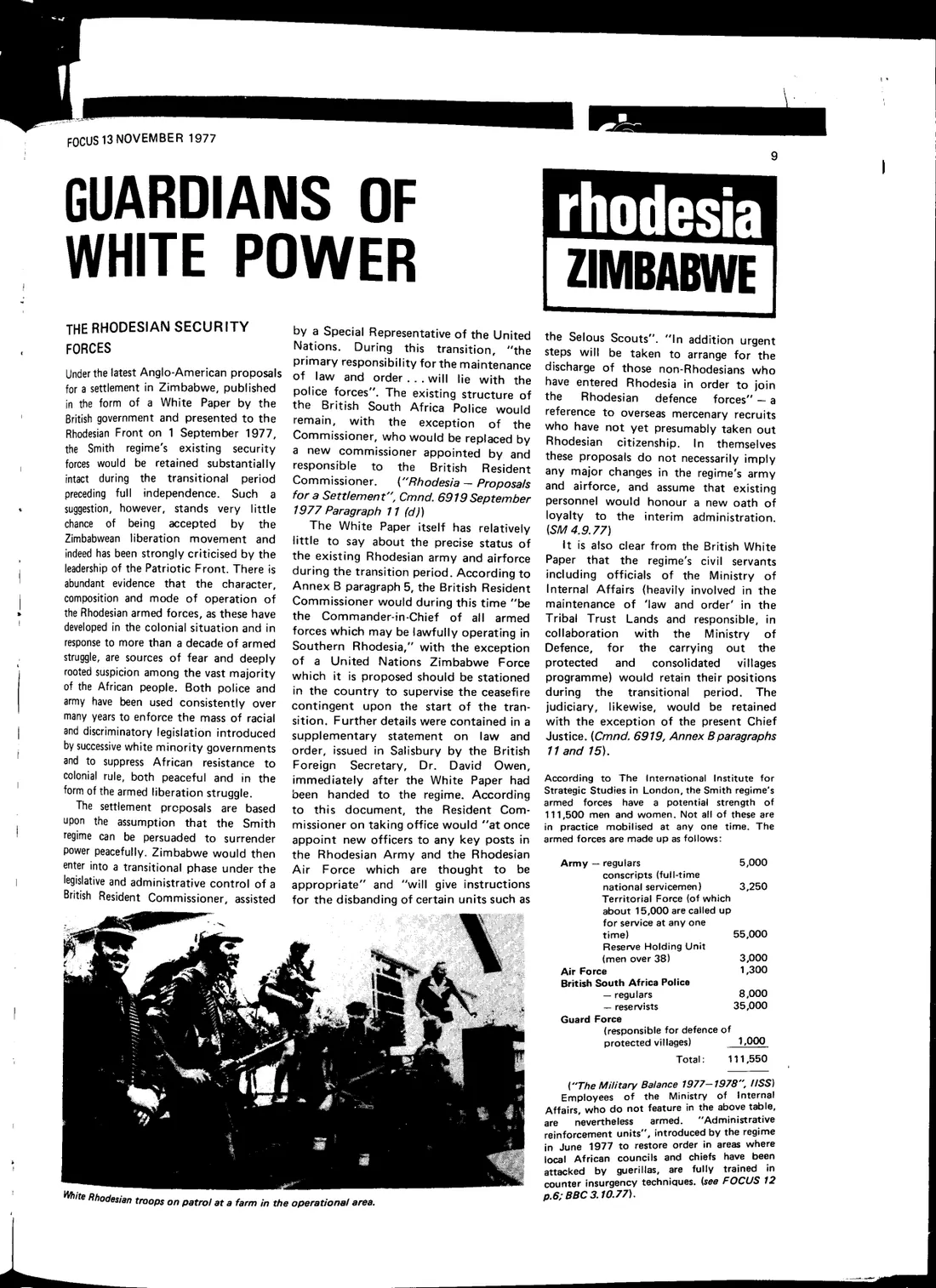
Under the latest Anglo-American proposals for a settlement in Zimbabwe, published in the form of a White Paper by the British government and presented to the Rhodesian Front on 1 September 1977, the Smith regime's existing security forces would be retained substantially intact during the transitional period preceding full independence. Such a suggestion, however, stands very little chance of being accepted by the Zimbabwean liberation movement and indeed has been strongly criticised by the leadership of the Patriotic Front. There is abundant evidence that the character, composition and mode of operation of the Rhodesian armed forces, as these have developed in the colonial situation and in response to more than a decade of armed struggle, are sources of fear and deeply rooted suspicion among the vast majority of the African people. Both police and army have been used consistently over many years to enforce the mass of racial and discriminatory legislation introduced by successive white minority governments and to suppress African resistance to colonial rule, both peaceful and in the form of the armed liberation struggle.
The settlement proposals are based upon the assumption that the Smith regime can be persuaded to surrender power peacefully. Zimbabwe would then enter into a transitional phase under the legislative and administrative control of a British Resident Commissioner, assisted by a Special Representative of the United Nations. During this transition, "the primary responsibility for the maintenance of law and order . . . will lie with the police forces". The existing structure of the British South Africa Police would remain, with the exception of the Commissioner, who would be replaced by a new commissioner appointed by and responsible to the British Resident Commissioner. ("Rhodesia - Proposals for a Settlement", Cmnd. 6919 September 1977 Paragraph 11 (d))
The White Paper itself has relatively little to say about the precise status of the existing Rhodesian army and airforce during the transition period. According to Annex B paragraph 5, the British Resident Commissioner would during this time "be the Commander-in-Chief of all armed forces which may be lawfully operating in Southern Rhodesia," with the exception of a United Nations Zimbabwe Force which it is proposed should be stationed in the country to supervise the ceasefire contingent upon the start of the transition. Further details were contained in a supplementary statement on law and order, issued in Salisbury by the British Foreign Secretary, Dr. David Owen, immediately after the White Paper had been handed to the regime. According to this document, the Resident Commissioner on taking office would "at once appoint new officers to any key posts in the Rhodesian Army and the Rhodesian Air Force which are thought to be appropriate" and "will give instructions for the disbanding of certain units such as the Selous Scouts". "In addition urgent steps will be taken to arrange for the discharge of those non-Rhodesians who have entered Rhodesia in order to join the Rhodesian defence forces" — a reference to overseas mercenary recruits who have not yet presumably taken out Rhodesian citizenship. In themselves these proposals do not necessarily imply any major changes in the regime's army and airforce, and assume that existing personnel would honour a new oath of loyalty to the interim administration. (SM 4.9.77)
It is also clear from the British White Paper that the regime's civil servants including officials of the Ministry of Internal Affairs (heavily involved in the maintenance of 'law and order' in the Tribal Trust Lands and responsible, in collaboration with the Ministry of Defence, for the carrying out the protected and consolidated villages programme) would retain their positions during the transitional period. The judiciary, likewise, would be retained with the exception of the present Chief Justice. (Cmnd. 6919, Annex B paragraphs 11 and 15).
According to The International Institute for Strategic Studies in London, the Smith regime's armed forces have a potential strength of 111,500 men and women. Not all of these are in practice mobilised at any one time. The armed forces are made up as follows:
Army - regulars 5,000 conscripts (full-time national servicemen) 3,250 Territorial Force (of which about 15,000 are called up for service at any one time) 55,000 Reserve Holding Unit (men over 38) 3,000 Air Force 1,300 British South Africa Police regulars 8,000 reservists 35,000 Guard Force (responsible for defence of protected villages) 1,000 Total: 111,550
"(The Military Balance 1977-1978", IISS) Employees of the Ministry of Internal Affairs, who do not feature in the above table, are nevertheless armed. "Administrative reinforcement units", introduced by the regime in June 1977 to restore order in areas where local African councils and chiefs have been attacked by guerillas, are fully trained in counter insurgency techniques. (see FOCUS 12 p.6; BBC 3.10.77).