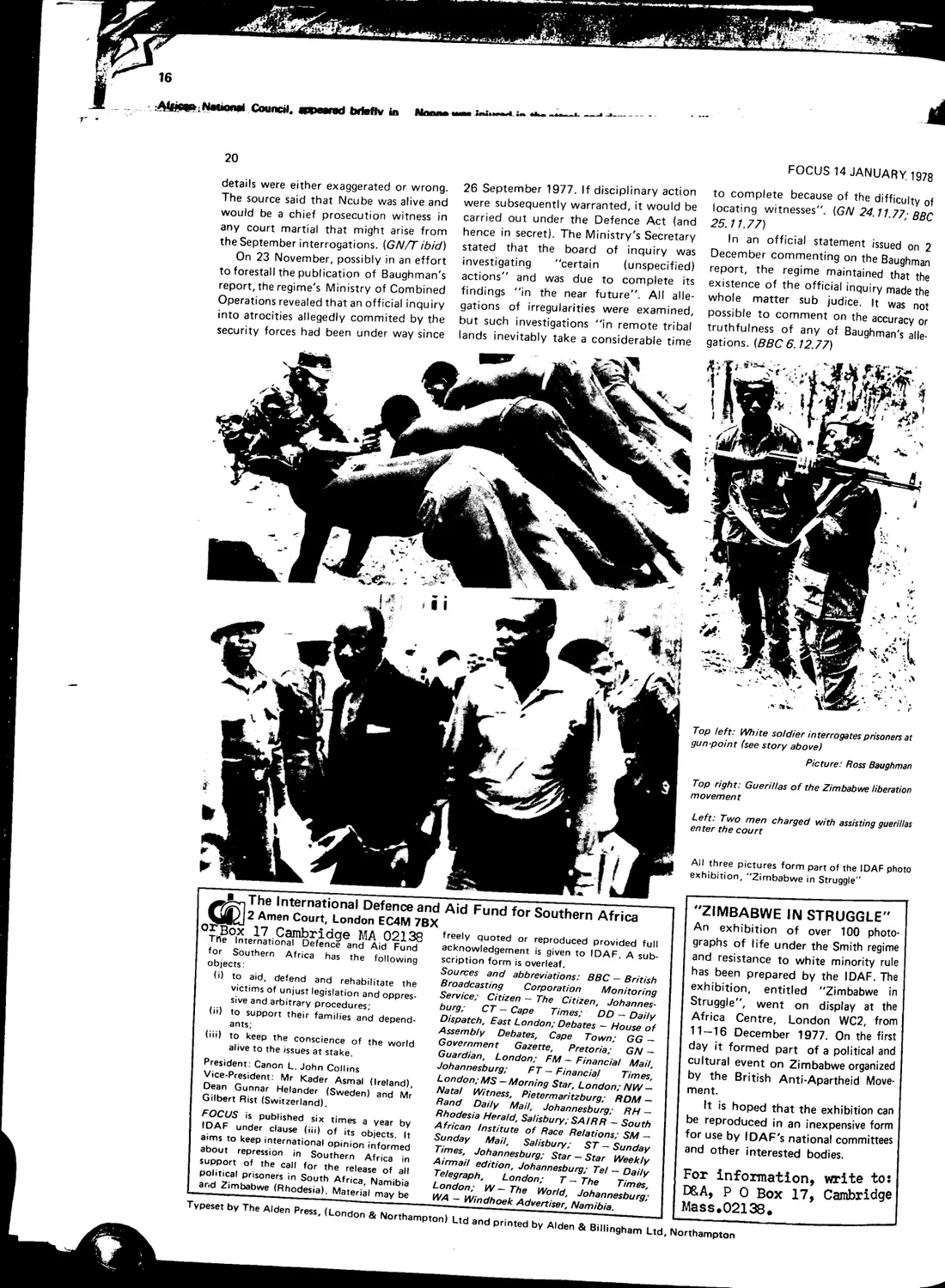
An eye-witness account of atrocities committed by the Smith regime's Grey's Scouts or mounted infantry was released by the Associated Press news agency in Salisbury at the beginning of December 1977. The report compiled by J. Ross Baughman, an American contract photographer with Associated Press who had persuaded a Grey's Scouts field commander to allow him to accompany a 25-man unit on a three-day mission into the operational area. The field commander, Major Mike Williams - described by Baughman as the highest ranking American in the Rhodesian army - agreed on the understanding that Baughman wore an army uniform, carried a weapon and could ride a horse as fast as the soldiers.
The main aim of the Scouts' mission, according to Williams, was to follow the tracks left from "confirmed sightings" of guerillas, overtake them and capture as much weaponry as possible. "But over and over again", he told Baughman, "the tracks lead us right into a village and we go in and say: 'Where are the terrorists?' and they say: 'We haven't seen any around here.' Then we have to get tough.' On 20 September, according to Baughman's account, a five-man squad from 3 Troop, commanded by Sgt. "Titch" Middleton, rounded up ten African youths at an abandoned school, ten miles from the village of Sipepa, a remote spot 50 miles southwest of Lupane and rather less distance from the Botswana border. Middleton radioed to his immediate superior in Sipepa, 19-year-old Lt. Graham Baillie, that the prisoners were members of a youth movement linked to the African National Council. One of the prisoners, Moffat Ncube, identified as the secretary of the local ANC branch, was beaten with a wooden bat after previously being knocked unconscious.
On 21 September, a second squad, commanded by Sgt. Bruce Moore-King, found several ragged guerilla uniforms and a list of 20 names and addresses, headed by Ncube's name, followed by "Sec", hidden in the general store of Kikidoo village, three miles from the school. Ncube and three other prisoners were now interrogated for information about hidden weapons. One prisoner was given the "water treatment" - he was pinned to the ground, his shirt was wrapped about his head and water poured from a bucket over his nose and mouth until he passed out. Ncube was then stripped of his clothes, knocked to the ground and forced to watch the beating of his wife and daughter. He was given the "water treatment", but attempted to resist it by drinking the water, spitting it out and holding his breath. The soldiers then tied a wire to Ncube's genitals and forced his daughter to pull on it, partially mutilating him. Ncube appeared to stop breathing and was rolled over onto his stomach. He did not move when Baillie fired a shot two or three inches from his ear.
Baughman further alleged that the Scouts whipped Ncube's daughter and wife several dozen times, and tied his wife on to a bed whose metal springs had been heated over a fire. Huts were burned down. Rope nooses were fastened about the necks of two prisoners who were then forced to run or be dragged several miles behind horses. Baughman was able to take photographs of an African wearing such a noose, the unconscious Ncube, and of a white soldier interrogating prisoners at gunpoint, cocking the pistol while they were forced to hold a press-up position for over an hour.
Baughman said that he later heard that Moffat Ncube had died as a result of his beating. Baughman himself was ordered to return to Salisbury after more senior Rhodesian authorities had found out who was, and some of his film was confiscated or spoilt. He left Rhodesia in November 1977.
A high level Rhodesian army source later said that Baughman's account was accurate in substance but that 75% of the details were either exaggerated or wrong. The source said that Ncube was alive and would be a chief prosecution witness in any court martial that might arise from the September interrogations.
On 23 November, possibly in an effort to forestall the publication of Baughman's report, the regime's Ministry of Combined Operations revealed that an official inquiry into atrocities allegedly committed by the security forces had been under way since 26 September 1977. If disciplinary action were subsequently warranted, it would be carried out under the Defence Act (and hence in secret). The Ministry's Secretary stated that the board of inquiry was investigating "certain (unspecified) actions" and was due to complete its findings "in the near future". All allegations of irregularities were examined, but such investigations "in remote tribal lands inevitably take a considerable time to complete because of the difficulty of locating witnesses".
In an official statement issued on 2 December commenting on the Baughman report, the regime maintained that the existence of the official inquiry made the whole matter sub judice. It was not possible to comment on the accuracy or truthfulness of any of Baughman's allegations.