The apartheid state's October attacks on the press through the suspension of the World newspapers, the detention of both editors, the banning of the Daily Dispatch editor, and the suppression of the Union of Black Journalists, represent the latest in a long series of acts against freedom of information in South Africa.
The banning of the World is significant in that it is the first time a major commercial paper has been forcibly closed in South Africa since 1897 when Paul Kruger tried unsuccessfully to silence the Star for its criticism of the government. Security legislation in 1950 (the Suppression of Communism Act) gave the Nationalist government power to suppress newspapers which was exercised against radical journals such as the Guardian (banned 1952), Advance (1954) and the New Age (1962). In 1962 the law was also amended to require a deposit of up to R20 000 before an unauthorised paper could be published, placing a major obstacle in the way of new and politically independent newspapers.
In addition to banning powers, the South African press is subject to numerous other statutes (excluding common law) restricting its activities. These include the Bantu Administration Act (1927), which curtails free reporting in the Bantuan areas, and the Prisons Act (1959), which forbids the publication of unauthorised information about prison conditions. The English-language press has been in constant conflict with the government ever since 1948. The history of this conflict and the restrictions on the press are contained in Press Under Apartheid by Alex Hepple (IDAF, 1974). Steadily but surely press freedom in South Africa has been eroded.
The image of a free press is a considerable asset overseas to the apartheid state, which frequently draws proud attention to this. Thus in February 1977 Johannesburg radio commented that "S.A. believes that free and independent news media contribute to the good government of the country. The enterprises journalist who investigates and reports honestly and openly is not merely tolerated but is rewarded for his efforts."
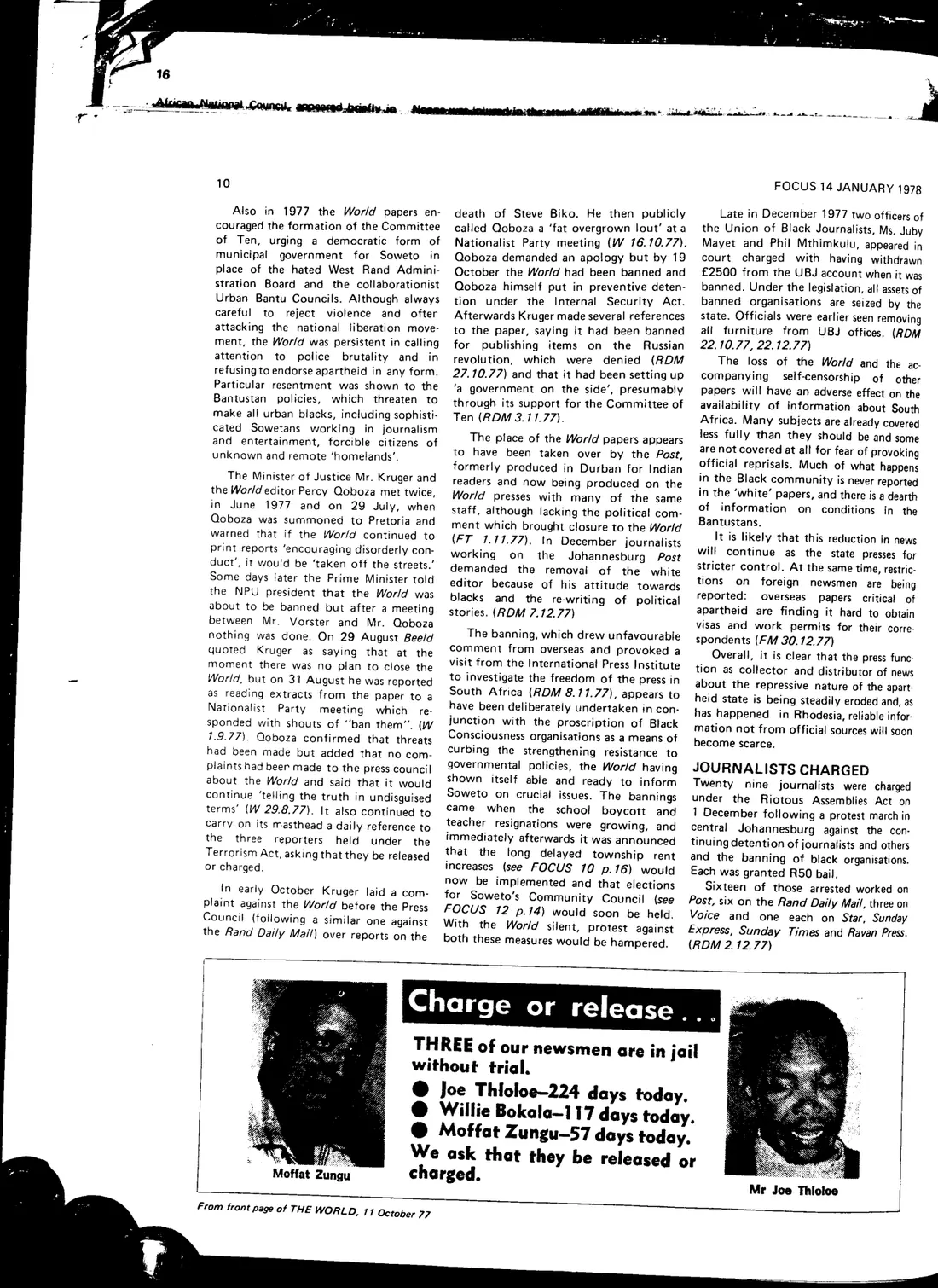
Within days of this broadcast, the enterprising journalist Joe Thloloe, president of the Union of Black Journalists, was detained under the Terrorism Act, for the government is swift to take action against newsmen who expose the injustices of apartheid, and is increasingly anxious to see the press fully under control.
PRESS CONTROL Within two years of coming to power in 1948 the Nationalist government appointed a commission to inquire into the press. This reported in 1962 and recommended a statutory press council and registration of all journalists. In 1963 a censorship bill was introduced which originally covered newspapers as well as other publications and entertainment but the Newspaper Press Union (proprietors) set up its own disciplinary body and newspapers were excluded from the final Act.
The government has periodically threatened the press with full controls. The latest occasion was March 1977 when a Newspaper Bill providing for a statutory press council and press code was introduced. The target is usually the English-language press, which the government claims publishes 'inflammatory material' inciting blacks against whites and encouraging foreign hostility to apartheid. On the previous occasion, in 1973, when the Prime Minister told the press it must 'put its house in order' or submit to legislative control, the NPU took its usual course of increasing self-censorship, giving its voluntary press council power to fine newspapers up to R10,000.
Harsher penalties were proposed by the Newspaper Bill, although the potential offences were loosely defined and its provisions probably unworkable in practice. The NPU agreed to impose on itself a more rigorous press code promising inter alia to exercise 'due care and responsibility' when dealing with subjects that may cause racial enmity, breaches of the law and adverse effects on the state and economy, or present violence and atrocities.
Supporting this code is a revised press council for complaints consisting of a judge and two assessors drawn from two panels, a professional (four representing English press, four Afrikaans press) and lay (six whites including Admiral Biermann, former SADF Chief, and two blacks, banker Sam Motsuenyane and Prof. van der Ross of the University of the Western Cape).
By thus exercising greater self-censorship the NPU once again escaped direct control. The threat remains; speaking to the Natal Nationalist Party Congress at the end of August Mr. Vorster said "We will give the press a chance to discipline itself but if it does not the legislation is there to be introduced". As the Rand Daily Mail (one of the government's chief targets) pointed out, the code's operation has to be acceptable to the government or the agreement will collapse. The new code "may buy a little time but is an act of appeasement and history shows that appeasement rarely pays". On an earlier occasion the paper had called such agreements 'surrender by instalment'.
Attacks on papers and journalists continued despite the code. At the end of April the first issue of a black-run paper The Voice was banned and its initial consignment seized. In June Willie Bokala, another World reporter, was detained by security police, to be followed by a third, Moffat Zungu in August. Other journalists were questioned while the World came under increasingly direct attack from the state.
BANNING THE WORLD Although it was written and read largely by blacks living in the Transvaal townships, the World was owned by the 'white' Argus Group, a big newspaper combine. The two papers, World and Weekend World, had only recently acquired a political reputation; for many years they concentrated on crime and entertainment. With the 1976 Soweto shootings they came increasingly to reflect black concerns and politics. Their black journalists were able to provide the best coverage of the disturbances, and the papers also played an active political role by relaying statements from the Soweto Students Representative Council when it was being hunted by the police, by announcing demonstrations in advance and by clarifying rumours. Circulation rose from around 120,000 in 1975 to nearly 160,000 at the end of 1976, making it the second largest selling daily after the Star.
At the beginning of 1977 the Weekend World introduced a free educational supplement called the People's College, prepared with the assistance of SACHED and providing both exam course material for the many students whose schooling had been interrupted or were working by correspondence, and non-exam material of a general educational nature. Some political material relating to African rights and restrictions under law and to developments in other countries were also included. The content and presentation of information in the People's College was often of a higher quality than that imparted in 'Bantu' schools, and it was valued by its audience. One white reader described it as the 'most worthwhile and excellent educational programme to be found'. At its inception the World called it "a step in the right direction in the Black man's fight for a better life.'
Also in 1977 the World papers encouraged the formation of the Committee of Ten, urging a democratic form of municipal government for Soweto in place of the hated West Rand Administration Board and the collaborationist Urban Bantu Councils. Although always careful to reject violence and offer attacking the national liberation movement, the World was persistent in calling attention to police brutality and in refusing to endorse apartheid in any form. Particular resentment was shown to the Bantustan policies, which threaten to make all urban blacks, including sophisticated Sowetans working in journalism and entertainment, forcible citizens of unknown and remote 'homelands'.
The Minister of Justice Mr. Kruger and the World editor Percy Qoboza met twice, in June 1977 and on 29 July, when Qoboza was summoned to Pretoria and warned that if the World continued to print reports 'encouraging disorderly conduct', it would be 'taken off the streets.' Some days later the Prime Minister told the NPU president that the World was about to be banned but after a meeting between Mr. Vorster and Mr. Qoboza nothing was done. On 29 August Beeld quoted Kruger as saying that at the moment there was no plan to close the World, but on 31 August he was reported as reading extracts from the paper to a Nationalist Party meeting which responded with shouts of "ban them". Qoboza confirmed that threats had been made but added that no complaints had been made to the press council about the World and said that it would continue 'telling the truth in undisguised terms'. It also continued to carry on its masthead a daily reference to the three reporters held under the Terrorism Act, asking that they be released or charged.
In early October Kruger laid a complaint against the World before the Press Council (following a similar one against the Rand Daily Mail) over reports on the death of Steve Biko. He then publicly called Qoboza a 'fat overgrown outot' at a Nationalist Party meeting. Qoboza demanded an apology but by 19 October the World had been banned and Qoboza himself put in preventive detention under the Internal Security Act. Afterwards Kruger made several references to the paper, saying it had been banned for publishing items on the Russian revolution, which were denied and that it had been setting up 'a government on the side', presumably through its support for the Committee of Ten.
The place of the World papers appears to have been taken over by the Post, formerly produced in Durban for Indian readers and now being produced on the World presses with many of the same staff, although lacking the political comment which brought closure to the World. In December journalists working on the Johannesburg Post demanded the removal of the white editor because of his attitude towards blacks and the re-writing of political stories.
The banning, which drew unfavourable comment from overseas and provoked a visit from the International Press Institute to investigate the freedom of the press in South Africa, appears to have been deliberately undertaken in conjunction with the proscription of Black Consciousness organisations as a means of curbing the strengthening resistance to governmental policies, the World having shown itself able and ready to inform Soweto on crucial issues. The bannings came when the school boycott and teacher resignations were growing, and immediately afterwards it was announced that the long delayed township rent increases would now be implemented and that elections for Soweto's Community Council would soon be held. With the World silent, protest against both these measures would be hampered.
Late in December 1977 two officers of the Union of Black Journalists, Ms. Juby Mayet and Phil Mthimkulu, appeared in court charged with having withdrawn £2500 from the UBJ account when it was banned. Under the legislation, all assets of banned organisations are seized by the state. Officials were earlier seen removing all furniture from UBJ offices.
The loss of the World and the accompanying self-censorship of other papers will have an adverse effect on the availability of information about South Africa. Many subjects are already covered less fully than they should be and some are not covered at all for fear of provoking official reprisals. Much of what happens in the Black community is never reported in the 'white' papers, and there is a dearth of information on conditions in the Bantustans.
It is likely that this reduction in news will continue as the state presses for stricter control. At the same time, restrictions on foreign newsmen are being reported: overseas papers critical of apartheid are finding it hard to obtain visas and work permits for their correspondents.
Overall, it is clear that the press function as collector and distributor of news about the repressive nature of the apartheid state is being steadily eroded and, as has happened in Rhodesia, reliable information not from official sources will soon become scarce.
JOURNALISTS CHARGED Twenty nine journalists were charged under the Riotous Assemblies Act on 1 December following a protest march in central Johannesburg against the continuing detention of journalists and others and the banning of black organisations. Each was granted R50 bail.
Sixteen of those arrested worked on Post, six on the Rand Daily Mail, three on Voice and one each on Star, Sunday Express, Sunday Times and Ravan Press.