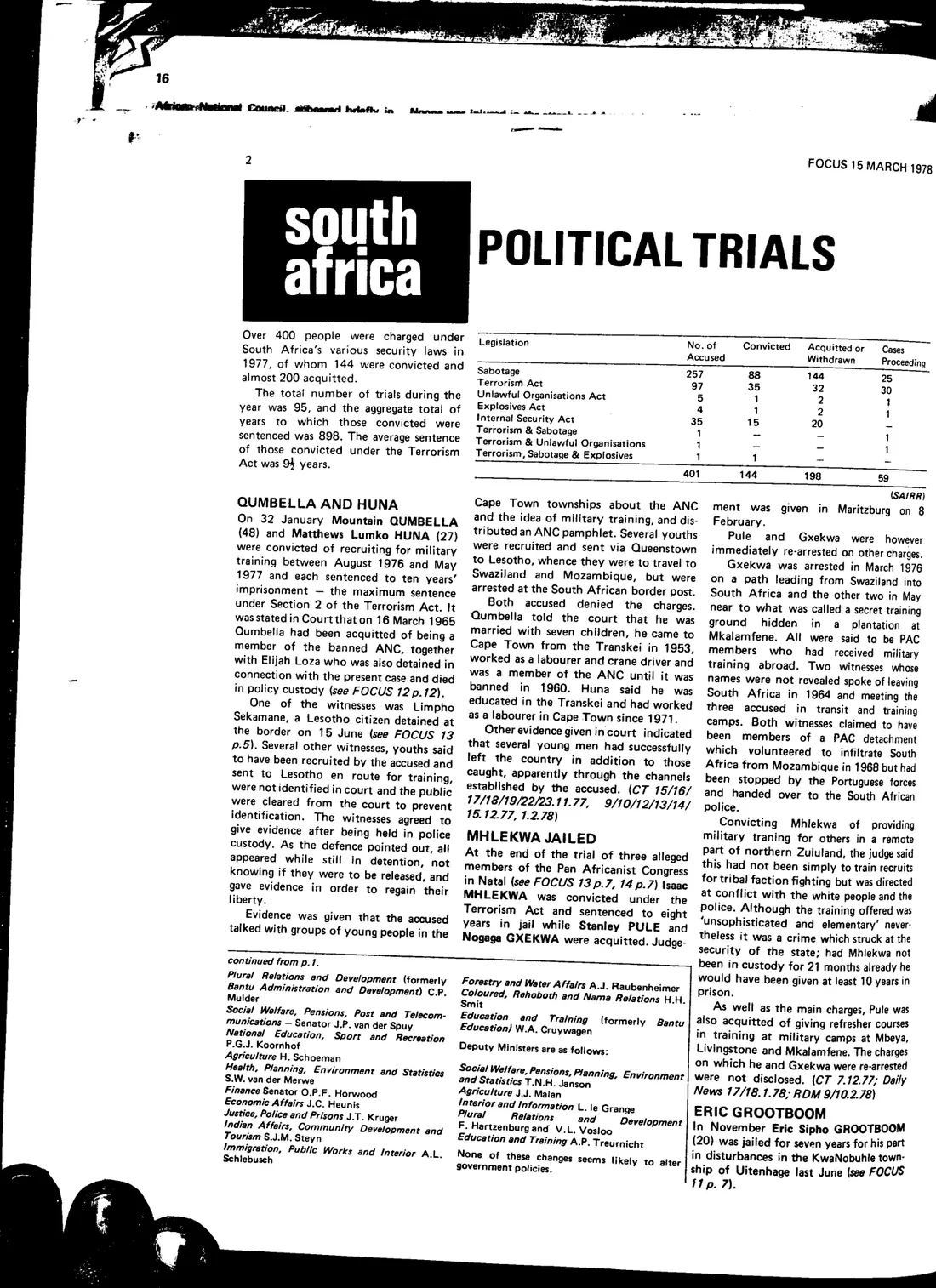
Over 400 people were charged under South Africa's various security laws in 1977, of whom 144 were convicted and almost 200 acquitted.
The total number of trials during the year was 95, and the aggregate total of years to which those convicted were sentenced was 898. The average sentence of those convicted under the Terrorism Act was 9½ years.
On 32 January Mountain QUMBELLA (48) and Matthews Lumko HUNA (27) were convicted of recruiting for military training between August 1976 and May 1977 and each sentenced to ten years' imprisonment — the maximum sentence under Section 2 of the Terrorism Act. It was stated in Court that on 16 March 1965 Qumbella had been acquitted of being a member of the banned ANC, together with Elijah Loza who was also detained in connection with the present case and died in policy custody.
One of the witnesses was Limpho Sekamane, a Lesotho citizen detained at the border on 15 June. Several other witnesses, youths said to have been recruited by the accused and sent to Lesotho en route for training, were not identified in court and the public were cleared from the court to prevent identification. The witnesses agreed to give evidence after being held in police custody. As the defence pointed out, all appeared while still in detention, not knowing if they were to be released, and gave evidence in order to regain their liberty.
Evidence was given that the accused talked with groups of young people in the Cape Town townships about the ANC and the idea of military training, and distributed an ANC pamphlet. Several youths were recruited and sent via Queenstown to Lesotho, whence they were to travel to Swaziland and Mozambique, but were arrested at the South African border post.
Both accused denied the charges. Qumbella told the court that he was married with seven children, he came to Cape Town from the Transkei in 1953, worked as a labourer and crane driver and was a member of the ANC until it was banned in 1960. Huna said he was educated in the Transkei and had worked as a labourer in Cape Town since 1971.
Other evidence given in court indicated that several young men had successfully left the country in addition to those caught, apparently through the channels established by the accused.
At the end of the trial of three alleged members of the Pan Africanist Congress in Natal Isaac MHLEKWA was convicted under the Terrorism Act and sentenced to eight years in jail while Stanley PULE and Nogaga GXEKWA were acquitted. Judgment was given in Maritzburg on 8 February. Pule and Gxekwa were however immediately re-arrested on other charges.
Gxekwa was arrested in March 1976 on a path leading from Swaziland into South Africa and the other two in May near to what was called a secret training ground hidden in a plantation at Mkalamfene. All were said to be PAC members who had received military training abroad. Two witnesses whose names were not revealed spoke of leaving South Africa in 1964 and meeting the three accused in transit and training camps. Both witnesses claimed to have been members of a PAC detachment which volunteered to infiltrate South Africa from Mozambique in 1968 but had been stopped by the Portuguese forces and handed over to the South African police.
Convicting Mhlekwa of providing military training for others in a remote part of northern Zululand, the judge said this had not been simply to train recruits for tribal faction fighting but was directed at conflict with the white people and the police. Although the training offered was 'unsophisticated and elementary' nevertheless it was a crime which struck at the security of the state; had Mhlekwa not been in custody for 21 months already he would have been given at least 10 years in prison.
As well as the main charges, Pule was also acquitted of giving refresher courses in training at military camps at Mbeya, Livingstone and Mkalamfene. The charges on which he and Gxekwa were re-arrested were not disclosed.
In November Eric Sipho GROOTBOOM (20) was jailed for seven years for his part in disturbances in the KwaNobuhle township of Uitenhage last June. Seven state witnesses aged between 12 and 16, who were warned as accomplices, stated that Grootboom had been part of a crowd that destroyed property belonging to the Bantu Affairs Administration Board, including three policemen's homes, and that he had played a leading role in urging others to set fire to the BAAB office, a shop and five houses. Damage was estimated at R58,500.
Grootboom denied the charges but was convicted on seven counts of public violence. This is not classified as an offence under security legislation and Grootboom will be treated as an ordinary prisoner and eligible for remission unlike political prisoners.
Two Soweto youths were convicted under the Terrorism Act in January and sentenced to five years imprisonment. Christopher HLONGWA (19) and Gerald NYEMBE (21) pleaded guilty to a charge that during September 1977 they attempted to leave the country to receive military training with the aim of endangering law and order in South Africa. They had paid a man R10 to take them to Swaziland but were arrested en route. Both made statements to the police; Nyembe's included this explanation: "We wanted to go to the camp to learn to be soldiers. We wanted to come back and fight with the government because we have a hard life."
In sentencing three men to long terms of imprisonment in November the judge said that had Thomas MASUKU, Temba NKOSI or Richard CHAUKE (previously reported as GAUKE) used any of the arms or explosives found in their possession they would have received the death sentence for treason.
The trial of Canzi LISA (previously reported as LIZA) accused of possessing arms and distributing ANC pamphlets, took place in Kempton Park Supreme Court in February. On 9 February Lisa changed his plea to guilty and was sentenced to five years imprisonment.
Lisa's two accomplices gave evidence for the state describing how an explosive device had been attached to a petrol tanker at Langlaagte station on the night of 14/15 June 1977, how explosive materials had been hidden in a house at Kagiso, Krugersdorp, and how ANC pamphlets were distributed at railway stations.
Police claimed that in July 1977, after his arrest, Lisa had co-operated with them in identifying places, and on 19 July had made a statement. Lisa admitted this on changing his plea and described how he had handed out ANC pamphlets at various places in Soweto. Sentencing Lisa under the Terrorism Act, the judge said the bomb attempt had been serious and it was tragic that someone of Lisa's family background and intelligence should have become involved in such activities. His full co-operation with the police merited the imposition of the minimum sentence.
Samuel MALEPANE (22) of Soweto was in February convicted of two charges under the Terrorism Act and sentenced to five years imprisonment. He was acquitted of the most serious charges namely a bomb attack on the Mzimhlophe hostel and attempting to damage a rail line. John MOEPHUDI (21) was acquitted on the same charges, the judge remarking that he was only peripherally involved in the offences.
Both were accused of belonging to South African Freedom Organisation (SAFO) and of being active between June and December 1976; they were represented pro deo and pleaded not guilty. Malepane claimed that after being arrested in December 1976 he had been assaulted and threatened by police, with electric shocks through his ears and blank shots fired at him.
Jabu MKWANAZI (29) was tried under the Terrorism Act in February and acquitted on charges of aiding 31 persons to leave the country for military training. He was convicted under the Immigration Act for helping persons to leave the country illegally and sentenced to a total of 18 months imprisonment but granted bail pending an appeal.
Evidence against Mkwanazi, a taxi driver of Soweto, was given by several youths from Soweto whom he had driven to Swaziland in 1976, including Johannes Simelane, 22, who admitted travelling to Swaziland in order to obtain military training and who had been arrested on his return to South Africa to visit his mother. Simelane said he had been in detention since March 1977; that it was a 'terrible experience' and that he would 'say anything to get out of it'.
The judge found that Mkwanazi had not participated in terrorist activities although he had been the driver; he had rather smuggled people over the border for profit.
Four witnesses who refused to testify in the case against Joseph Mati were sentenced to six months imprisonment in East London Regional Court on 4 November. All were former Robben Island prisoners. Moses Mbonisile TWEBE told the court that he would rather go to jail for five years than give evidence against Mati. Milner Bonakere NTSANGANI said he had been politically active all his life and to give evidence would be "stabbing in the back the movement, the ANC, to which I was connected and for which I have worked for many years". It would "also be letting down my young comrades for whom I have been responsible in this movement."
Sipho Fielden HINA told the court he had been detained in Port Elizabeth on 7 June 1977 and held for six months. He said "I was tortured by the security police to accept a statement they said was made by Mr. Mati" but refused to do so. Zola NQINI said he was arrested on 21 September and after being charged was put in the same cell as Mati. When he came to court on 13 October he found that the charges had been withdrawn against him and instead he was "told I would be used as a witness against Mr. Mati", which he refused to do.
The re-trial of the 12 people accused of ANC activities began on 16 January with a prosecution attempt to introduce a new indictment. Defence objections were upheld and the old indictment retained.
In what promises to be lengthy proceedings (more than 100 witnesses testified in the first hearing) the first state witnesses included several who gave evidence for the second time, among them Fred Motaung, Alpheus Ramokgadi and a 15 year old youth.
Several of the witnesses were not identified in court, but it appears that at least two were subjected to bomb attacks in their homes as retaliation for giving evidence. The home of Fred Motaung in Alexandra was attacked although he himself had been removed by the police. Later another (unnamed) resident in Alexandra who gave evidence against two of the accused was also bombed but he was not there.
Reporting of this re-trial has been sketchy and it is not possible from press reports to establish how closely the re-trial is following the previous trial or what new witnesses and evidence are being called.
The trial of Mondy MOTLOUNG and Solomon MAHLANGU, accused of murder following the shooting of two men in Goch Street, Johannesburg in June 1977, and of offences under the Terrorism Act re-opened in February in Kempton Park Circuit Court. On 2 March Mahlangu was convicted on all charges and sentenced to death. The judge accepted that Mahlangu had not fired any of the fatal shots but found him guilty of common purpose.
This is the first death sentence to be imposed for a political offence since the mid 1960s and has aroused international protest.
Motloung was declared unfit to stand trial due to brain damage resulting from a head injury. Medical evidence indicated that he was suffering from 'prison psychosis', a condition which might improve if he were in a different environment. The judge ordered him to be detained at Johannesburg Fort pending a decision by the State President. It was suggested that Motloung's brain injury was caused when he was hit on the head by a submachinegun during his arrest.
Mahlangu pleaded not guilty to the charges. His counsel said that his departure from South Africa had been organised by the ANC and he had been trained in Angola. In his training it was emphasised that the preservation of life was of the utmost importance. The indictment alleged that Mahlangu and Motloung entered South Africa from Swaziland in June 1977 with arms and explosives and being surprised in the street ran into a warehouse where they murdered two men and injured two others.
Ammunition, explosives and ANC pamphlets were hidden by the two men in a house in Duduza township, Nigei (where Motloung also lived). Police testified to having found maps and instructions in toothpaste tubes, nine hand grenades in a soap powder box, together with plastic explosive and detonating devices in cocoa tins.
Giving evidence Mahlangu contested a statement he had made on the day of his arrest, saying that he had been assaulted for refusing to talk by a team led by Captain Cronwright, who said they would begin "killing him gradually" if he did not give a statement.
A total of 18 men are accused of furthering the aims of the banned Pan Africanist Congress (PAC) in the trial of Zephania Mothopeng, aged 65, and others, which opened in January. The accused first appeared on 5 December 1977 in the small town of Bethal, a location apparently chosen to reduce the public impact of the proceedings.
The accused are Zephania MOTHOPENG (65), founding member of PAC; Moffat ZUNGU (48), newspaper photographer; John GANYA (48) of Soweto; Mark SHINNERS (37) of Pretoria; Bennie NTOELE (38) of Pretoria; Hamilton KEKE (42) of East London; Michael KHALA (24) of Soweto; Michael NTSHALI-TSHALI (47) of Manzini, Swaziland; Julius LANDINGWE (30) of Cape Town; Jerome KODISANG (26) of Soweto; Michael MATSOBANE (36) of Krugersdorp; Johnson NYATHI (32) of Krugersdorp; Mothlagegi THLALE (22) of Krugersdorp; Rodney TSOLETSANE (20) of Krugersdorp; Daniel MATSOBANE (31) of Krugersdorp; Themba HLATSHWAYO (21) of Krugersdorp; Zolile NDINGWA (26) of Cape Town; and Goodwill MONI (24) of Cape Town.
All are accused under the Terrorism Act with taking part in terrorist activities, conspiring to overthrow the government and furthering the aims of the PAC, in a number of offences alleged to have taken place between 1963 and 1977 in different places and countries. The list of co-conspirators includes Robert Sobukwe, late President of PAC, Potlako Leballo, PAC general secretary in exile and 12 other PAC leaders in exile.
Other alleged co-conspirators include four of those who died in detention in 1977 - Naboath Ntshuntsha, Samuel Malinga, Aaron Khoza and Bonaventura Malaza.
The indictment adds that the Urban Resources Centre and the Young African Christian (or Religious) Movement were both used as fronts to further the aims of PAC. A total of 165 state witnesses are due to appear.
When the trial opened in Bethal Circuit Court on 17 January (coinciding with the retrial of the Pretoria Twelve) the defence applied for an adjournment of 75 days because of the length of the indictment. The judge granted a 14-day adjournment.
On 31 January the accused were asked to plead. Mothopeng and 15 others refused to recognise the right of the court to try them and pleas of not guilty were entered on their behalf. Ntshali-Tshali, a Swazi citizen, pleaded not guilty and is separately represented.
The defence applied for the indictment against Hamilton Keke to be quashed on the grounds that he has already been tried and acquitted of the same offences. He had been released from prison in 1974 after serving ten years on Robben Island for PAC activities, was detained in April 1976 and tried in November that year. In April 1977 he was acquitted and promptly re-detained. The judge ruled that it could not be proved that he was appearing for the same offences.
The first state witness, a security policeman from East London gave evidence in Afrikaans and the accused requested interpreters - in English and eight African languages. The initial evidence concerned the finding of banned publications at Mothopeng's home in Soweto, and PAC documents said to constitute 'a classic exposition of Communist-Marxist ideology' with leanings towards Communist China.
On 13 February the state applied for the case to be heard in camera on the grounds that the safety of witnesses would be jeopardised if they were identified; this was granted.
Three men from Soweto were arrested near the Swaziland-South African border in January and appeared in court in Mbabane on 3 February charged with possessing arms of war - a grenade, a machine pistol, magazines and ammunition.
Wilfred MADELA (24), Thamsanqua Humphrey MAKHUBU (24), and Thuthuku Dennis HLUBI (22) were said to have been hiding in an abandoned vehicle about 5 km from Oshoek border post; according to SABC on 31 January their arrest followed a machine gun attack.
Two men were charged in Johannesburg Magistrates Court in January with setting fire to 16 buildings in the Rossettenville area between April and September 1977. Joshua MQWATHI (32) and Samson MAZIBUKO (29) were alleged to have set fire to shops, banks and restaurants.
On 28 February both were convicted. Mazibuko was jailed to 12 years, as he had been employed as nightwatchman to the buildings destroyed. Mqwathi was jailed for three years for his part.
According to the Rand Daily Mail an unnamed youth appeared in court in Port Elizabeth charged with sabotage in February. No further details were given except that the trial was taking place in a courtroom at Algoa Park police station which the defending attorney found unsatisfactory.
Two Johannesburg men appeared in court in February charged on four counts under the Terrorism Act. They are Enoch DUMA (36) a journalist on the Sunday Times who has been in detention since September 1977 and Aitken RAMUDZULI (24), who are alleged to have furthered the aims of the African National Congress through acts committed between April and September 1977, together with five co-conspirators.
The indictment alleges that: Duma used his car for ANC activities; both accused and co-conspirators went to Botswana to post a letter to New York requesting that money and PAC pamphlets be sent to South Africa; that with others they planted explosives on the railway line between Horizon and Princess stations, Roodapoort; that Ramudzuli went to Botswana in August 1977 to fetch weapons and explosives; that Ramudzuli brought guerillas into the country; and that both planted explosives in the main Pretoria Post Office. The railway line incident appears to be connected with the 'shoot-out' reported in Dobsonville on 26 September when teacher Nicholas Molokwane was shot dead by police and two policemen injured. Enoch Duma was arrested the same day, and the Minister of Police announced that another 'terrorist cell' had been uncovered, and six arrests made.