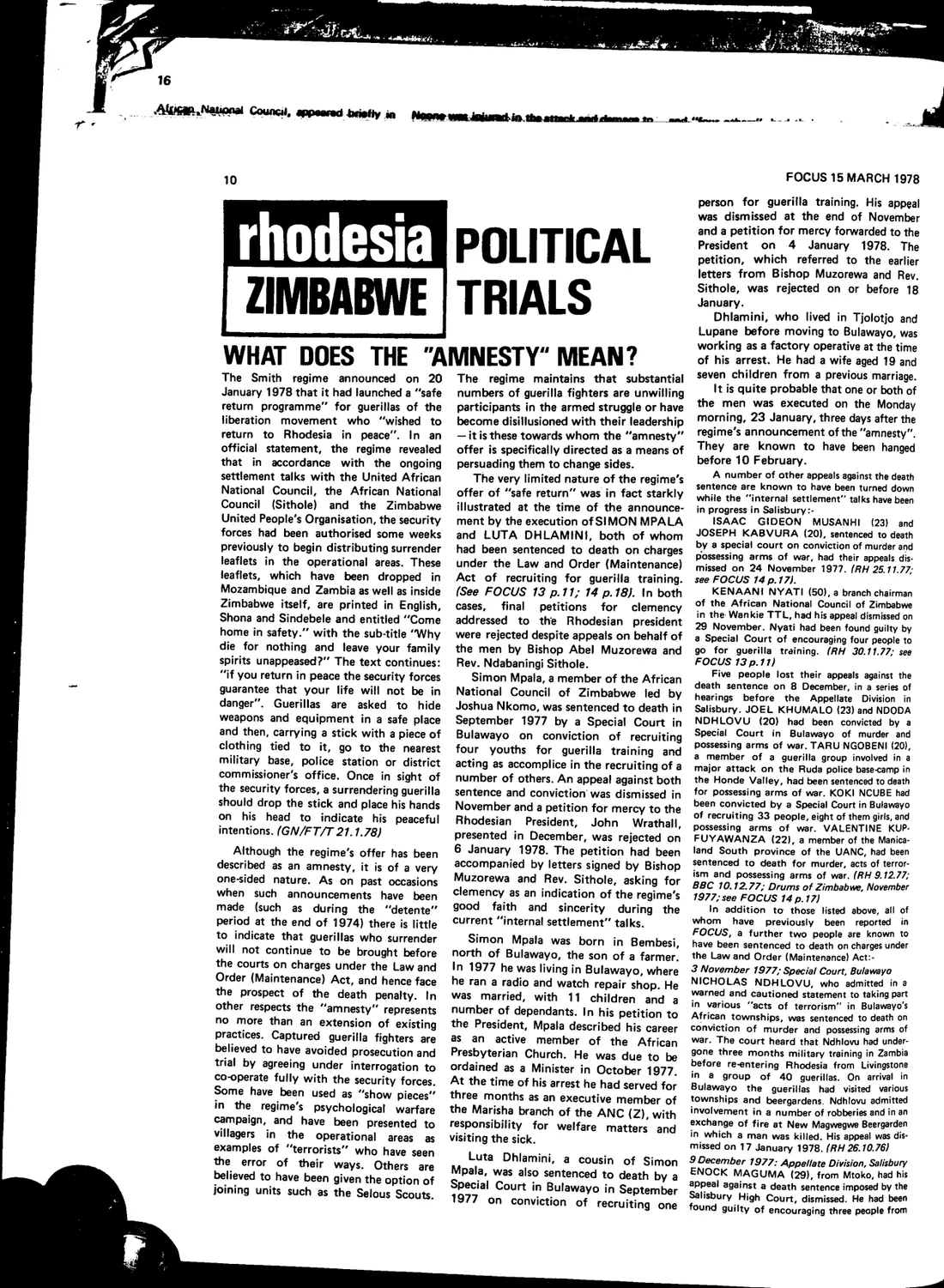
The Smith regime announced on 20 January 1978 that it had launched a "safe return programme" for guerillas of the liberation movement who "wished to return to Rhodesia in peace". In an official statement, the regime revealed that in accordance with the ongoing settlement talks with the United African National Council, the African National Council (Sithole) and the Zimbabwe United People's Organisation, the security forces had been authorised some weeks previously to begin distributing surrender leaflets in the operational areas. These leaflets, which have been dropped in Mozambique and Zambia as well as inside Zimbabwe itself, are printed in English, Shona and Sindebele and entitled "Come home in safety." with the sub-title "Why die for nothing and leave your family spirits unappeased?" The text continues: "if you return in peace the security forces guarantee that your life will not be in danger". Guerillas are asked to hide weapons and equipment in a safe place and then, carrying a stick with a piece of clothing tied to it, go to the nearest military base, police station or district commissioner's office. Once in sight of the security forces, a surrendering guerilla should drop the stick and place his hands on his head to indicate his peaceful intentions.
Although the regime's offer has been described as an amnesty, it is of a very one-sided nature. As on past occasions when such announcements have been made (such as during the "detente" period at the end of 1974) there is little to indicate that guerillas who surrender will not continue to be brought before the courts on charges under the Law and Order (Maintenance) Act, and hence face the prospect of the death penalty. In other respects the "amnesty" represents no more than an extension of existing practices. Captured guerilla fighters are believed to have avoided prosecution and trial by agreeing under interrogation to co-operate fully with the security forces. Some have been used as "show pieces" in the regime's psychological warfare campaign, and have been presented to villagers in the operational areas as examples of "terrorists" who have seen the error of their ways. Others are believed to have been given the option of joining units such as the Selous Scouts.
The regime maintains that substantial numbers of guerilla fighters are unwilling participants in the armed struggle or have become disillusioned with their leadership — it is these towards whom the "amnesty" offer is specifically directed as a means of persuading them to change sides.
The very limited nature of the regime's offer of "safe return" was in fact starkly illustrated at the time of the announcement by the execution of SIMON MPALA and LUTA DHLAMINI, both of whom had been sentenced to death on charges under the Law and Order (Maintenance) Act of recruiting for guerilla training. In both cases, final petitions for clemency addressed to the Rhodesian president were rejected despite appeals on behalf of the men by Bishop Abel Muzorewa and Rev. Ndabaningi Sithole.
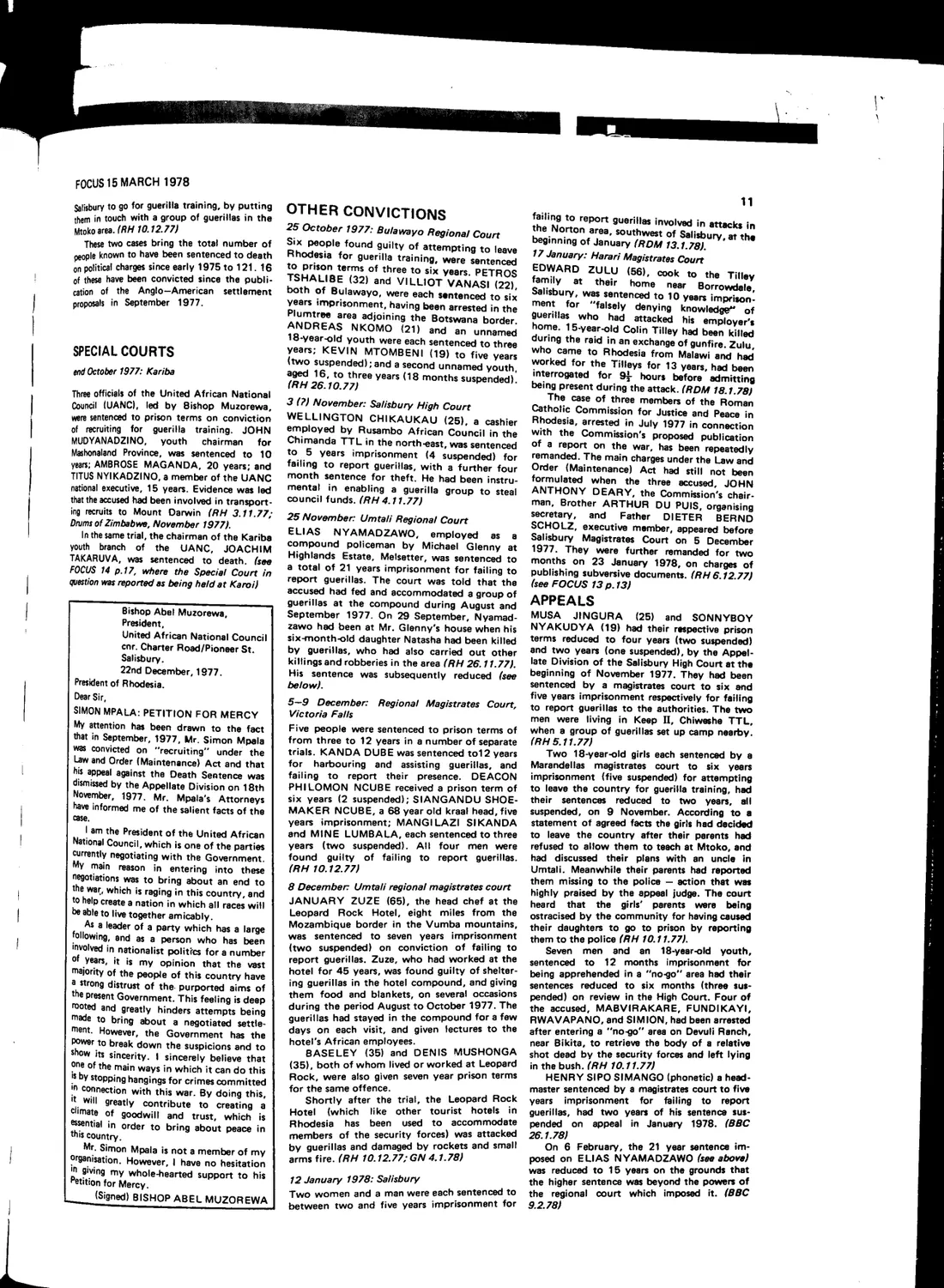
Simon Mpala, a member of the African National Council of Zimbabwe led by Joshua Nkomo, was sentenced to death in September 1977 by a Special Court in Bulawayo on conviction of recruiting four youths for guerilla training and acting as accomplice in the recruiting of a number of others. An appeal against both sentence and conviction was dismissed in November and a petition for mercy to the Rhodesian President, John Wrathall, presented in December, was rejected on 6 January 1978. The petition had been accompanied by letters signed by Bishop Muzorewa and Rev. Sithole, asking for clemency as an indication of the regime's good faith and sincerity during the current "internal settlement" talks.
Simon Mpala was born in Bembesi, north of Bulawayo, the son of a farmer. In 1977 he was living in Bulawayo, where he ran a radio and watch repair shop. He was married, with 11 children and a number of dependants. In his petition to the President, Mpala described his career as an active member of the African Presbyterian Church. He was due to be ordained as a Minister in October 1977. At the time of his arrest he had served for three months as an executive member of the Marisha branch of the ANC (Z), with responsibility for welfare matters and visiting the sick.
Luta Dhlamini, a cousin of Simon Mpala, was also sentenced to death by a Special Court in Bulawayo in September 1977 on conviction of recruiting one person for guerilla training. His appeal was dismissed at the end of November and a petition for mercy forwarded to the President on 4 January 1978. The petition, which referred to the earlier letters from Bishop Muzorewa and Rev. Sithole, was rejected on or before 18 January.
It is quite probable that one or both of the men was executed on the Monday morning, 23 January, three days after the regime's announcement of the "amnesty". They are known to have been hanged before 10 February.
A number of other appeals against the death sentence are known to have been turned down while the "internal settlement" talks have been in progress in Salisbury:- ISAAC GIDEON MUSANHI (23) and JOSEPH KABVURA (20), sentenced to death by a special court on conviction of murder and possessing arms of war, had their appeals dismissed on 24 November 1977. KENAANI NYATI (50), a branch chairman of the African National Council of Zimbabwe in the Wankie TTL, had his appeal dismissed on 29 November. Nyati had been found guilty by a Special Court of encouraging four people to go for guerilla training. Five people lost their appeals against the death sentence on 8 December, in a series of hearings before the Appellate Division in Salisbury. JOEL KHUMALO (23) and NDODA NDHLOVU (20) had been convicted by a Special Court in Bulawayo of murder and possessing arms of war. TARU NGOBENI (20), a member of a guerilla group involved in a major attack on the Ruda police base-camp in the Honde Valley, had been sentenced to death for possessing arms of war. KOKI NCUBE had been convicted by a Special Court in Bulawayo of recruiting 33 people, eight of them girls, and possessing arms of war. VALENTINE KUP-FUYAWANZA (22), a member of the Manica-land South province of the UANC, had been sentenced to death for murder, acts of terrorism and possessing arms of war.
In addition to those listed above, all of whom have previously been reported in FOCUS, a further two people are known to have been sentenced to death on charges under the Law and Order (Maintenance) Act:- 3 November 1977; Special Court, Bulawayo NICHOLAS NDHLOVU, who admitted in a warned and cautioned statement to taking part in various "acts of terrorism" in Bulawayo's African townships, was sentenced to death on conviction of murder and possessing arms of war. The court heard that Ndhlovu had undergone three months military training in Zambia before re-entering Rhodesia from Livingstone in a group of 40 guerillas. On arrival in Bulawayo the guerillas had visited various townships and beergardens. Ndhlovu admitted involvement in a number of robberies and in an exchange of fire at New Magwegwe Beergarden in which a man was killed. His appeal was dismissed on 17 January 1978.
9 December 1977; Appellate Division, Salisbury ENOCK MAGUMA (29), from Mtoko, had his appeal against a death sentence imposed by the Salisbury High Court, dismissed. He had been found guilty of encouraging three people from Salisbury to go for guerilla training, by putting them in touch with a group of guerillas in the Mtoko area.
These two cases bring the total number of people known to have been sentenced to death on political charges since early 1975 to 121. 16 of these have been convicted since the publication of the Anglo-American settlement proposals in September 1977.
SPECIAL COURTS end October 1977: Kariba Three officials of the United African National Council (UANC), led by Bishop Muzorewa, were sentenced to prison terms on conviction of recruiting for guerilla training. JOHN MUDYANADZINO, youth chairman for Mashonaland Province, was sentenced to 10 years; AMBROSE MAGANDA, 20 years; and TITUS NYIKADZINO, a member of the UANC national executive, 15 years. Evidence was led that the accused had been involved in transporting recruits to Mount Darwin.
In the same trial, the chairman of the Karibe youth branch of the UANC, JOACHIM TAKARUVA, was sentenced to death.
OTHER CONVICTIONS 25 October 1977: Bulawayo Regional Court Six people found guilty of attempting to leave Rhodesia for guerilla training, were sentenced to prison terms of three to six years. PETROS TSHALIBE (32) and VILLIOT VANASI (22), both of Bulawayo, were each sentenced to six years imprisonment, having been arrested in the Plumtree area adjoining the Botswana border. ANDREAS NKOMO (21) and an unnamed 18-year-old youth were each sentenced to three years; KEVIN MTOMBENI (19) to five years (two suspended); and a second unnamed youth, aged 16, to three years (18 months suspended).
3 (7) November: Salisbury High Court WELLINGTON CHIKAUKAU (25), a cashier employed by Rusambo African Council in the Chimanda TTL in the north-east, was sentenced to 5 years imprisonment (4 suspended) for failing to report guerillas, with a further four month sentence for theft. He had been instrumental in enabling a guerilla group to steal council funds.
25 November: Umtali Regional Court ELIAS NYAMADZAWO, employed as a compound policeman by Michael Glenny at Highlands Estate, Melsetter, was sentenced to a total of 21 years imprisonment for failing to report guerillas. The court was told that the accused had fed and accommodated a group of guerillas at the compound during August and September 1977. On 29 September, Nyamadzawo had been at Mr. Glenny's house when his six-month-old daughter Natasha had been killed by guerillas, who had also carried out other killings and robberies in the area. His sentence was subsequently reduced.
5-9 December: Regional Magistrates Court, Victoria Falls Five people were sentenced to prison terms of from three to 12 years in a number of separate trials. KANDA DUBE was sentenced to 12 years for harbouring and assisting guerillas, and failing to report their presence. DEACON PHILOMON NCUBE received a prison term of six years (2 suspended); SIANGANDU SHOEMAKER NCUBE, a 68 year old kraal head, five years imprisonment; MANGILAZI SIKANDA and MINE LUMBALA, each sentenced to three years (two suspended). All four men were found guilty of failing to report guerillas.
8 December: Umtali regional magistrates court JANUARY ZUZE (65), the head chef at the Leopard Rock Hotel, eight miles from the Mozambique border in the Vumba mountains, was sentenced to seven years imprisonment (two suspended) on conviction of failing to report guerillas. Zuze, who had worked at the hotel for 45 years, was found guilty of sheltering guerillas in the hotel compound, and giving them food and blankets, on several occasions during the period August to October 1977. The guerillas had stayed in the compound for a few days on each visit, and given lectures to the hotel's African employees.
BASELEY (35) and DENIS MUSHONGA (35), both of whom lived or worked at Leopard Rock, were also given seven year prison terms for the same offence.
Shortly after the trial, the Leopard Rock Hotel (which like other tourist hotels in Rhodesia has been used to accommodate members of the security forces) was attacked by guerillas and damaged by rockets and small arms fire.
12 January 1978: Salisbury Two women and a man were each sentenced to between two and five years imprisonment for failing to report guerillas involved in attacks in the Norton area, southwest of Salisbury, at the beginning of January.
17 January: Harari Magistrates Court EDWARD ZULU (56), cook to the Tilley family at their home near Borrowdale, Salisbury, was sentenced to 10 years imprisonment for "falsely denying knowledge" of guerillas who had attacked his employer's home. 15-year-old Colin Tilley had been killed during the raid in an exchange of gunfire. Zulu, who came to Rhodesia from Malawi and had worked for the Tilleys for 13 years, had been interrogated for 9½ hours before admitting being present during the attack.
The case of three members of the Roman Catholic Commission for Justice and Peace in Rhodesia, arrested in July 1977 in connection with the Commission's proposed publication of a report on the war, has been repeatedly remanded. The main charges under the Law and Order (Maintenance) Act had still not been formulated when the three accused, JOHN ANTHONY DEARY, the Commission's chairman, Brother ARTHUR DU PUIS, organising secretary, and Father DIETER BERND SCHOLZ, executive member, appeared before Salisbury Magistrates Court on 5 December 1977. They were further remanded for two months on 23 January 1978, on charges of publishing subversive documents.
APPEALS MUSA JINGURA (25) and SONNYBOY NYAKUDYA (19) had their respective prison terms reduced to four years (two suspended) and two years (one suspended), by the Appellate Division of the Salisbury High Court at the beginning of November 1977. They had been sentenced by a magistrates court to six and five years imprisonment respectively for failing to report guerillas to the authorities. The two men were living in Keep II, Chiweswe TTL, when a group of guerillas set up camp nearby.
Two 18-year-old girls each sentenced by a Marandellas magistrates court to six years imprisonment (five suspended) for attempting to leave the country for guerilla training, had their sentences reduced to two years, all suspended, on 9 November. According to a statement of agreed facts the girls had decided to leave the country after their parents had refused to allow them to teach at Mtoko, and had discussed their plans with an uncle in Umtali. Meanwhile their parents had reported them missing to the police - action that was highly praised by the appeal judge. The court heard that the girls' parents were being ostracised by the community for having caused their daughters to go to prison by reporting them to the police.
Seven men and an 18-year-old youth, sentenced to 12 months imprisonment for being apprehended in a "no-go" area had their sentences reduced to six months (three suspended) on review in the High Court. Four of the accused, MABVIRAKARE, FUNDIKAYI, RWAVAPANO, and SIMION, had been arrested after entering a "no-go" area on Devuli Ranch, near Bikita, to retrieve the body of a relative shot dead by the security forces and left lying in the bush.
HENRY SIPO SIMANGO (phonetic) a headmaster sentenced by a magistrates court to five years imprisonment for failing to report guerillas, had two years of his sentence suspended on appeal in January 1978.
On 6 February, the 21 year sentence imposed on ELIAS NYAMADZAWO was reduced to 15 years on the grounds that the higher sentence was beyond the powers of the regional court which imposed it.