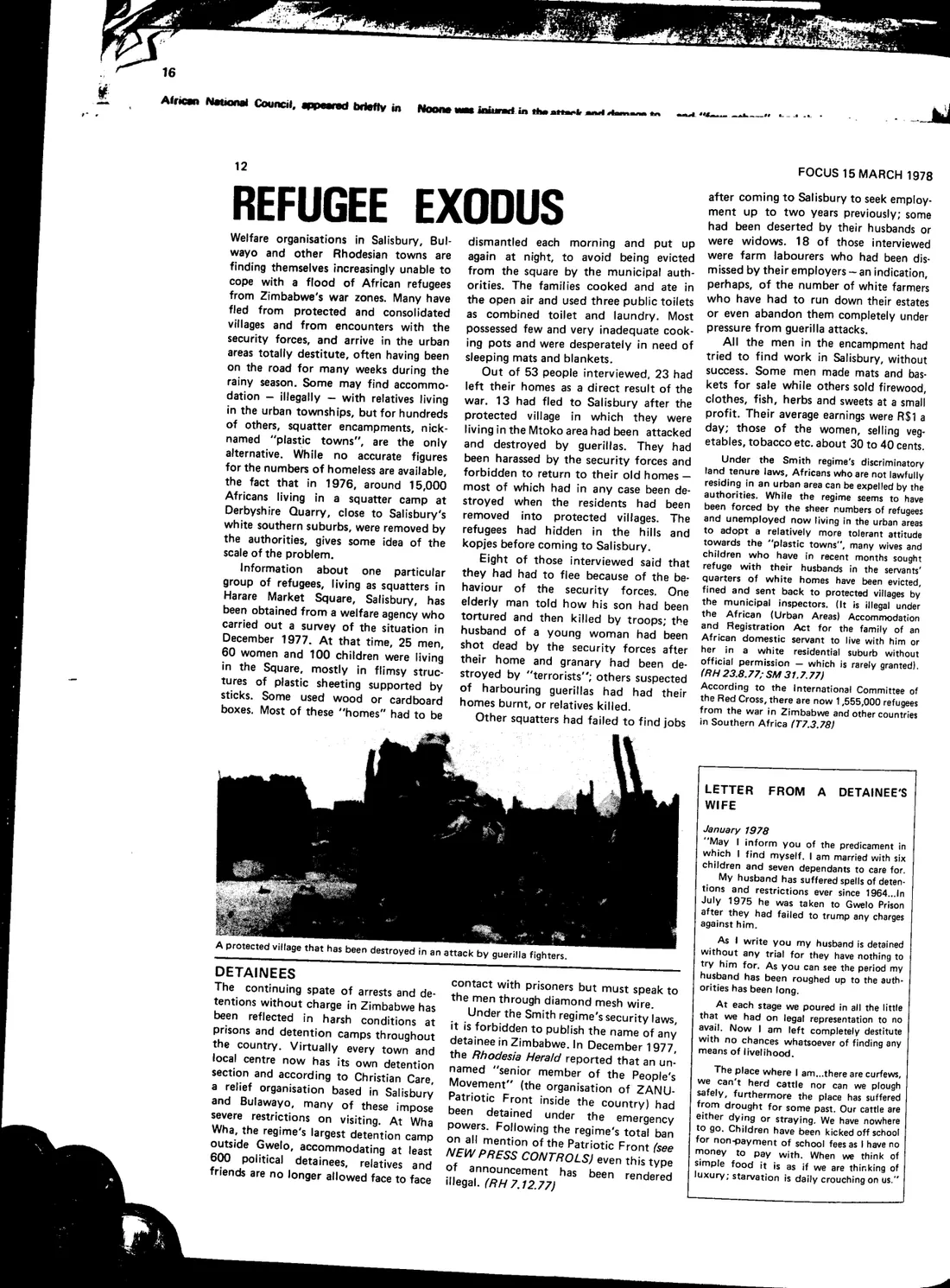
Welfare organisations in Salisbury, Bulwayo and other Rhodesian towns are finding themselves increasingly unable to cope with a flood of African refugees from Zimbabwe's war zones. Many have fled from protected and consolidated villages and from encounters with the security forces, and arrive in the urban areas totally destitute, often having been on the road for many weeks during the rainy season. Some may find accommodation — illegally — with relatives living in the urban townships, but for hundreds of others, squatter encampments, nicknamed "plastic towns", are the only alternative. While no accurate figures for the numbers of homeless are available, the fact that in 1976, around 15,000 Africans living in a squatter camp at Derbyshire Quarry, close to Salisbury's white southern suburbs, were removed by the authorities, gives some idea of the scale of the problem.
Information about one particular group of refugees, living as squatters in Harare Market Square, Salisbury, has been obtained from a welfare agency who carried out a survey of the situation in December 1977. At that time, 25 men, 60 women and 100 children were living in the Square, mostly in flimsy structures of plastic sheeting supported by sticks. Some used wood or cardboard boxes. Most of these "homes" had to be dismantled each morning and put up again at night, to avoid being evicted from the square by the municipal authorities. The families cooked and ate in the open air and used three public toilets as combined toilet and laundry. Most possessed few and very inadequate cooking pots and were desperately in need of sleeping mats and blankets.
Out of 53 people interviewed, 23 had left their homes as a direct result of the war. 13 had fled to Salisbury after the protected village in which they were living in the Mtoko area had been attacked and destroyed by guerillas. They had been harassed by the security forces and forbidden to return to their old homes — most of which had in any case been destroyed when the residents had been removed into protected villages. The refugees had hidden in the hills and kopjes before coming to Salisbury.
Eight of those interviewed said that they had had to flee because of the behaviour of the security forces. One elderly man told how his son had been tortured and then killed by troops; the husband of a young woman had been shot dead by the security forces after their home and granary had been destroyed by "terrorists"; others suspected of harbouring guerillas had had their homes burnt, or relatives killed.
Other squatters had failed to find jobs after coming to Salisbury to seek employment up to two years previously; some had been deserted by their husbands or were widows. 18 of those interviewed were farm labourers who had been dismissed by their employers — an indication, perhaps, of the number of white farmers who have had to run down their estates or even abandon them completely under pressure from guerilla attacks.
All the men in the encampment had tried to find work in Salisbury, without success. Some men made mats and baskets for sale while others sold firewood, clothes, fish, herbs and sweets at a small profit. Their average earnings were R1 a day; those of the women, selling vegetables, tobacco etc. about 30 to 40 cents.
Under the Smith regime's discriminatory land tenure laws, Africans who are not lawfully residing in an urban area can be expelled by the authorities. While the regime seems to have been forced by the sheer numbers of refugees and unemployed now living in the urban areas to adopt a relatively more tolerant attitude towards the "plastic towns", many wives and children who have in recent months sought refuge with their husbands in the servants' quarters of white homes have been evicted, fined and sent back to protected villages by the municipal inspectors. (It is illegal under the African (Urban Areas) Accommodation and Registration Act for the family of an African domestic servant to live with him or her in a white residential suburb without official permission — which is rarely granted.)
According to the International Committee of the Red Cross, there are now 1,555,000 refugees from the war in Zimbabwe and other countries in Southern Africa.