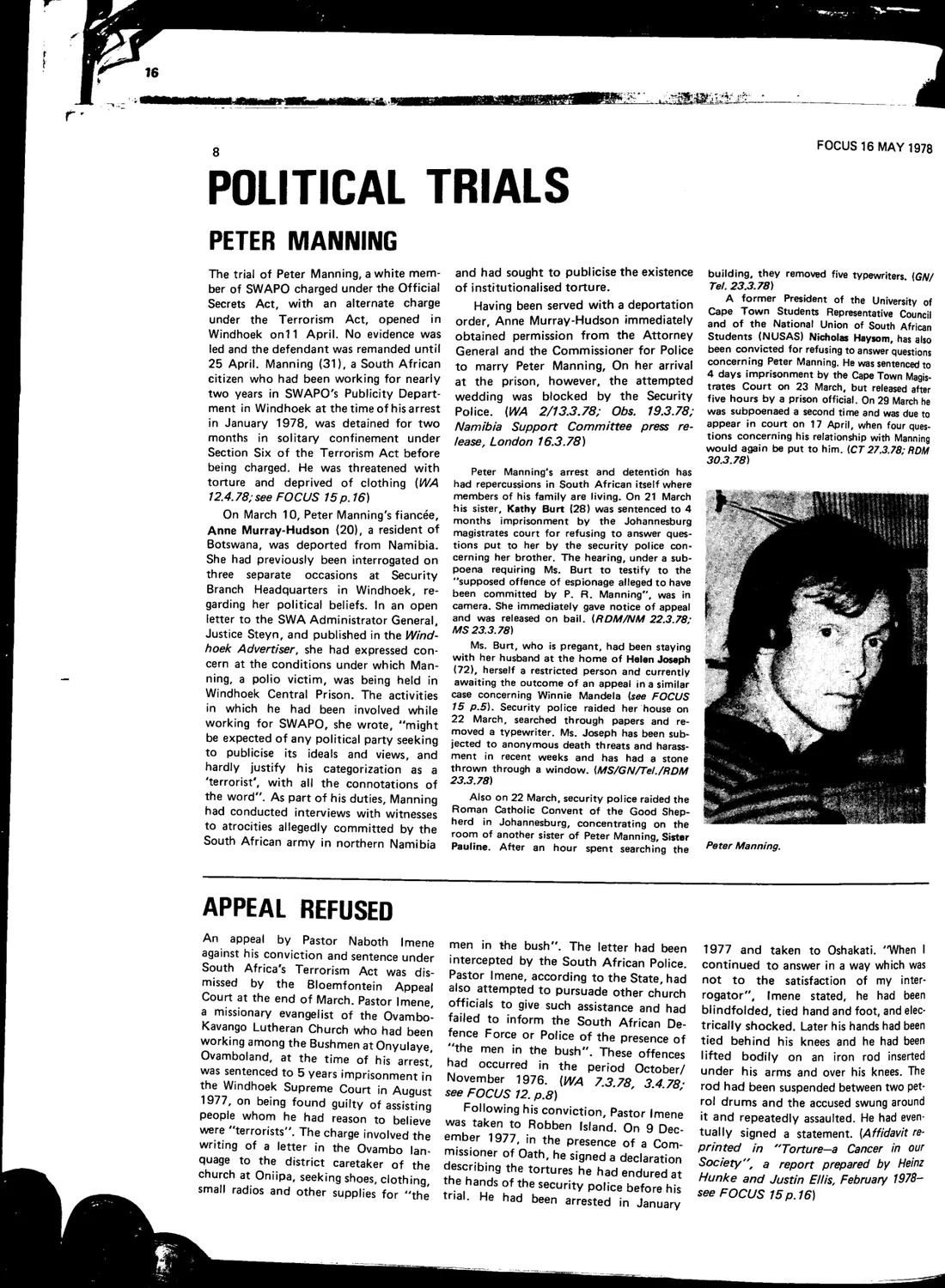
The trial of Peter Manning, a white member of SWAPO charged under the Official Secrets Act, with an alternate charge under the Terrorism Act, opened in Windhoek on 11 April. No evidence was led and the defendant was remanded until 25 April. Manning (31), a South African citizen who had been working for nearly two years in SWAPO's Publicity Department in Windhoek at the time of his arrest in January 1978, was detained for two months in solitary confinement under Section Six of the Terrorism Act before being charged. He was threatened with torture and deprived of clothing.
On March 10, Peter Manning's fiancée, Anne Murray-Hudson (20), a resident of Botswana, was deported from Namibia. She had previously been interrogated on three separate occasions at Security Branch Headquarters in Windhoek, regarding her political beliefs. In an open letter to the SWA Administrator General, Justice Steyn, and published in the Windhoek Advertiser, she had expressed concern at the conditions under which Manning, a polio victim, was being held in Windhoek Central Prison. The activities in which he had been involved while working for SWAPO, she wrote, "might be expected of any political party seeking to publicise its ideals and views, and hardly justify his categorization as a 'terrorist', with all the connotations of the word". As part of his duties, Manning had conducted interviews with witnesses to atrocities allegedly committed by the South African army in northern Namibia and had sought to publicise the existence of institutionalised torture.
Having been served with a deportation order, Anne Murray-Hudson immediately obtained permission from the Attorney General and the Commissioner for Police to marry Peter Manning. On her arrival at the prison, however, the attempted wedding was blocked by the Security Police.
Peter Manning's arrest and detention has had repercussions in South African itself where members of his family are living. On 21 March his sister, Kathy Burt (28) was sentenced to 4 months imprisonment by the Johannesburg magistrates court for refusing to answer questions put to her by the security police concerning her brother. The hearing, under a subpoena requiring Ms. Burt to testify to the "supposed offence of espionage alleged to have been committed by P. R. Manning", was in camera. She immediately gave notice of appeal and was released on bail.
Ms. Burt, who is pregnant, had been staying with her husband at the home of Helen Joseph (72), herself a restricted person and currently awaiting the outcome of an appeal in a similar case concerning Winnie Mandela. Security police raided her house on 22 March, searched through papers and removed a typewriter. Ms. Joseph has been subjected to anonymous death threats and harassment in recent weeks and has had a stone thrown through a window.
Also on 22 March, security police raided the Roman Catholic Convent of the Good Shepherd in Johannesburg, concentrating on the room of another sister of Peter Manning, Sister Pauline. After an hour spent searching the building, they removed five typewriters.
A former President of the University of Cape Town Students Representative Council and of the National Union of South African Students (NUSAS) Nicholas Haysom, has also been convicted for refusing to answer questions concerning Peter Manning. He was sentenced to 4 days imprisonment by the Cape Town Magistrates Court on 23 March, but released after five hours by a prison official. On 29 March he was subpoenaed a second time and was due to appear in court on 17 April, when four questions concerning his relationship with Manning would again be put to him.
An appeal by Pastor Naboth Imene against his conviction and sentence under South Africa's Terrorism Act was dismissed by the Bloemfontein Appeal Court at the end of March. Pastor Imene, a missionary evangelist of the Ovambo-Kavango Lutheran Church who had been working among the Bushmen at Onyulaye, Ovamboland, at the time of his arrest, was sentenced to 5 years imprisonment in the Windhoek Supreme Court in August 1977, on being found guilty of assisting people whom he had reason to believe were "terrorists". The charge involved the writing of a letter in the Ovambo language to the district caretaker of the church at Oniipa, seeking shoes, clothing, small radios and other supplies for "the men in the bush". The letter had been intercepted by the South African Police. Pastor Imene, according to the State, had also attempted to pursuade other church officials to give such assistance and had failed to inform the South African Defence Force or Police of the presence of "the men in the bush". These offences had occurred in the period October/November 1976.
Following his conviction, Pastor Imene was taken to Robben Island. On 9 December 1977, in the presence of a Commissioner of Oath, he signed a declaration describing the tortures he had endured at the hands of the security police before his trial. He had been arrested in January 1977 and taken to Oshakati. "When I continued to answer in a way which was not to the satisfaction of my interrogator", Imene stated, he had been blindfolded, tied hand and foot, and electrically shocked. Later his hands had been tied behind his knees and he had been lifted bodily on an iron rod inserted under his arms and over his knees. The rod had been suspended between two petrol drums and the accused swung around it and repeatedly assaulted. He had eventually signed a statement.