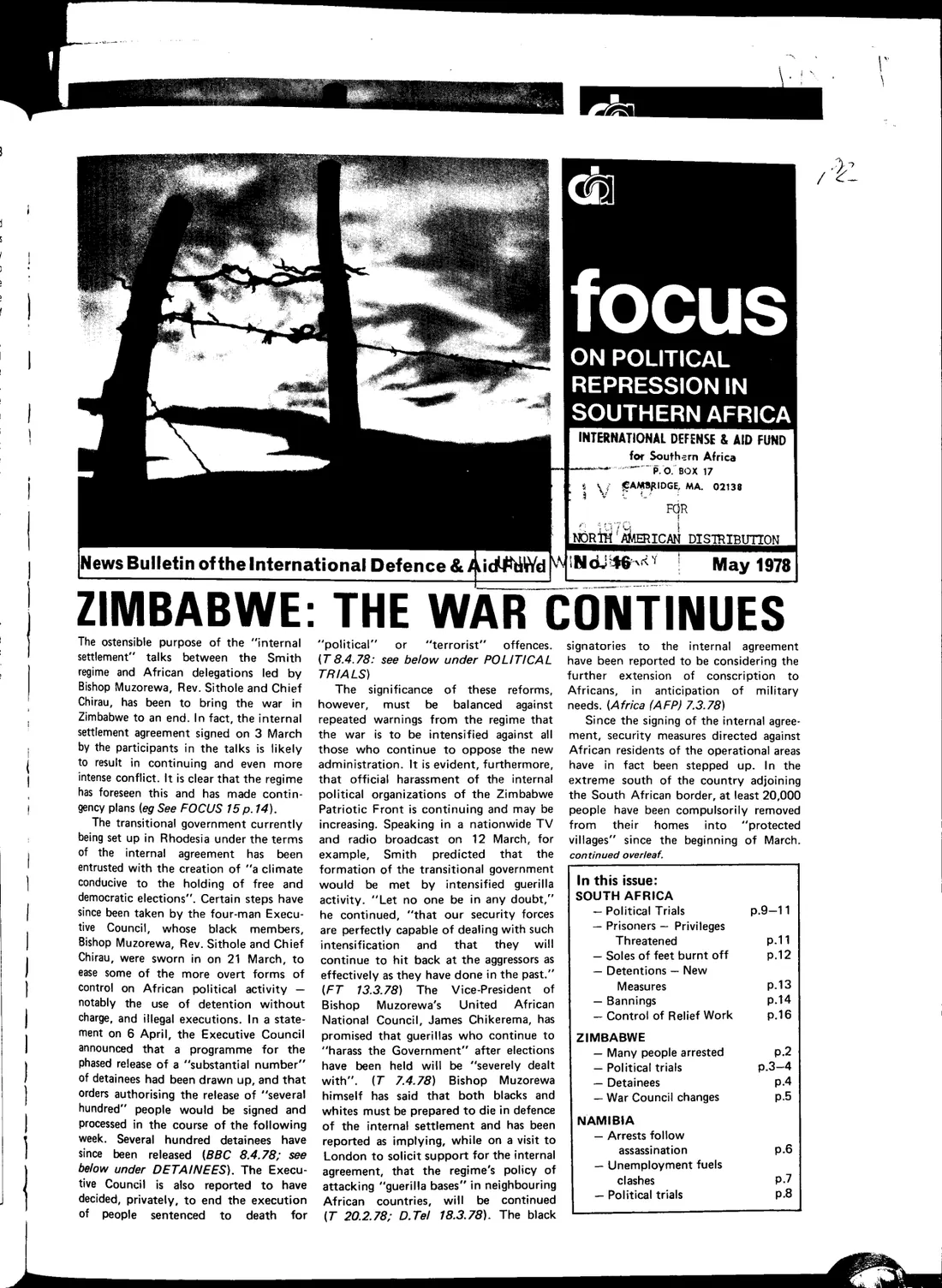
The ostensible purpose of the "internal settlement" talks between the Smith regime and African delegations led by Bishop Muzorewa, Rev. Sithole and Chief Chirau, has been to bring the war in Zimbabwe to an end. In fact, the internal settlement agreement signed on 3 March by the participants in the talks is likely to result in continuing and even more intense conflict. It is clear that the regime has foreseen this and has made contingency plans.
The transitional government currently being set up in Rhodesia under the terms of the internal agreement has been entrusted with the creation of "a climate conducive to the holding of free and democratic elections". Certain steps have since been taken by the four-man Executive Council, whose black members, Bishop Muzorewa, Rev. Sithole and Chief Chirau, were sworn in on 21 March, to ease some of the more overt forms of control on African political activity – notably the use of detention without charge, and illegal executions. In a statement on 6 April, the Executive Council announced that a programme for the phased release of a "substantial number" of detainees had been drawn up, and that orders authorising the release of "several hundred" people would be signed and processed in the course of the following week. Several hundred detainees have since been released. The Executive Council is also reported to have decided, privately, to end the execution of people sentenced to death for "political" or "terrorist" offences.
The significance of these reforms, however, must be balanced against repeated warnings from the regime that the war is to be intensified against all those who continue to oppose the new administration. It is evident, furthermore, that official harassment of the internal political organizations of the Zimbabwe Patriotic Front is continuing and may be increasing. Speaking in a nationwide TV and radio broadcast on 12 March, for example, Smith predicted that the formation of the transitional government would be met by intensified guerilla activity. "Let no one be in any doubt," he continued, "that our security forces are perfectly capable of dealing with such intensification and that they will continue to hit back at the aggressors as effectively as they have done in the past." The Vice-President of Bishop Muzorewa's United African National Council, James Chikerema, has promised that guerillas who continue to "harass the Government" after elections have been held will be "severely dealt with". Bishop Muzorewa himself has said that both blacks and whites must be prepared to die in defence of the internal settlement and has been reported as implying, while on a visit to London to solicit support for the internal agreement, that the regime's policy of attacking "guerilla bases" in neighbouring African countries, will be continued. The black signatories to the internal agreement have been reported to be considering the further extension of conscription to Africans, in anticipation of military needs.
Since the signing of the internal agreement, security measures directed against African residents of the operational areas have in fact been stepped up. In the extreme south of the country adjoining the South African border, at least 20,000 people have been compulsorily removed from their homes into "protected villages" since the beginning of March.