KASSINGA MASSACRE SA TROOP BUILD-UP CONTINUES
Over 700 Namibians were killed, and 1500 wounded, during South African attacks on Kassinga refugee camp and other targets in Southern Angola on 4 May. The raids, which constitute the most serious violation of the northern Namibian border since South African troops were defeated inside Angola in March 1976, have been followed by warnings from Pretoria that such operations can and will be repeated. There is evidence, furthermore, that the Kassinga operations were preceded by a substantial build up of South African troops in Ovamboland, which has since continued and been extended into the Caprivi region to the east.
Accounts from Angolan government sources and visiting journalists, as well as from SWAPO, point to the fact that the South African authorities must have been well aware of the nature and purpose of Kassinga camp in advance of the raid. A Swedish journalist, Per Sanden, for example, who visited Kassinga at the end of March 1978 at SWAPO's invitation, confirmed that the camp housed between 5 and 6,000 Namibian refugees in old mine buildings and tents and was equipped with a clinic, a sewing factory and facilities for repairing trucks and other vehicles. A small number of SWAPO troops were maintained there for defensive purposes, particularly to prevent attacks from guerillas of the Angolan rebel movement, UNITA, but there were no military installations as such. Sanden also reported that unidentified planes, both jets and slow-moving aircraft, had flown over the camp daily at low altitudes. (Press Conference by Sanden in London 10.5.78; DD 10.5.78)
The South African Air Force is known to have sent regular reconnaissance flights into southern Angola since March 1976. In recent months, SAAF planes are reported to have made supply runs to UNITA troops in the south eastern provinces, taking in food, weapons and ammunition for UNITA's guerilla operations against both SWAPO and the Angolan army. (GN 6.5.78)
The 4 May operations were mounted as a joint exercise by the South African Army and Air Force, and involved a two-pronged series of attacks. To reach Kassinga, 250 km. inside Angola, troops were flown across the border from Grootfontein air base in northern Namibia, possibly halting at Ruacana over the night of 3 May. According to the accounts of survivors from among the refugees, bombing from fighter jets began at 6 am on Thursday 4 May, while children were assembling for a morning meeting. At 7 am paratroopers began to be dropped into the fields surrounding the camp. Further troop reinforcements were later landed at an airstrip which had served mining installations at Kassinga in colonial days. Brigadier Hannes Botha, SADF Director of Operations, who led the raid, afterwards said that his troops had met "much more resistance than we expected". The fact that the camp had contained women and children had posed the South Africans with a "problem". "Many of our troops said afterwards that it was hell to have to shoot at women. This is one of the psychological tricks being employed by SWAPO", another Defence Force spokesman remarked. (ST 7.5.78)
Later in the day, Angolan army units attempting to relieve Kassinga were strafed from the air and delayed by landmines planted around the camp. The jets continued bombing until 6 pm, long after South African paratroops had withdrawn and Angolan army units had occupied the area. According to a statement from the Angolan Defence Minister, a total of 16 Angolan soldiers were killed and 74 wounded. (BBC 8.5.78)
The raid on Kassinga was an air-borne operation - according to the official Angolan news agency ANGOP the South Africans employed 12 F1-11 fighters; four Hercules transport planes and five helicopters (probably Pumas). (MS 12.5.78; BBC 13.5.78). Meanwhile, in the second stage of the South African attacks, ground troops crossed the northern Namibian border through Ombalantu and Ruacana in the eastern part of Ovamboland. A three-pronged attack, backed by 60 tanks, struck at Chetequela, Cuamato and Dombondola in the Cunene province of Angola. Namibian refugees at Chetequela were attacked and 100 people killed. (BBC 8.5.78; reporting press statement issued by the Angolan Minister of Defence).
Two Finnish journalists who were in Ovamboland during the first few days of May have reported that on Thursday 4 May the Ombalantu area was full of military traffic, both airborne and on the roads. A Finnish missionary stationed in the region told the journalists that "the day was like in the war. The troops were concentrated up to the border on Wednesday evening (3 May). Early on Thursday morning they bombed over the border on to refugee camps located just within 30 kilometres from the border. Later in the morning motor battalions followed and started more systematically killing those people in the refugee camps who had just left Namibia. The main purpose was to murder." (Report of a visit to Namibia, 15 April - 15 May 1978, by Marja-Lisa and Kimmo Kiljunen).
SWAPO's Department of Information stated that on 7 May, South African troops were believed to be still occupying the Southern Angolan town of N'give (formerly Pereira de Eca), 40 km inside the border. (MS 8.5.78)
(The South Africans themselves confirmed that their raids were launched on two series of targets, one 50 km inside the border and accommodating a SWAPO guerilla force which had been making regular border crossings - the "Vietnam" base - and the other described as the main SWAPO headquarters for the whole of Angola - i.e. Kassinga, code-named "Moscow" base in South African reports. (RDM 6.5.78)
In addition to the refugees who were killed, many prisoners were taken, both Angolans and Namibians. Most of these were detained by the ground troops involved in the second stage of the raids - South African officials stated that relatively few prisoners were brought back from Kassinga due to shortage of space on the transport planes. (ST 7.5.78). The South African press reported that 63 people - 34 men and 29 women - described as "half-trained terrorists and terrorist accomplices" from the "Vietnam" base, who had originally been "lured across the border under false pretences "or taken by force, were released by the SADF on 27 May into the "care" of the Chief Minister of Ovamboland. This left "more than two thirds" of the prisoners captured on 4 May still in custody, according to South African sources. Five Angolans, "Ombodje tribesmen mistakenly hauled in by the massive SA military dragnet", were due to be returned across the border in the course of the next few days. (RDM 29.5.78; WA/BBC 30.5.78). On 21 June, SWAPO stated that it had received information that eight Namibian victims of the Kassinga massacre were being held secretly at a Windhoek hospital. (SWAPO Press Release 21.6.78)
THE CASUALTIES
- Journalists who visited Kassinga after the raid reported seeing a mass grave containing 460 bodies, including many women and children. 122 bodies were buried in a separate trench. Other refugees were believed to have fled into the bush and been killed there. Many of those who died had gunshot head wounds and are believed to have been shot at close range after SA troops tossed tear gas grenades into the buildings to drive out people sheltering inside. (T/GN 10.5.78; GN/BBC 13.5.78)
- Those killed at Kassinga included Ms. Kanuunuu Frans, the adopted daughter of Bishop Leonard Auala of the Evangelical Lutheran Ovambokavango Church; Josia Dumeni, oldest son of Rev. Kleopas Dumeni, Bishop Auala's assistant; the son of Rev. Efraim Angula; and the daughters of Rev. Filippus Limene and Rev. Juuso Shikongo, (all Lutheran pastors). Many other members of the Ovambokavango Church are believed to have died. (Lutheran World Federation Information 23/78, 12.6.78)
The past six months have seen a renewed exodus of Namibian refugees from Ovamboland into Angola. An estimated 20,000 Namibians are now in exile. (FT 6.5.78)
ELECTION PLANS MOVE AHEAD
The SWA Administrator General, Justice Steyn, announced on 20 June that registration of voters in Namibia would take place from 26 June to 22 September 1978. Potential voters must be at least 18 years of age and have been born in Namibia or lived there for at least four years. He described this move as "an essentially neutral step of an administrative nature", and a "necessary preparation" for the free general elections envisaged for Namibia under the terms of the Western settlement proposals. In fact, Justice Steyn said, the decision to begin registering voters should be seen as evidence of the South African government's continuing commitment to the Western proposals, which were formally accepted by Mr Vorster on 24 April. (FT 16/21.6.78; BBC 17.6.78)
Spokesmen for the Western members of the UN Security Council, together with the UN Secretary General, have nevertheless expressed great concern at the move and have described it as "provocative" and "extremely prejudicial" to the settlement negotiations involving both SWAPO and South Africa. (WA 19.6.78; T/FT 21.6.78). The South African authorities have not only acted unilaterally in pressing ahead with election plans before any final agreement on Namibia's independence has been reached and without involving the UN in any way, but it is clear that inside Namibia the process of registration will be anything but "neutral". It is, in the first place, being undertaken in the north in conditions of, to all intents and purposes, martial law. The Officer Commanding SWA Command of the Defence Force, Major-General J. Geldenhuys, has stated that registration will "once more place a heavy burden on the Defence Force, for it (will) have to ensure security in the Operational Area to make registration possible". (WA 19.6.78) (see also KASSINGA MASSACRE).
Registration, further, is taking place according to South African-devised rules. It has been reported, for example, that a birth certificate and/or baptismal certificate is required to qualify for registration. (WA 19.6.78). If this report is true, it would appear that many black Namibians, who possess neither, may be disenfranchised.
According to SWAPO, registration of a highly unorthodox kind had already got under way before Justice Steyn's announcement. Speaking in Lusaka on 25 April, SWAPO's vice-president Mr Mishek Muyongo revealed that "very authoritative information" had been received that between 7,000 and 10,000 Angolan refugees settled in northern Namibia were being forced to register as voters by South African administrative officials. Some of these refugees, he said, were supporters of UNITA, the rebel Angolan guerilla group. (UNITA is believed to have been receiving military training and other forms of assistance from the South African Defence Force for its operations in southern Angola against both SWAPO and the Angolan government.) (RDM 26.4.78)
According to the Chief Registration Officer, Mr L.V. Kock, the registration exercise will employ about 400 civil servants of all races, and 400 government vehicles. Registration points are being set up in magistrate's offices, shopping centres and government and municipal buildings. The South African authorities have stated that about 444,000 voters are to be registered over the three months period. (WA 21.6.78)
In addition to the role of the Defence Force in ensuring that registration proceeds smoothly, penalties of £2,000 in fines and/or 3 years imprisonment have been introduced by the Administrator General for anyone convicted of advising or encouraging another person(s) not to register. (ST Lon 2.7.78)
NEW SECURITY MEASURES
New controls on freedom of movement in Ovamboland were introduced by the SWA Administrator General on 13 June. Under Proclamation AG34 (Security Districts Amendment), it is forbidden to drive or travel in a vehicle or to pick up passengers during the night without the written consent of a Peace Officer or an officer of the Security Forces. AG34 which amends the Security Districts Proclamation AG9 of 1977 (see FOCUS 14 p.2), also empowers the Administrator General to issue an order prohibiting anyone anywhere in a Security District (i.e. Ovamboland, Kavango and Eastern Caprivi) from driving or travelling in a vehicle at night.
According to the office of the Administrator General, the new measures are intended to curb the movement of guerillas and to safeguard "the general peace of the territory with a view to the forthcoming elections". (WA 14.6.78; BBC 15.6.78). In effect, they represent a return to the state of emergency imposed on northern Namibia during the contract workers' strike of 1971-2, and partially relaxed by Justice Steyn in November 1977.
Further to these measures, the Administrator General has announced that individual political leaders and politicians in Namibia will be afforded personal state protection where necessary. (BBC 30.6.78)
TROOP BUILD-UP
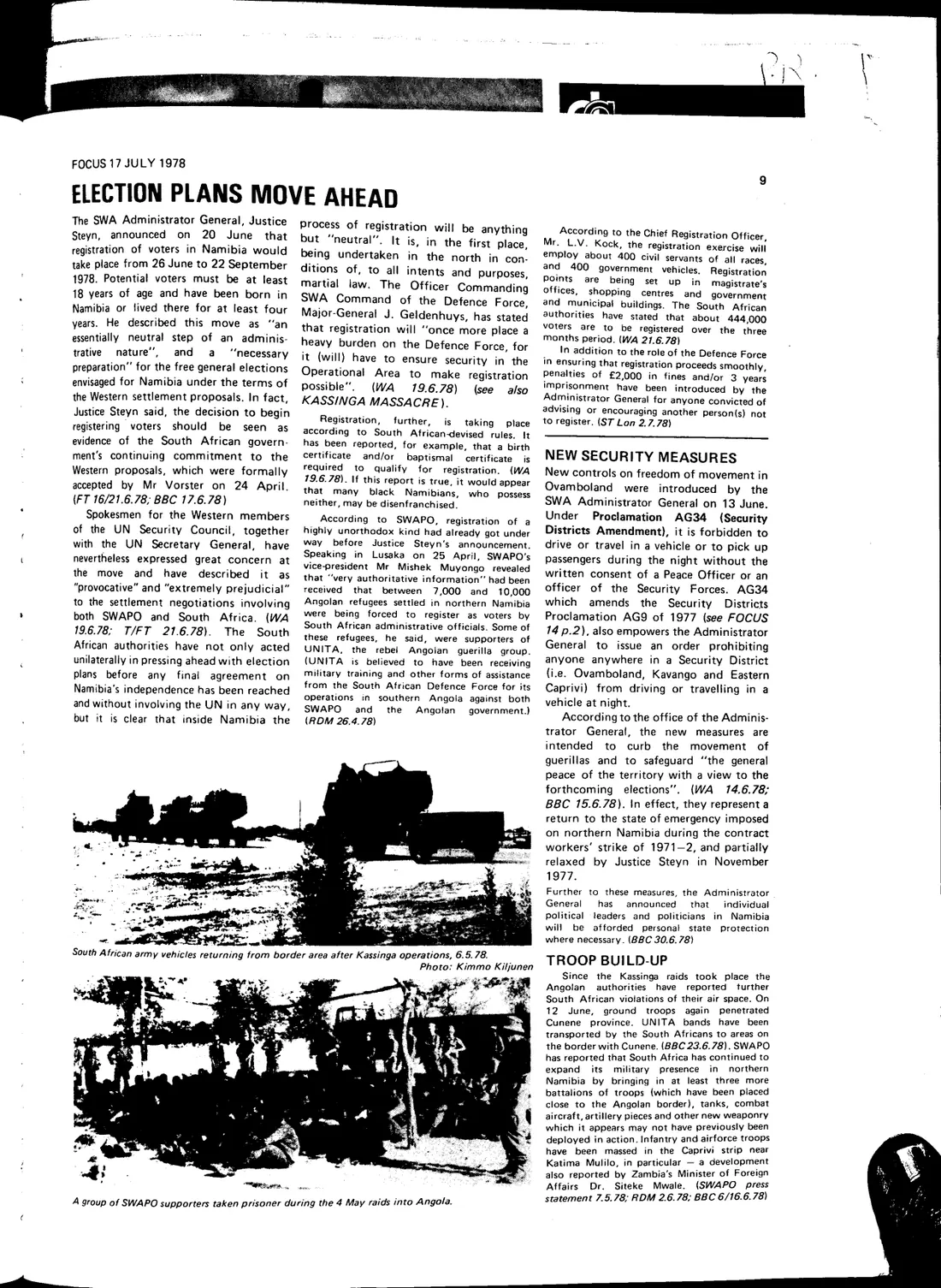
Since the Kassinga raids took place the Angolan authorities have reported further South African violations of their air space. On 12 June, ground troops again penetrated Cunene province. UNITA bands have been transported by the South Africans to areas on the border with Cunene. (BBC 23.6.78). SWAPO has reported that South Africa has continued to expand its military presence in northern Namibia by bringing in at least three more battalions of troops (which have been placed close to the Angolan border), tanks, combat aircraft, artillery pieces and other new weaponry which it appears may not have previously been deployed in action. Infantry and airforce troops have been massed in the Caprivi strip near Katima Mulilo, in particular - a development also reported by Zambia's Minister of Foreign Affairs Dr. Siteke Mwale. (SWAPO press statement 7.5.78; RDM 2.6.78; BBC 6/16.6.78)