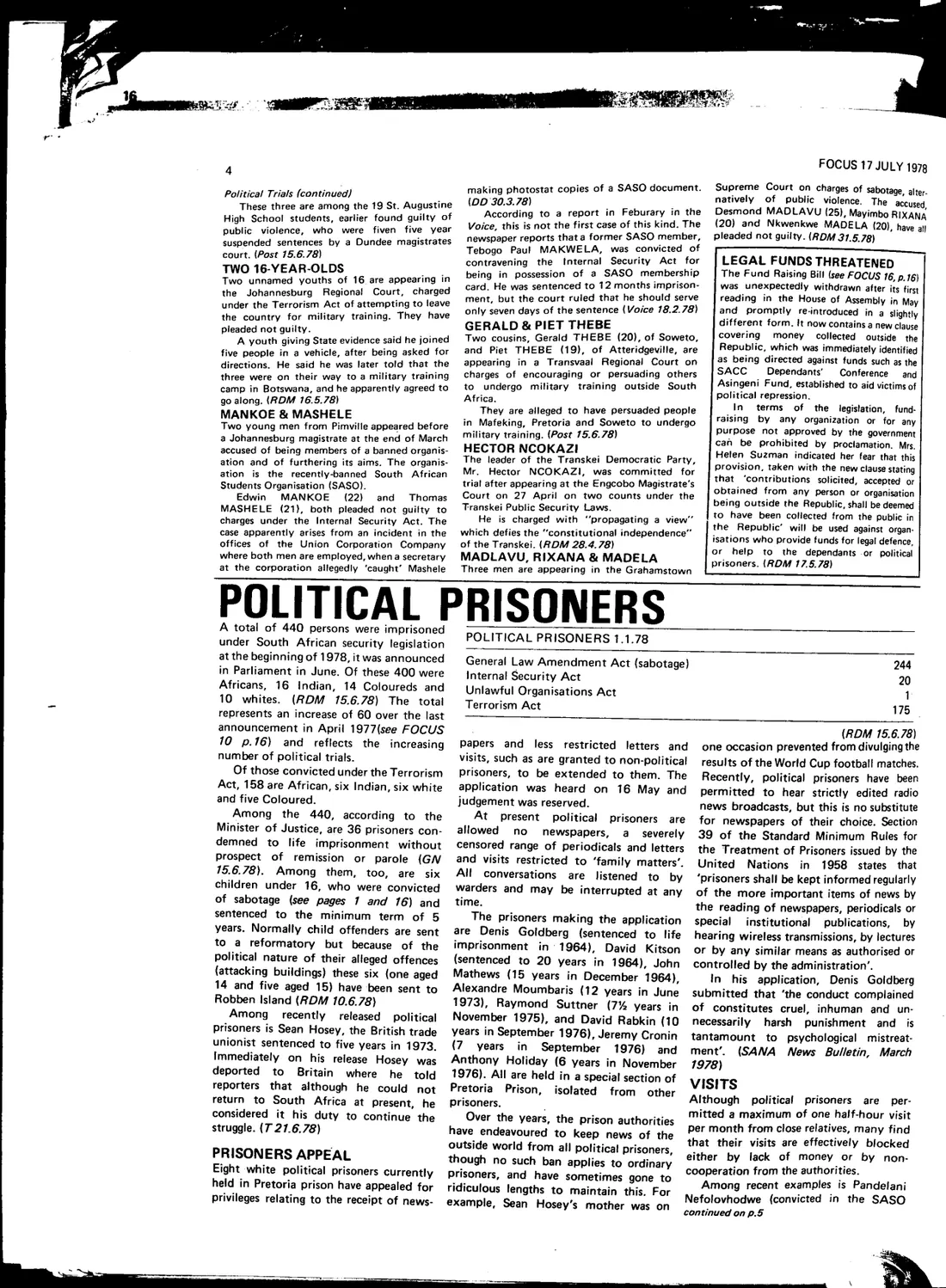
A total of 440 persons were imprisoned under South African security legislation at the beginning of 1978, it was announced in Parliament in June. Of these 400 were Africans, 16 Indian, 14 Coloureds and 10 whites. (RDM 15.6.78) The total represents an increase of 60 over the last announcement in April 1977(see FOCUS 10 p.16) and reflects the increasing number of political trials.
Of those convicted under the Terrorism Act, 158 are African, six Indian, six white and five Coloured.
Among the 440, according to the Minister of Justice, are 36 prisoners condemned to life imprisonment without prospect of remission or parole (GN 15.6.78). Among them, too, are six children under 16, who were convicted of sabotage (see pages 1 and 16) and sentenced to the minimum term of 5 years. Normally child offenders are sent to a reformatory but because of the political nature of their alleged offences (attacking buildings) these six (one aged 14 and five aged 15) have been sent to Robben Island (RDM 10.6.78)
Among recently released political prisoners is Sean Hosey, the British trade unionist sentenced to five years in 1973. Immediately on his release Hosey was deported to Britain where he told reporters that although he could not return to South Africa at present, he considered it his duty to continue the struggle. (T 21.6.78)
PRISONERS APPEAL
Eight white political prisoners currently held in Pretoria prison have appealed for privileges relating to the receipt of news- papers and less restricted letters and visits, such as are granted to non-political prisoners, to be extended to them. The application was heard on 16 May and judgement was reserved.
At present political prisoners are allowed no newspapers, a severely censored range of periodicals and letters and visits restricted to 'family matters'. All conversations are listened to by warders and may be interrupted at any time.
The prisoners making the application are Denis Goldberg (sentenced to life imprisonment in 1964), David Kitson (sentenced to 20 years in 1964), John Mathews (15 years in December 1964), Alexandre Moubaris (12 years in June 1973), Raymond Suttner (7½ years in November 1975), and David Rabkin (10 years in September 1976), Jeremy Cronin (7 years in September 1976) and Anthony Holiday (6 years in November 1976). All are held in a special section of Pretoria Prison, isolated from other prisoners.
Over the years, the prison authorities have endeavoured to keep news of the outside world from all political prisoners, though no such ban applies to ordinary prisoners, and have sometimes gone to ridiculous lengths to maintain this. For example, Sean Hosey's mother was on one occasion prevented from divulging the results of the World Cup football matches. Recently, political prisoners have been permitted to hear strictly edited radio news broadcasts, but this is no substitute for newspapers of their choice. Section 39 of the Standard Minimum Rules for the Treatment of Prisoners issued by the United Nations in 1958 states that 'prisoners shall be kept informed regularly of the more important items of news by the reading of newspapers, periodicals or special institutional publications, by hearing wireless transmissions, by lectures or by any similar means as authorised or controlled by the administration'.
In his application, Denis Goldberg submitted that 'the conduct complained of constitutes cruel, inhuman and unnecessarily harsh punishment and is tantamount to psychological mistreatment'. (SANA News Bulletin, March 1978)
VISITS
Although political prisoners are permitted a maximum of one half-hour visit per month from close relatives, many find that their visits are effectively blocked either by lack of money or by non-cooperation from the authorities.
Among recent examples is Pandelani Nefolovhodwe (convicted in the SASO trial in 1976), whose elderly parents cannot afford to travel to Robben Island from their home in the Northern Transvaal. (Voice 6.5.78) Another is Denis Goldberg, whose wife told a London press conference that her applications for a visa to visit South Africa are regularly refused, although her children are allowed to go. (MS 19.5.78)
In protest against the authorities' refusal to grant his wife a visa to visit him, Alex Moumbaris went on hunger strike from 27 February to 10 March, without effect. (Citizen 29.5.78)
BEDS FOR ALL
The Prisons Department has decided in principle to remove racial discrimination in the treatment of prisoners, according to the 1976-7 Annual Report. Investigations are being conducted 'in order to compile a uniform diet scale for all prisoners and eventually to provide all prisoners with beds' (At present black prisoners sleep on floor mats). This will however not be immediately implemented.
A new prison farm being built in the Kirkwood district is one of 20 prison farms listed in the Report where agricultural production is carried out by inmates. In addition, 'prison labour supplied to government departments' brings in an annual revenue of R8 million to the Prisons Dept. (Report of the Commissioner of Prisons 1976-7).
POQO PRISONERS FREED
It was announced in June that 27 members of Poqo who were imprisoned in the early 1960s for plotting to assassinate Chief Matanzima were released from Robben Island after serving 15 year sentences. All were held in Butterworth and then transported to locations in western Tembuland, Transkei. (CT 12.6.78)
NELSON MANDELA AT 60
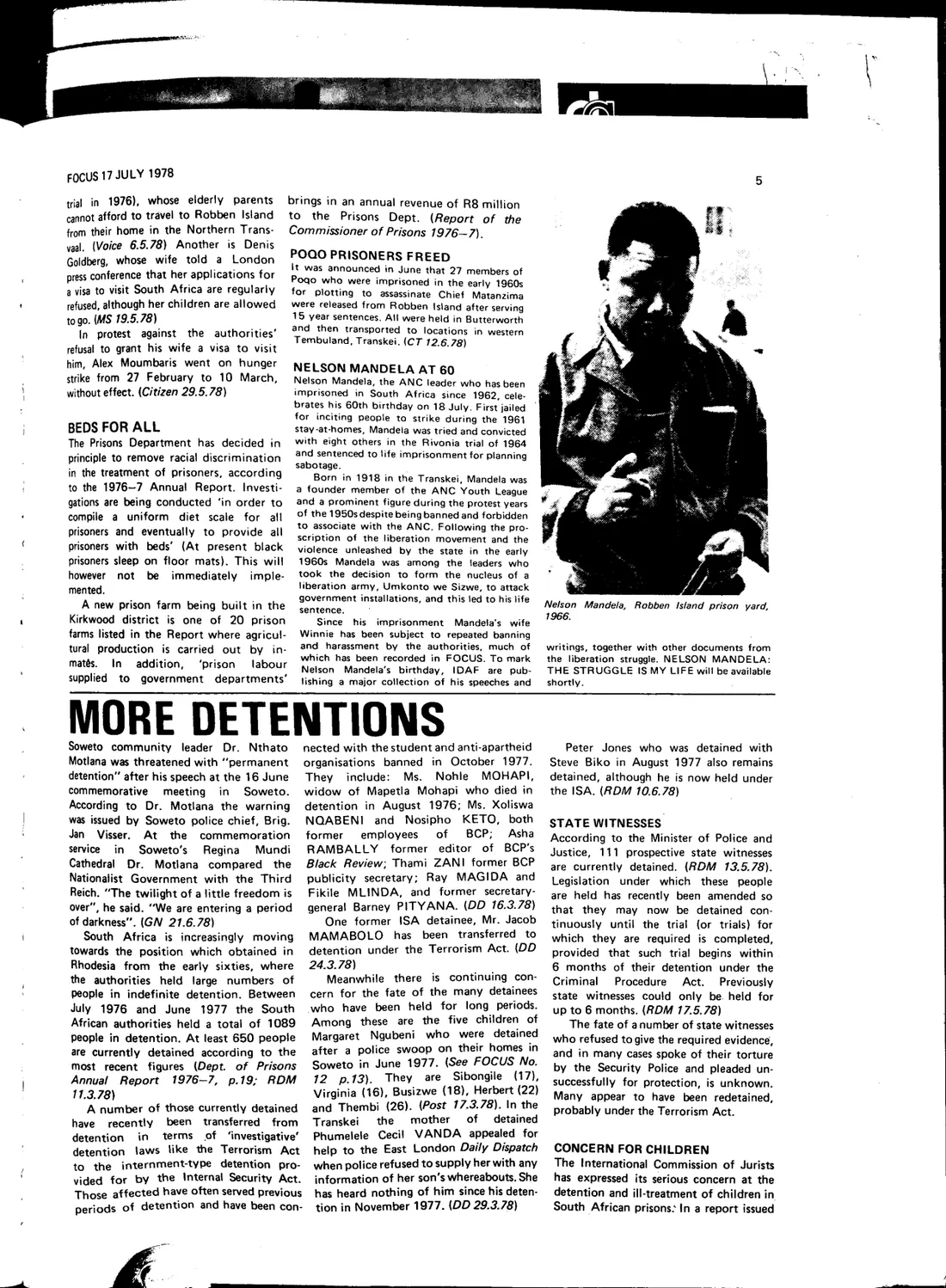
Nelson Mandela, the ANC leader who has been imprisoned in South Africa since 1962, celebrates his 60th birthday on 18 July. First jailed for inciting people to strike during the 1961 stay-at-homes, Mandela was tried and convicted with eight others in the Rivonia trial of 1964 and sentenced to life imprisonment for planning sabotage.
Born in 1918 in the Transkei, Mandela was a founder member of the ANC Youth League and a prominent figure during the protest years of the 1950s despite being banned and forbidden to associate with the ANC. Following the pro-scription of the liberation movement and the violence unleashed by the state in the early 1960s Mandela was among the leaders who took the decision to form the nucleus of a liberation army, Umkonto we Sizwe, to attack government installations, and this led to his life sentence.
Since his imprisonment Mandela's wife Winnie has been subject to repeated banning and harassment by the authorities, much of which has been recorded in FOCUS. To mark Nelson Mandela's birthday, IDAF are publishing a major collection of his speeches and writings, together with other documents from the liberation struggle. NELSON MANDELA: THE STRUGGLE IS MY LIFE will be available shortly.