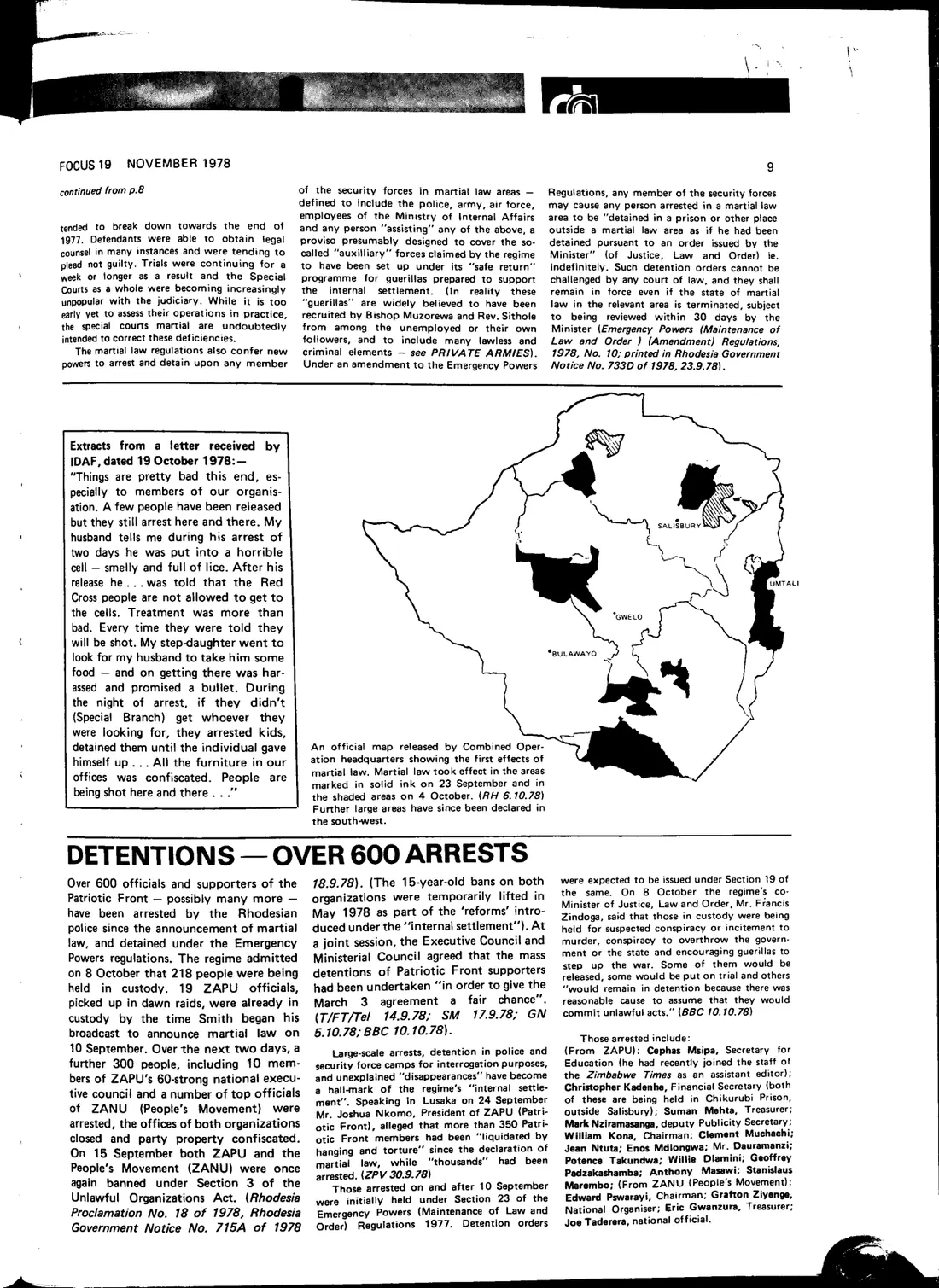
The martial law regulations also confer new powers to arrest and detain upon any member of the security forces in martial law areas — defined to include the police, army, air force, employees of the Ministry of Internal Affairs and any person "assisting" any of the above, a proviso presumably designed to cover the so-called "auxilliary" forces claimed by the regime to have been set up under its "safe return" programme for guerillas prepared to support the internal settlement. Under an amendment to the Emergency Powers Regulations, any member of the security forces may cause any person arrested in a martial law area to be "detained in a prison or other place outside a martial law area as if he had been detained pursuant to an order issued by the Minister" (of Justice, Law and Order) ie. indefinitely. Such detention orders cannot be challenged by any court of law, and they shall remain in force even if the state of martial law in the relevant area is terminated, subject to being reviewed within 30 days by the Minister.
DETENTIONS — OVER 600 ARRESTS Over 600 officials and supporters of the Patriotic Front — possibly many more — have been arrested by the Rhodesian police since the announcement of martial law, and detained under the Emergency Powers regulations. The regime admitted on 8 October that 218 people were being held in custody. 19 ZAPU officials, picked up in dawn raids, were already in custody by the time Smith began his broadcast to announce martial law on 10 September. Over the next two days, a further 300 people, including 10 members of ZAPU's 60-strong national executive council and a number of top officials of ZANU (People's Movement) were arrested, the offices of both organizations closed and party property confiscated. On 15 September both ZAPU and the People's Movement (ZANU) were once again banned under Section 3 of the Unlawful Organizations Act. (The 15-year-old bans on both organizations were temporarily lifted in May 1978 as part of the 'reforms' introduced under the "internal settlement"). At a joint session, the Executive Council and Ministerial Council agreed that the mass detentions of Patriotic Front supporters had been undertaken "in order to give the March 3 agreement a fair chance".
Large-scale arrests, detention in police and security force camps for interrogation purposes, and unexplained "disappearances" have become a hall-mark of the regime's "internal settlement". Speaking in Lusaka on 24 September Mr. Joshua Nkomo, President of ZAPU (Patriotic Front), alleged that more than 350 Patriotic Front members had been "liquidated by hanging and torture" since the declaration of martial law, while "thousands" had been arrested.
Those arrested on and after 10 September were initially held under Section 23 of the Emergency Powers (Maintenance of Law and Order) Regulations 1977. Detention orders were expected to be issued under Section 19 of the same. On 8 October the regime's co-Minister of Justice, Law and Order, Mr. Francis Zindoga, said that those in custody were being held for suspected conspiracy or incitement to murder, conspiracy to overthrow the government or the state and encouraging guerillas to step up the war. Some of them would be released, some would be put on trial and others "would remain in detention because there was reasonable cause to assume that they would commit unlawful acts."
Those arrested include: (From ZAPU): Cephas Msipa, Secretary for Education; Christopher Kadenhe, Financial Secretary; Suman Mehta, Treasurer; Mark Nziramasanga, deputy Publicity Secretary; William Kona, Chairman; Clement Muchachi; Jean Ntuta; Enos Mdlongwa; Mr. Dauramanzi; Potence Takundwa; Willie Dlamini; Geoffrey Padzakashamba; Anthony Masawi; Stanislaus Marembo; (From ZANU (People's Movement): Edward Pswarayi, Chairman; Grafton Ziyenge, National Organiser; Eric Gwanzura, Treasurer; Joe Taderera, national official.