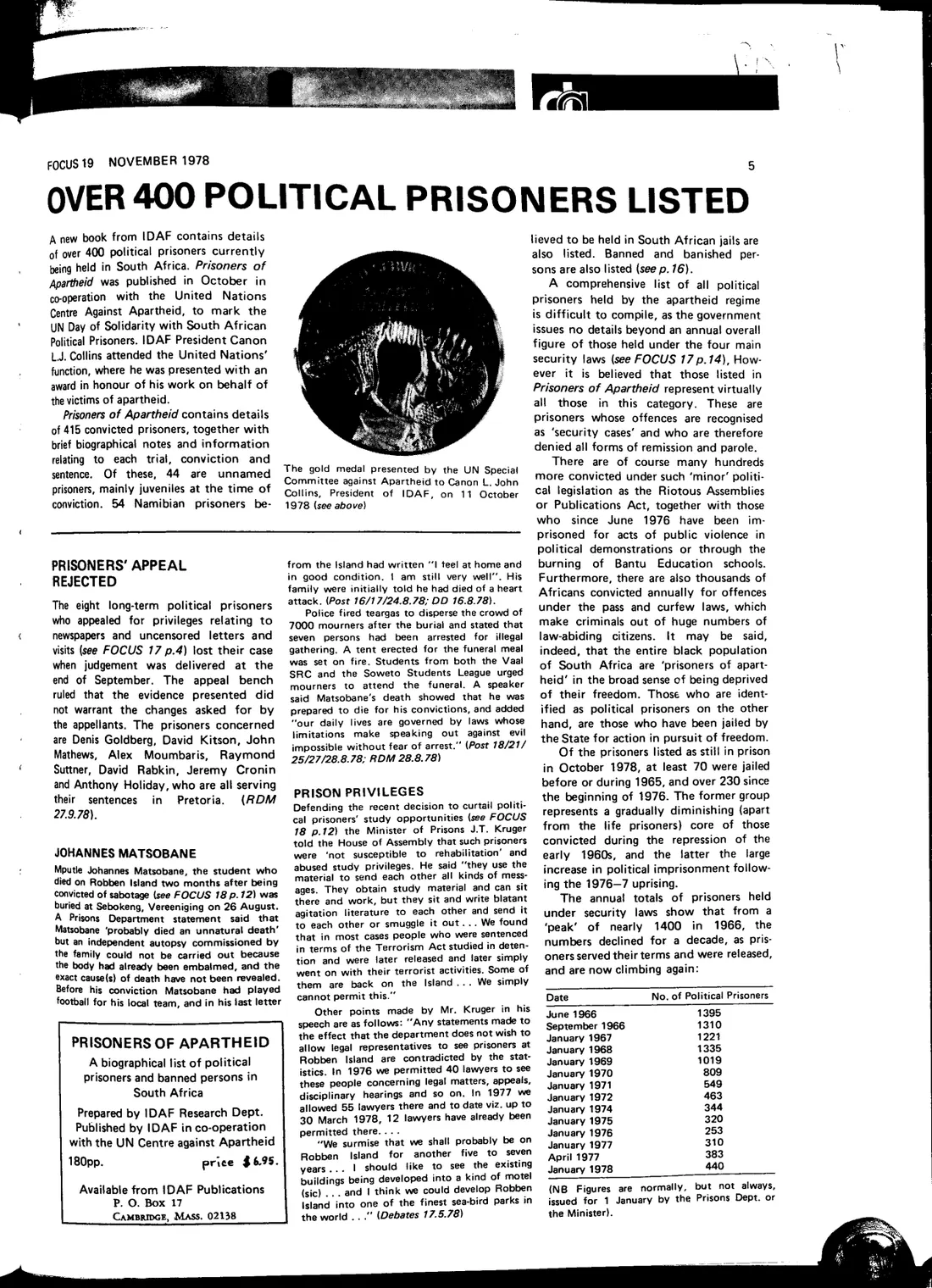
A new book from IDAF contains details of over 400 political prisoners currently being held in South Africa. Prisoners of Apartheid was published in October in co-operation with the United Nations Centre Against Apartheid, to mark the UN Day of Solidarity with South African Political Prisoners. IDAF President Canon L.J. Collins attended the United Nations' function, where he was presented with an award in honour of his work on behalf of the victims of apartheid.
Prisoners of Apartheid contains details of 415 convicted prisoners, together with brief biographical notes and information relating to each trial, conviction and sentence. Of these, 44 are unnamed prisoners, mainly juveniles at the time of conviction. 54 Namibian prisoners believed to be held in South African jails are also listed. Banned and banished persons are also listed.
A comprehensive list of all political prisoners held by the apartheid regime is difficult to compile, as the government issues no details beyond an annual overall figure of those held under the four main security laws, However it is believed that those listed in Prisoners of Apartheid represent virtually all those in this category. These are prisoners whose offences are recognised as 'security cases' and who are therefore denied all forms of remission and parole.
There are of course many hundreds more convicted under such 'minor' political legislation as the Riotous Assemblies or Publications Act, together with those who since June 1976 have been imprisoned for acts of public violence in political demonstrations or through the burning of Bantu Education schools. Furthermore, there are also thousands of Africans convicted annually for offences under the pass and curfew laws, which make criminals out of huge numbers of law-abiding citizens. It may be said, indeed, that the entire black population of South Africa are 'prisoners of apartheid' in the broad sense of being deprived of their freedom. Those who are identified as political prisoners on the other hand, are those who have been jailed by the State for action in pursuit of freedom.
Of the prisoners listed as still in prison in October 1978, at least 70 were jailed before or during 1965, and over 230 since the beginning of 1976. The former group represents a gradually diminishing (apart from the life prisoners) core of those convicted during the repression of the early 1960s, and the latter the large increase in political imprisonment following the 1976-7 uprising.
The annual totals of prisoners held under security laws show that from a 'peak' of nearly 1400 in 1966, the numbers declined for a decade, as prisoners served their terms and were released, and are now climbing again:
[Table of Political Prisoners omitted]
PRISONERS' APPEAL REJECTED The eight long-term political prisoners who appealed for privileges relating to newspapers and uncensored letters and visits lost their case when judgement was delivered at the end of September. The appeal bench ruled that the evidence presented did not warrant the changes asked for by the appellants. The prisoners concerned are Denis Goldberg, David Kitson, John Mathews, Alex Moumbaris, Raymond Suttner, David Rabkin, Jeremy Cronin and Anthony Holiday, who are all serving their sentences in Pretoria.
JOHANNES MATSOBANE Mputle Johannes Matsobane, the student who died on Robben Island two months after being convicted of sabotage was buried at Sebokeng, Vereeniging on 26 August. A Prisons Department statement said that Matsobane 'probably died an unnatural death' but an independent autopsy commissioned by the family could not be carried out because the body had already been embalmed, and the exact cause(s) of death have not been revealed. Before his conviction Matsobane had played football for his local team, and in his last letter from the Island had written "I feel at home and in good condition. I am still very well". His family were initially told he had died of a heart attack.
Police fired teargas to disperse the crowd of 7000 mourners after the burial and stated that seven persons had been arrested for illegal gathering. A tent erected for the funeral meal was set on fire. Students from both the Vaal SRC and the Soweto Students League urged mourners to attend the funeral. A speaker said Matsobane's death showed that he was prepared to die for his convictions, and added "our daily lives are governed by laws whose limitations make speaking out against evil impossible without fear of arrest."
PRISON PRIVILEGES Defending the recent decision to curtail political prisoners' study opportunities the Minister of Prisons J.T. Kruger told the House of Assembly that such prisoners were 'not susceptible to rehabilitation' and abused study privileges. He said "they use the material to send each other all kinds of messages. They obtain study material and can sit there and work, but they sit and write blatant agitation literature to each other and send it to each other or smuggle it out... We found that in most cases people who were sentenced in terms of the Terrorism Act studied in detention and were later released and later simply went on with their terrorist activities. Some of them are back on the Island... We simply cannot permit this."
Other points made by Mr. Kruger in his speech are as follows: "Any statements made to the effect that the department does not wish to allow legal representatives to see prisoners at Robben Island are contradicted by the statistics. In 1976 we permitted 40 lawyers to see these people concerning legal matters, appeals, disciplinary hearings and so on. In 1977 we allowed 55 lawyers there and to date viz. up to 30 March 1978, 12 lawyers have already been permitted there....
"We surmise that we shall probably be on Robben Island for another five to seven years... I should like to see the existing buildings being developed into a kind of motel (sic)... and I think we could develop Robben Island into one of the finest sea-bird parks in the world..."