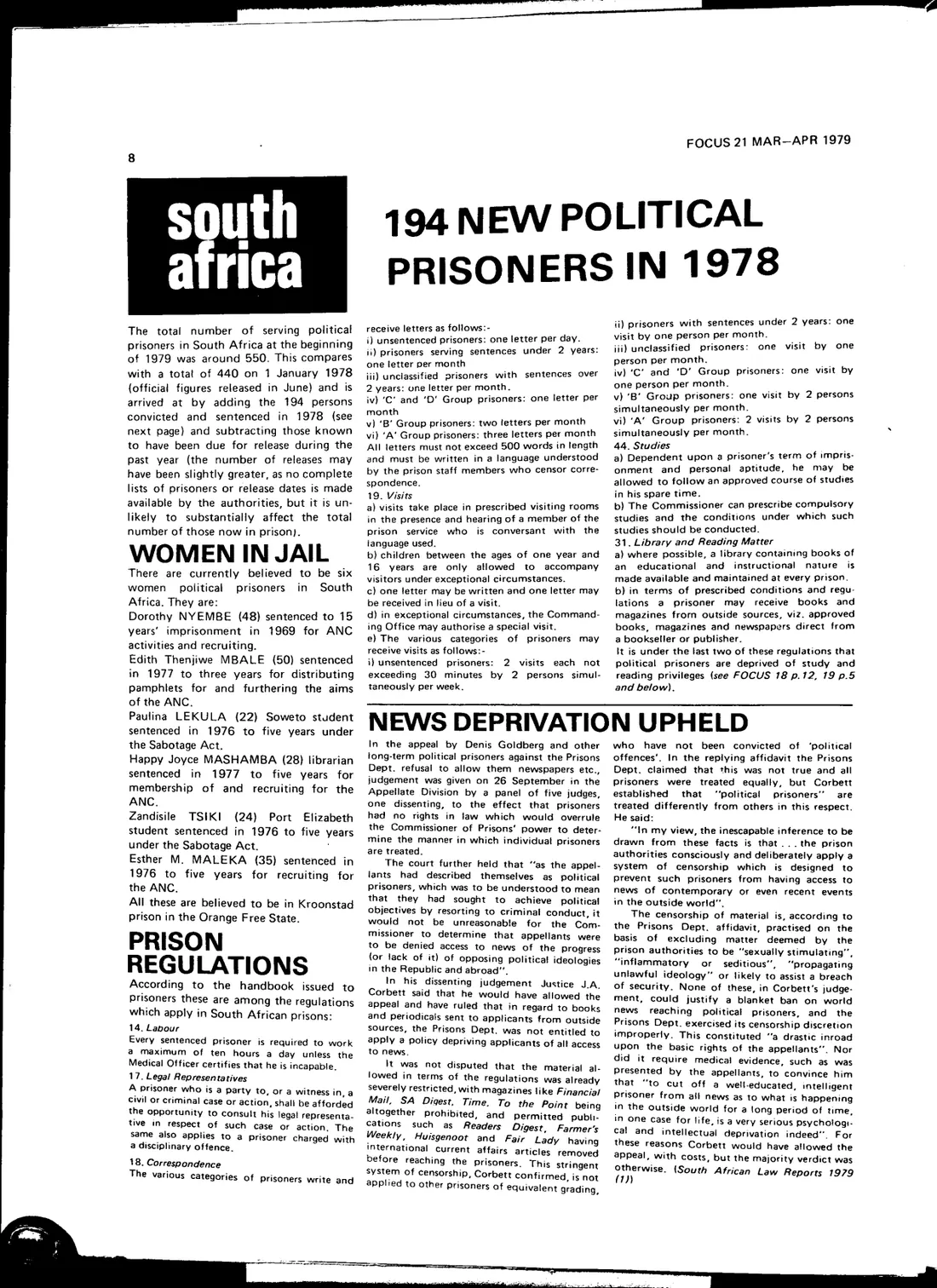
In the appeal by Denis Goldberg and other long-term political prisoners against the Prisons Dept. refusal to allow them newspapers etc., judgement was given on 26 September in the Appellate Division by a panel of five judges, one dissenting, to the effect that prisoners had no rights in law which would overrule the Commissioner of Prisons' power to determine the manner in which individual prisoners are treated.
The court further held that "as the appellants had described themselves as political prisoners, which was to be understood to mean that they had sought to achieve political objectives by resorting to criminal conduct, it would not be unreasonable for the Commissioner to determine that appellants were to be denied access to news of the progress (or lack of it) of opposing political ideologies in the Republic and abroad".
In his dissenting judgement Justice J.A. Corbett said that he would have allowed the appeal and have ruled that in regard to books and periodicals sent to applicants from outside sources, the Prisons Dept. was not entitled to apply a policy depriving applicants of all access to news.
It was not disputed that the material allowed in terms of the regulations was already severely restricted, with magazines like Financial Mail, SA Digest, Time. To the Point being altogether prohibited, and permitted publications such as Readers Digest, Farmer's Weekly, Huisgenoot and Fair Lady having international current affairs articles removed before reaching the prisoners. This stringent system of censorship, Corbett confirmed, is not applied to other prisoners of equivalent grading, who have not been convicted of 'political offences'. In the replying affidavit the Prisons Dept. claimed that 'this was not true and all prisoners were treated equally, but Corbett established that "political prisoners" are treated differently from others in this respect. He said:
"In my view, the inescapable inference to be drawn from these facts is that ... the prison authorities consciously and deliberately apply a system of censorship which is designed to prevent such prisoners from having access to news of contemporary or even recent events in the outside world".
The censorship of material is, according to the Prisons Dept. affidavit, practised on the basis of excluding matter deemed by the prison authorities to be "sexually stimulating", "inflammatory or seditious", "propagating unlawful ideology" or likely to assist a breach of security. None of these, in Corbett's judgement, could justify a blanket ban on world news reaching political prisoners, and the Prisons Dept. exercised its censorship discretion improperly. This constituted "a drastic inroad upon the basic rights of the appellants". Nor did it require medical evidence, such as was presented by the appellants, to convince him that "to cut off a well-educated, intelligent prisoner from all news as to what is happening in the outside world for a long period of time, in one case for life, is a very serious psychological and intellectual deprivation indeed". For these reasons Corbett would have allowed the appeal, with costs, but the majority verdict was otherwise. (South African Law Reports 1979 (1))