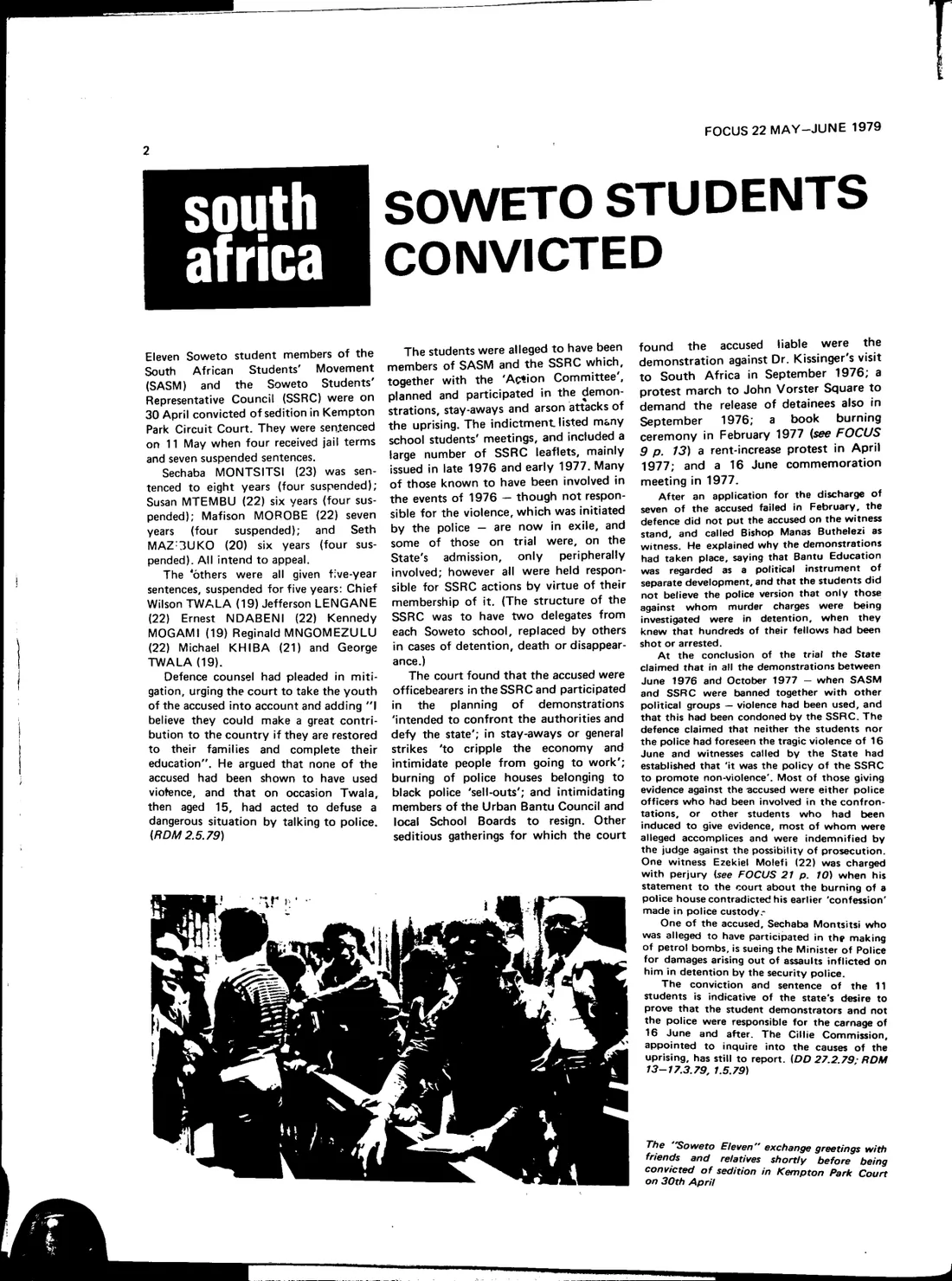
Eleven Soweto student members of the South African Students' Movement (SASM) and the Soweto Students' Representative Council (SSRC) were on 30 April convicted of sedition in Kempton Park Circuit Court. They were sentenced on 11 May when four received jail terms and seven suspended sentences.
Sechaba MONTSITSI (23) was sentenced to eight years (four suspended); Susan MTEMBU (22) six years (four suspended); Mafison MOROBE (22) seven years (four suspended); and Seth MAZUKO (20) six years (four suspended). All intend to appeal.
The others were all given five-year sentences, suspended for five years: Chief Wilson TWALA (19) Jefferson LENGANE (22) Ernest NDABENI (22) Kennedy MOGAMI (19) Reginald MNGOMEZULU (22) Michael KHIBA (21) and George TWALA (19).
Defence counsel had pleaded in mitigation, urging the court to take the youth of the accused into account and adding "I believe they could make a great contribution to the country if they are restored to their families and complete their education". He argued that none of the accused had been shown to have used violence, and that on occasion Twala, then aged 15, had acted to defuse a dangerous situation by talking to police.
The students were alleged to have been members of SASM and the SSRC which, together with the 'Action Committee', planned and participated in the demonstrations, stay-aways and arson attacks of the uprising. The indictment listed many school students' meetings, and included a large number of SSRC leaflets, mainly issued in late 1976 and early 1977. Many of those known to have been involved in the events of 1976 — though not responsible for the violence, which was initiated by the police — are now in exile, and some of those on trial were, on the State's admission, only peripherally involved; however all were held responsible for SSRC actions by virtue of their membership of it. (The structure of the SSRC was to have two delegates from each Soweto school, replaced by others in cases of detention, death or disappearance.)
The court found that the accused were officebearers in the SSRC and participated in the planning of demonstrations 'intended to confront the authorities and defy the state'; in stay-aways or general strikes 'to cripple the economy and intimidate people from going to work'; burning of police houses belonging to black police 'sell-outs'; and intimidating members of the Urban Bantu Council and local School Boards to resign. Other seditious gatherings for which the court found the accused liable were the demonstration against Dr. Kissinger's visit to South Africa in September 1976; a protest march to John Vorster Square to demand the release of detainees also in September 1976; a book burning ceremony in February 1977; a rent-increase protest in April 1977; and a 16 June commemoration meeting in 1977.
After an application for the discharge of seven of the accused failed in February, the defence did not put the accused on the witness stand, and called Bishop Manas Buthelezi as witness. He explained why the demonstrations had taken place, saying that Bantu Education was regarded as a political instrument of separate development, and that the students did not believe the police version that only those against whom murder charges were being investigated were in detention, when they knew that hundreds of their fellows had been shot or arrested.
At the conclusion of the trial the State claimed that in all the demonstrations between June 1976 and October 1977 - when SASM and SSRC were banned together with other political groups - violence had been used, and that this had been condoned by the SSRC. The defence claimed that neither the students nor the police had foreseen the tragic violence of 16 June and witnesses called by the State had established that 'it was the policy of the SSRC to promote non-violence'. Most of those giving evidence against the accused were either police officers who had been involved in the confrontations, or other students who had been induced to give evidence, most of whom were alleged accomplices and were indemnified by the judge against the possibility of prosecution. One witness Ezekiel Molefi (22) was charged with perjury when his statement to the court about the burning of a police house contradicted his earlier 'confession' made in police custody.
One of the accused, Sechaba Montsitsi who was alleged to have participated in the making of petrol bombs, is suing the Minister of Police for damages arising out of assaults inflicted on him in detention by the security police.
The conviction and sentence of the 11 students is indicative of the state's desire to prove that the student demonstrators and not the police were responsible for the carnage of 16 June and after. The Cillie Commission, appointed to inquire into the causes of the uprising, has still to report.