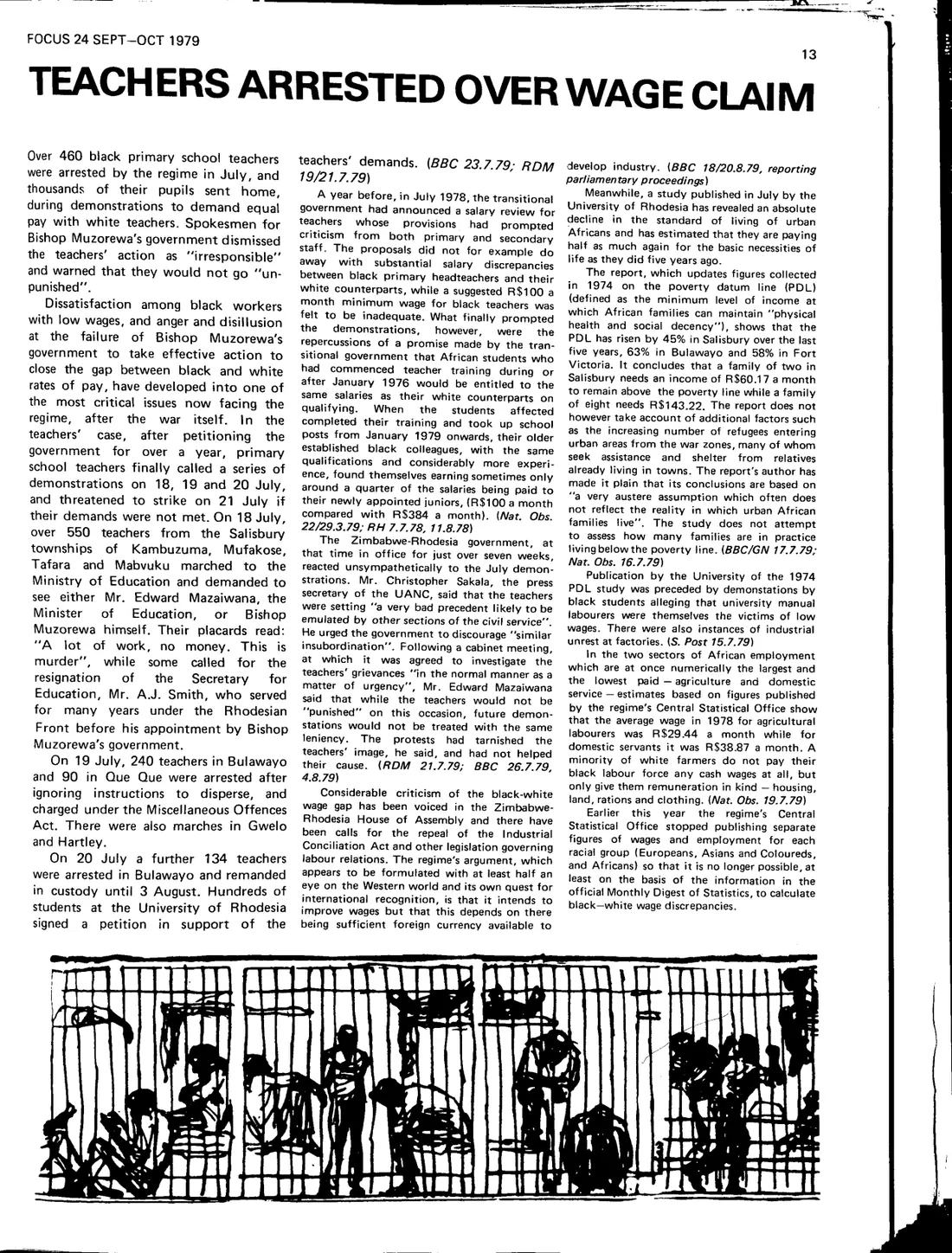
Over 460 black primary school teachers were arrested by the regime in July, and thousands of their pupils sent home, during demonstrations to demand equal pay with white teachers. Spokesmen for Bishop Muzorewa's government dismissed the teachers' action as "irresponsible" and warned that they would not go "unpunished".
Dissatisfaction among black workers with low wages, and anger and disillusion at the failure of Bishop Muzorewa's government to take effective action to close the gap between black and white rates of pay, have developed into one of the most critical issues now facing the regime, after the war itself. In the teachers' case, after petitioning the government for over a year, primary school teachers finally called a series of demonstrations on 18, 19 and 20 July, and threatened to strike on 21 July if their demands were not met. On 18 July, over 550 teachers from the Salisbury townships of Kambuzuma, Mufakose, Tafara and Mabvuku marched to the Ministry of Education and demanded to see either Mr. Edward Mazaiwana, the Minister of Education, or Bishop Muzorewa himself. Their placards read: "A lot of work, no money. This is murder", while some called for the resignation of the Secretary for Education, Mr. A.J. Smith, who served for many years under the Rhodesian Front before his appointment by Bishop Muzorewa's government.
On 19 July, 240 teachers in Bulawayo and 90 in Que Que were arrested after ignoring instructions to disperse, and charged under the Miscellaneous Offences Act. There were also marches in Gwelo and Hartley.
On 20 July a further 134 teachers were arrested in Bulawayo and remanded in custody until 3 August. Hundreds of students at the University of Rhodesia signed a petition in support of the teachers' demands.
A year before, in July 1978, the transitional government had announced a salary review for teachers whose provisions had prompted criticism from both primary and secondary staff. The proposals did not for example do away with substantial salary discrepancies between black primary headteachers and their white counterparts, while a suggested R$100 a month minimum wage for black teachers was felt to be inadequate. What finally prompted the demonstrations, however, were the repercussions of a promise made by the transitional government that African students who had commenced teacher training during or after January 1976 would be entitled to the same salaries as their white counterparts on qualifying. When the students affected completed their training and took up school posts from January 1979 onwards, their older established black colleagues, with the same qualifications and considerably more experience, found themselves earning sometimes only around a quarter of the salaries being paid to their newly appointed juniors, (R$100 a month compared with R$384 a month).
The Zimbabwe-Rhodesia government, at that time in office for just over seven weeks, reacted unsympathetically to the July demonstrations. Mr. Christopher Sakala, the press secretary of the UANC, said that the teachers were setting "a very bad precedent likely to be emulated by other sections of the civil service". He urged the government to discourage "similar insubordination". Following a cabinet meeting, at which it was agreed to investigate the teachers' grievances "in the normal manner as a matter of urgency", Mr. Edward Mazaiwana said that while the teachers would not be "punished" on this occasion, future demonstrations would not be treated with the same leniency. The protests had tarnished the teachers' image, he said, and had not helped their cause.
Considerable criticism of the black-white wage gap has been voiced in the Zimbabwe-Rhodesia House of Assembly and there have been calls for the repeal of the Industrial Conciliation Act and other legislation governing labour relations. The regime's argument, which appears to be formulated with at least half an eye on the Western world and its own quest for international recognition, is that it intends to improve wages but that this depends on there being sufficient foreign currency available to develop industry.
Meanwhile, a study published in July by the University of Rhodesia has revealed an absolute decline in the standard of living of urban Africans and has estimated that they are paying half as much again for the basic necessities of life as they did five years ago.
The report, which updates figures collected in 1974 on the poverty datum line (PDL) (defined as the minimum level of income at which African families can maintain "physical health and social decency"), shows that the PDL has risen by 45% in Salisbury over the last five years, 63% in Bulawayo and 58% in Fort Victoria. It concludes that a family of two in Salisbury needs an income of R$60.17 a month to remain above the poverty line while a family of eight needs R$143.22. The report does not however take account of additional factors such as the increasing number of refugees entering urban areas from the war zones, many of whom seek assistance and shelter from relatives already living in towns. The report's author has made it plain that its conclusions are based on "a very austere assumption which often does not reflect the reality in which urban African families live". The study does not attempt to assess how many families are in practice living below the poverty line.
Publication by the University of the 1974 PDL study was preceded by demonstrations by black students alleging that university manual labourers were themselves the victims of low wages. There were also instances of industrial unrest at factories.
In the two sectors of African employment which are at once numerically the largest and the lowest paid - agriculture and domestic service - estimates based on figures published by the regime's Central Statistical Office show that the average wage in 1978 for agricultural labourers was R$29.44 a month while for domestic servants it was R$38.87 a month. A minority of white farmers do not pay their black labour force any cash wages at all, but only give them remuneration in kind - housing, land, rations and clothing.
Earlier this year the regime's Central Statistical Office stopped publishing separate figures of wages and employment for each racial group (Europeans, Asians and Coloureds, and Africans) so that it is no longer possible, at least on the basis of the information in the official Monthly Digest of Statistics, to calculate black-white wage discrepancies.