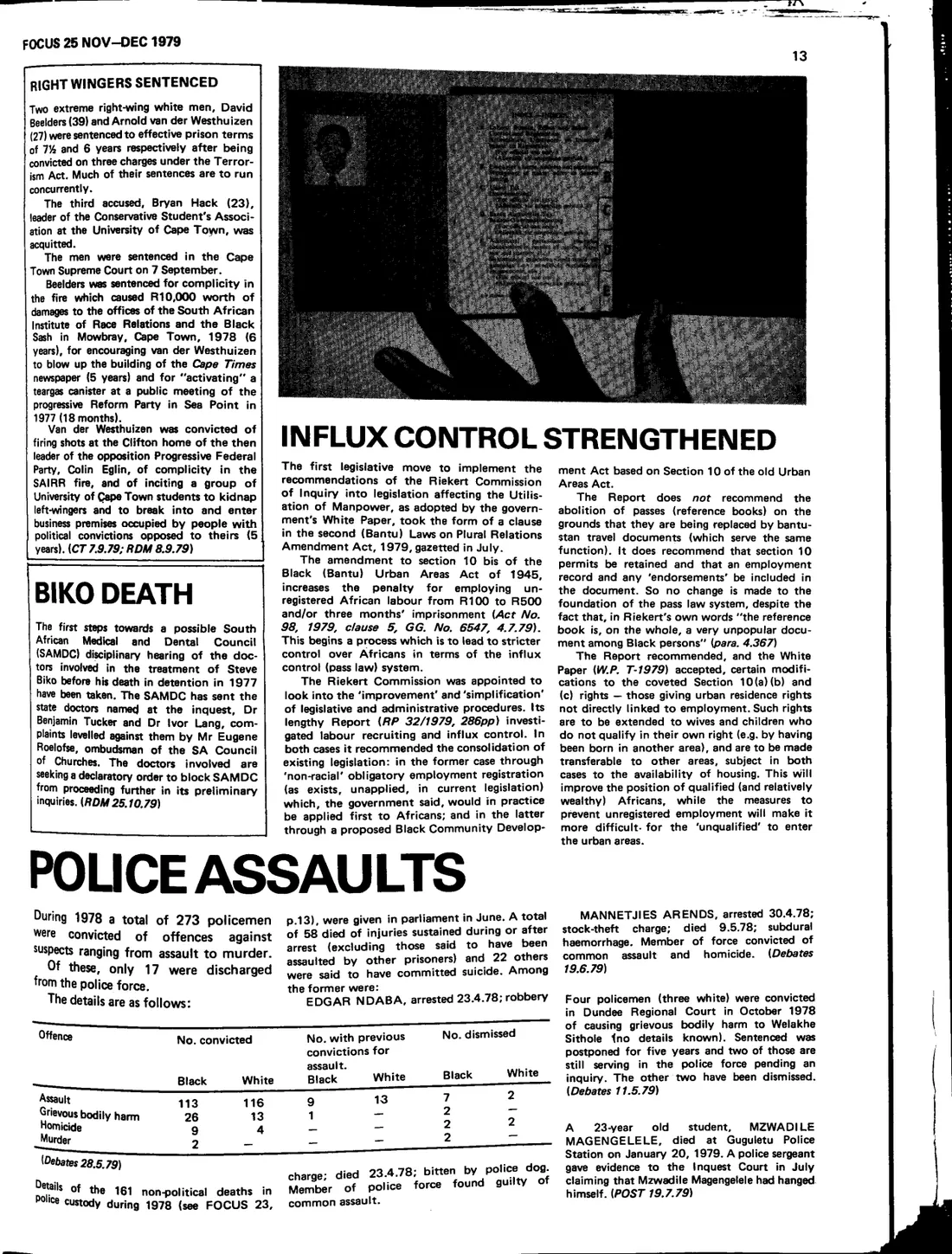
The first legislative move to implement the recommendations of the Riekert Commission of Inquiry into legislation affecting the Utilisation of Manpower, as adopted by the government's White Paper, took the form of a clause in the second (Bantu) Laws on Plural Relations Amendment Act, 1979, gazetted in July.
The amendment to section 10 bis of the Black (Bantu) Urban Areas Act of 1945, increases the penalty for employing unregistered African labour from R100 to R500 and/or three months' imprisonment (Act No. 98, 1979, clause 5, GG. No. 6547, 4.7.79). This begins a process which is to lead to stricter control over Africans in terms of the influx control (pass law) system.
The Riekert Commission was appointed to look into the 'improvement' and 'simplification' of legislative and administrative procedures. Its lengthy Report (RP 32/1979, 286pp) investigated labour recruiting and influx control. In both cases it recommended the consolidation of existing legislation: in the former case through 'non-racial' obligatory employment registration (as exists, unapplied, in current legislation) which, the government said, would in practice be applied first to Africans; and in the latter through a proposed Black Community Development Act based on Section 10 of the old Urban Areas Act.
The Report does not recommend the abolition of passes (reference books) on the grounds that they are being replaced by bantu-stan travel documents (which serve the same function). It does recommend that section 10 permits be retained and that an employment record and any 'endorsements' be included in the document. So no change is made to the foundation of the pass law system, despite the fact that, in Riekert's own words "the reference book is, on the whole, a very unpopular document among Black persons" (para. 4.367)
The Report recommended, and the White Paper (W.P. T-1979) accepted, certain modifications to the coveted Section 10(a) (b) and (c) rights - those giving urban residence rights not directly linked to employment. Such rights are to be extended to wives and children who do not qualify in their own right (e.g. by having been born in another area), and are to be made transferable to other areas, subject in both cases to the availability of housing. This will improve the position of qualified (and relatively wealthy) Africans, while the measures to prevent unregistered employment will make it more difficult for the 'unqualified' to enter the urban areas.