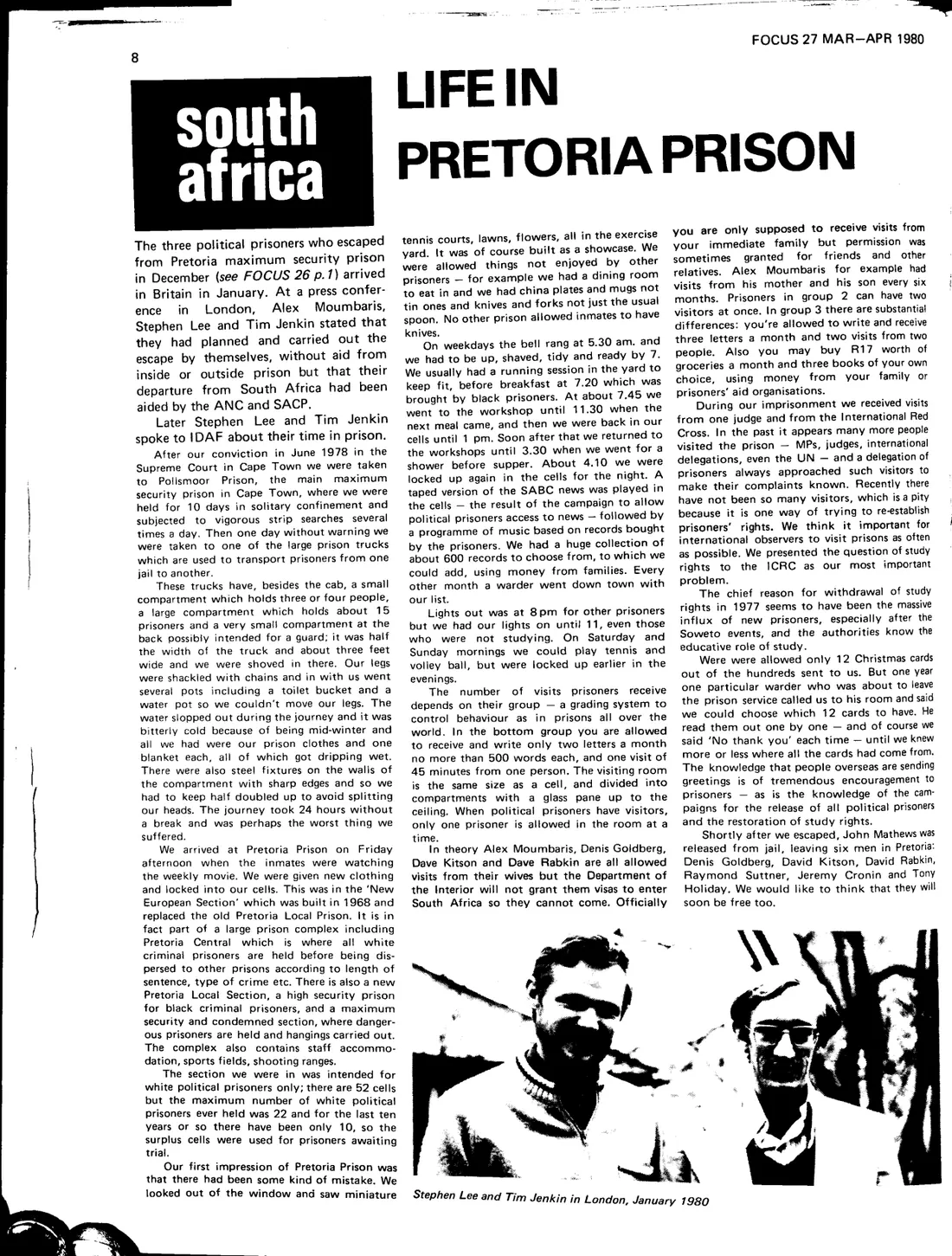
The three political prisoners who escaped from Pretoria maximum security prison in December arrived in Britain in January. At a press conference in London, Alex Moumbaris, Stephen Lee and Tim Jenkin stated that they had planned and carried out the escape by themselves, without aid from inside or outside prison but that their departure from South Africa had been aided by the ANC and SACP. Later Stephen Lee and Tim Jenkin spoke to IDAF about their time in prison.
After our conviction in June 1978 in the Supreme Court in Cape Town we were taken to Pollsmoor Prison, the main maximum security prison in Cape Town, where we were held for 10 days in solitary confinement and subjected to vigorous strip searches several times a day. Then one day without warning we were taken to one of the large prison trucks which are used to transport prisoners from one jail to another. These trucks have, besides the cab, a small compartment which holds three or four people, a large compartment which holds about 15 prisoners and a very small compartment at the back possibly intended for a guard; it was half the width of the truck and about three feet wide and we were shaved in there. Our legs were shackled with chains and in with us went several pots including a toilet bucket and a water pot so we couldn't move our legs. The water slopped out during the journey and it was bitterly cold because of being mid-winter and all we had were our prison clothes and one blanket each, all of which got dripping wet. There were also steel fixtures on the walls of the compartment with sharp edges and so we had to keep half doubled up to avoid splitting our heads. The journey took 24 hours without a break and was perhaps the worst thing we suffered.
We arrived at Pretoria Prison on Friday afternoon when the inmates were watching the weekly movie. We were given new clothing and locked into our cells. This was in the 'New European Section' which was built in 1968 and replaced the old Pretoria Local Prison. It is in fact part of a large prison complex including Pretoria Central which is where all white criminal prisoners are held before being dispersed to other prisons according to length of sentence, type of crime etc. There is also a new Pretoria Local Section, a high security prison for black criminal prisoners, and a maximum security and condemned section, where dangerous prisoners are held and hangings carried out. The complex also contains staff accommodation, sports fields, shooting ranges. The section we were in was intended for white political prisoners only; there are 52 cells but the maximum number of white political prisoners ever held was 22 and for the last ten years or so there have been only 10, so the surplus cells were used for prisoners awaiting trial.
Our first impression of Pretoria Prison was that there had been some kind of mistake. We looked out of the window and saw miniature tennis courts, lawns, flowers, all in the exercise yard. It was of course built as a showcase. We were allowed things not enjoyed by other prisoners - for example we had a dining room to eat in and we had china plates and mugs not tin ones and knives and forks not just the usual spoon. No other prison allowed inmates to have knives.
On weekdays the bell rang at 5.30 am. and we had to be up, shaved, tidy and ready by 7. We usually had a running session in the yard to keep fit, before breakfast at 7.20 which was brought by black prisoners. At about 7.45 we went to the workshop until 11.30 when the next meal came, and then we were back in our cells until 1 pm. Soon after that we returned to the workshops until 3.30 when we went for a shower before supper. About 4.10 we were locked up again in the cells for the night. A taped version of the SABC news was played in the cells - the result of the campaign to allow political prisoners access to news - followed by a programme of music based on records bought by the prisoners. We had a huge collection of about 600 records to choose from, to which we could add, using money from families. Every other month a warder went down town with our list. Lights out was at 8 pm for other prisoners but we had our lights on until 11, even those who were not studying. On Saturday and Sunday mornings we could play tennis and volleyball, but were locked up earlier in the evenings.
The number of visits prisoners receive depends on their group - a grading system to control behaviour as in prisons all over the world. In the bottom group you are allowed to receive and write only two letters a month no more than 500 words each, and one visit of 45 minutes from one person. The visiting room is the same size as a cell, and divided into compartments with a glass pane up to the ceiling. When political prisoners have visitors, only one prisoner is allowed in the room at a time.
In theory Alex Moumbaris, Denis Goldberg, Dave Kitson and Dave Rabkin are all allowed visits from their wives but the Department of the Interior will not grant them visas to enter South Africa so they cannot come. Officially you are only supposed to receive visits from your immediate family but permission was sometimes granted for friends and other relatives. Alex Moumbaris for example had visits from his mother and his son every six months. Prisoners in group 2 can have two visitors at once. In group 3 there are substantial differences: you're allowed to write and receive three letters a month and two visits from two people. Also you may buy R17 worth of groceries a month and three books of your own choice, using money from your family or prisoners' aid organisations.
During our imprisonment we received visits from one judge and from the International Red Cross. In the past it appears many more people visited the prison - MPs, judges, international delegations, even the UN - and a delegation of prisoners always approached such visitors to make their complaints known. Recently there have not been so many visitors, which is a pity because it is one way of trying to re-establish prisoners' rights. We think it important for international observers to visit prisons as often as possible. We presented the question of study rights to the ICRC as our most important problem. The chief reason for withdrawal of study rights in 1977 seems to have been the massive influx of new prisoners, especially after the Soweto events, and the authorities know the educative role of study.
Were we allowed only 12 Christmas cards out of the hundreds sent to us. But one year one particular warder who was about to leave the prison service called us to his room and said we could choose which 12 cards to have. He read them out one by one - and of course we said 'No thank you' each time - until we knew more or less where all the cards had come from. The knowledge that people overseas are sending greetings is of tremendous encouragement to prisoners - as is the knowledge of the campaigns for the release of all political prisoners and the restoration of study rights. Shortly after we escaped, John Mathews was released from jail, leaving six men in Pretoria: Denis Goldberg, David Kitson, David Rabkin, Raymond Suttner, Jeremy Cronin and Tony Holiday. We would like to think that they will soon be free too.