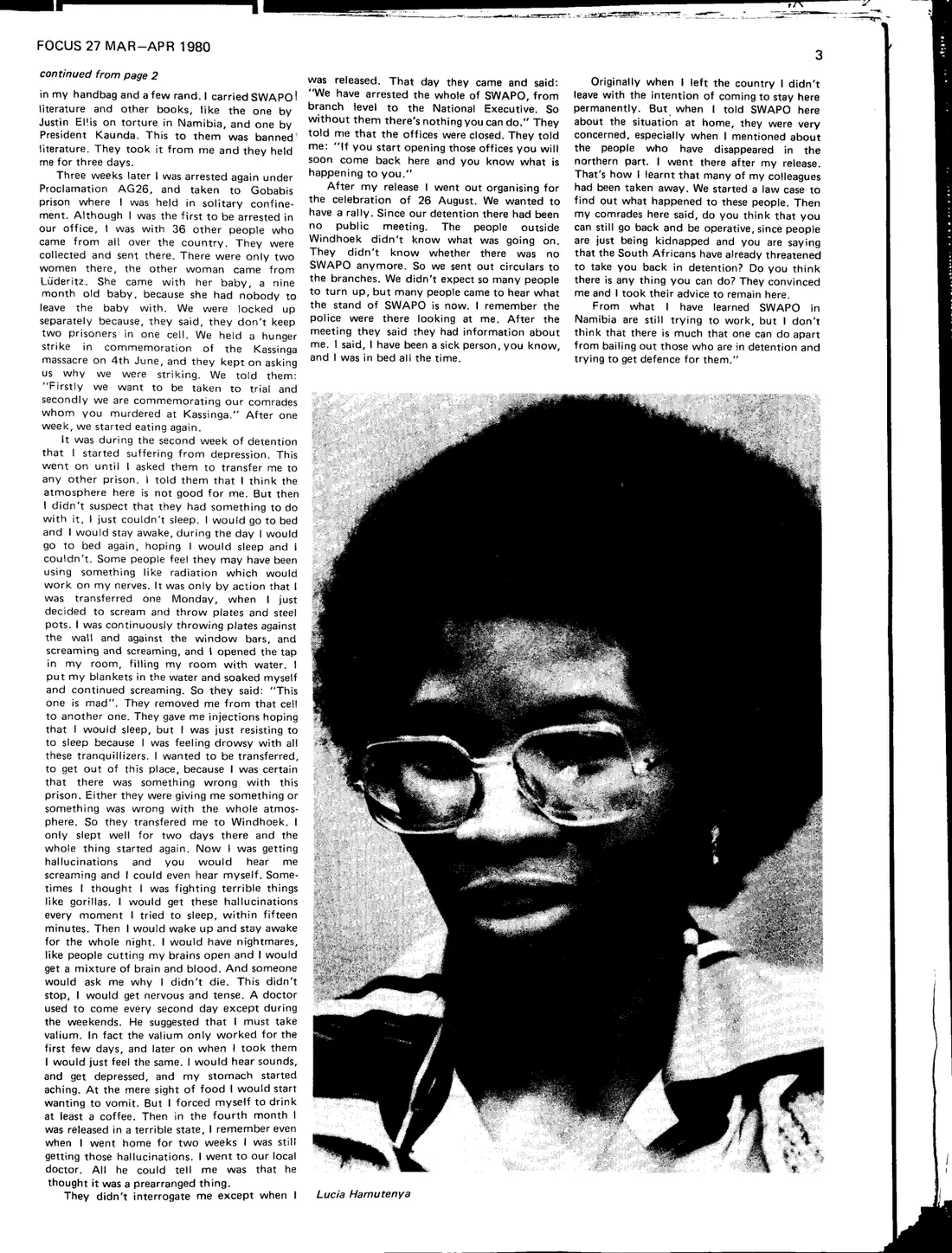
The difficulties confronting anyone in Namibia who attempts to organise political activities, or is suspected of disagreeing with South African policies in Namibia, are clearly shown in the experience of Lucia HAMUTENYA who until August 1979 was working as SWAPO's Secretary for Legal Affairs in Windhoek but found it increasingly dangerous to pursue her legal and political work. In an interview with IDAF, she described her experiences in Namibia.
"I was born on 30 June 1953 at Odibo, an Anglican Church mission in the north. I was educated in Windhoek up to secondary school, after that I went to Fort Hare University in South Africa where I studied law for four years. I could not complete my course because of the Soweto uprising in 1976. The University was closed for over three terms. I did not go to write my examinations because there was hostility between the lecturers and the students and I was involved in the student movement in South Africa. So I registered with a correspondence university in South Africa, and completed the remaining courses in 1979.
At the end of 1976 I started working in the SWAPO office in Windhoek. I organised the defence for political detainees and support from the churches to pay bail for those who were granted bail. Apart from that we helped to mobilise the people by addressing public rallies. On the women's side, we had a lot of house-to-house meetings, mobilising the women, handing out pamphlets telling them about SWAPO. We had lots of women joining. Women were making dresses in SWAPO flags and beads in SWAPO colours, and many of them started writing pamphlets on women.
The police knew about the political meetings we organised. They tried to intimidate those who were new, and frighten them away from us by picking them up and interrogating them. But this did not deter the women.
I was arrested in November 1977 in the north. We had organised a seminar there and we were going to address it. On our way we were detained under Proclamation AG9. We were held for three days in the military camp at Oshakati where we were questioned. They tried to connect us with the guerrillas who were fighting in that area. They kept on asking: "Why did you come to this area?" We explained that we intended to give speeches at this seminar and even had our written speeches with us. They asked me: "How many times have you made an encounter with guerillas?" I said I had never encountered guerillas. Then they said: "But are you aware that there are terrorists in this country?" I said yes, I had learnt that from the news media. I asked: "Who exactly are these terrorists, can you define to me who they are?" They said: "These are the people who cross over the borders and come and fight here. Most of them are people who came from here." So I said: "What is wrong with people who belong here to come back to their country? Why do you fight them?" They just laughed, and I was released a few days later.
I was detained again in 1978 under the Terrorism Act. This was just before the internal elections. We had held a demonstration a day before we were arrested, and this demonstration coincided with bomb explosions in the city centre. They wanted to find a connection between us and the people who placed the bombs. They said we were the guerrillas responsible for it.
Police had been at the demonstration and had told people to disperse. We found that people were picked up and badly beaten up. Some of them lost their teeth, others were bleeding, at least four were taken to the police office. We went to the police station and found some people lying there bleeding. We asked one of the senior police officers to take these people to hospital and tried to find out why people had been arrested. He told us that the demonstration was illegal. He said the people would only be released after they had been charged and tried. We planned to instruct lawyers to keep a check on when these people were going to appear for trial. The following day the police came and cordoned off my house. They were paramilitary armed soldiers. They told me I was going to be arrested under Section Six of the Terrorism Act, and that they wanted to search my room. They produced a search warrant and went into my house. They found nothing except my books on politics. I didn't get any of my things back, not even the personal addresses and things like that.
They arrested all the leadership. The last batch was arrested on 23rd December. This time I was tortured and harassed. First they started by punishing me, by keeping me awake for a whole week. They told me to stand in the centre of a room, and an alternating team of police would come and look at me while I was still in this position and tell me to stand right in the middle of the room. There was nowhere to lean against. After a week they asked me to write down everything I did in SWAPO. I told them about my legal work and what I was doing. After that they came and asked: "But what about the terrorists? Did you meet them in Luanda?" I told them I had met no terrorists, just the group from SWAPO who met the Western Five. Then they slapped my face damaging my ear drums. After writing all the statements they saw that they wouldn't get what they wanted, so they used force.
We were only allowed out to the toilet and in the beginning for medical check-ups, which were not accurate at all. For torture purposes they wanted to know how fit we were. Although I wasn't all that medically healthy, the results from that doctor came out that I was reasonably healthy. Not all the political detainees who are, tortured are taken for medical check-ups first, but the police knew that we were recognised as leaders in the country and if they did something to us they would be blamed for it. I think we were the only privileged victims of torture to get medical check-ups before we were tortured. I have been taking statements from all the ex-prisoners and ex-detainees and nobody told me that they had first been taken for medical check-ups.
I was held in Windhoek security police buildings, not in prison. Often people are kept at police stations, not just for interrogation but even for torture, because in prison people are mixed up and so they may hear you screaming. One of the prisons is in town, and there are lots of people around who can hear these screams. The security police buildings are off somewhere away, so you may scream and there is nobody to hear you scream. In most cases they keep you in the security buildings, and after getting statements from you perhaps they take you to prison.
I was arrested on various occasions in 1979. First, I was arrested in March. I spent three days in prison for having banned literature and for allegedly violating the currency laws, although it was not true. I only had a few dollars in my handbag and a few rand. I carried SWAPO literature and other books, like the one by Justin Elis on torture in Namibia, and one by President Kaunda. This to them was banned literature. They took it from me and they held me for three days.
Three weeks later I was arrested again under Proclamation AG26, and taken to Gobabis prison where I was held in solitary confinement. Although I was the first to be arrested in our office, I was with 36 other people who came from all over the country. They were collected and sent there. There were only two women there, the other woman came from Lüderitz. She came with her baby, a nine month old baby, because she had nobody to leave the baby with. We were locked up separately because, they said, they don't keep two prisoners in one cell. We held a hunger strike in commemoration of the Kassinga massacre on 4th June, and they kept on asking us why we were striking. We told them: "Firstly we want to be taken to trial and secondly we are commemorating our comrades whom you murdered at Kassinga." After one week, we started eating again.
It was during the second week of detention that I started suffering from depression. This went on until I asked them to transfer me to any other prison. I told them that I think the atmosphere here is not good for me. But then I didn't suspect that they had something to do with it, I just couldn't sleep. I would go to bed and I would stay awake, during the day I would go to bed again, hoping I would sleep and I couldn't. Some people feel they may have been using something like radiation which would work on my nerves. It was only by action that I was transferred one Monday, when I just decided to scream and throw plates and steel pots. I was continuously throwing plates against the wall and against the window bars, and screaming and screaming, and I opened the tap in my room, filling my room with water. I put my blankets in the water and soaked myself and continued screaming. So they said: "This one is mad". They removed me from that cell to another one. They gave me injections hoping that I would sleep, but I was just resisting to to sleep because I was feeling drowsy with all these tranquillizers. I wanted to be transferred, to get out of this place, because I was certain that there was something wrong with this prison. Either they were giving me something or something was wrong with the whole atmosphere. So they transfered me to Windhoek. I only slept well for two days there and the whole thing started again. Now I was getting hallucinations and you would hear me screaming and I could even hear myself. Sometimes I thought I was fighting terrible things like gorillas. I would get these hallucinations every moment I tried to sleep, within fifteen minutes. Then I would wake up and stay awake for the whole night. I would have nightmares, like people cutting my brains open and I would get a mixture of brain and blood. And someone would ask me why I didn't die. This didn't stop, I would get nervous and tense. A doctor used to come every second day except during the weekends. He suggested that I must take valium. In fact the valium only worked for the first few days, and later on when I took them I would just feel the same. I would hear sounds, and get depressed, and my stomach started aching. At the mere sight of food I would start wanting to vomit. But I forced myself to drink at least a coffee. Then in the fourth month I was released in a terrible state, I remember even when I went home for two weeks I was still getting those hallucinations. I went to our local doctor. All he could tell me was that he thought it was a prearranged thing.
They didn't interrogate me except when I was released. That day they came and said: "We have arrested the whole of SWAPO, from branch level to the National Executive. So without them there's nothing you can do." They told me that the offices were closed. They told me: "If you start opening those offices you will soon come back here and you know what is happening to you."
After my release I went out organising for the celebration of 26 August. We wanted to have a rally. Since our detention there had been no public meeting. The people outside Windhoek didn't know what was going on. They didn't know whether there was no SWAPO anymore. So we sent out circulars to the branches. We didn't expect so many people to turn up, but many people came to hear what the stand of SWAPO is now. I remember the police were there looking at me. After the meeting they said they had information about me. I said, I have been a sick person, you know, and I was in bed all the time.
Originally when I left the country I didn't leave with the intention of coming to stay here permanently. But when I told SWAPO here about the situation at home, they were very concerned, especially when I mentioned about the people who have disappeared in the northern part. I went there after my release. That's how I learnt that many of my colleagues had been taken away. We started a law case to find out what happened to these people. Then my comrades here said, do you think that you can still go back and be operative, since people are just being kidnapped and you are saying that the South Africans have already threatened to take you back in detention? Do you think there is any thing you can do? They convinced me and I took their advice to remain here.
From what I have learned SWAPO in Namibia are still trying to work, but I don't think that there is much that one can do apart from bailing out those who are in detention and trying to get defence for them."