A sharp increase in fighting between SWAPO guerillas and South African troops since the beginning of the year has led to the introduction of new security measures in the north and an increased police presence. The effect on the population in the north is a further curtailment of their freedom of movement and of political activities.
The Administrator General announced on 12 January 1980 that, following the death of Mr Thomas Shilongo former Minister of Works in the Ovambo "Government", in a landmine explosion, a number of measures would be implemented. The existing police programme in Ovamboland would be extended and increased so that special police could protect headmen and senior headmen more effectively. Headmen would be given more power to maintain law and order in their villages, and aid might be given to the heads of villages and heads of families to buy arms. An amendment to Security Districts Proclamation AG9 of 1977 was published on 6 February 1980, stipulating further restrictions on movement in Ovamboland. It empowers the Officer Commanding the South African Defence Force or his representatives to prohibit travel on any road in Ovamboland at times they may specify, or without such escort as the security forces may provide. It also prohibits any person selling any merchandise from one half-hour after sunset until one half-hour before sunrise in Ovamboland without the consent of these authorities, who may grant consent after consultation with the Cabinet of Ovambo.
New security measures have also been introduced in Kaokoland, which borders on Ovamboland, after an admission by the South African Defence Force that SWAPO guerillas are active there. Kaokoland had been considered free of guerilla activity and is not part of the "operational area" in which the South African Defence Force is concentrated. Among the measures considered are the limitation of entry points into Kaokoland and methods to identify aliens in the region.
In a Proclamation promulgated on 19 December 1979 (Procl. AG114) entitled "Declaration Under The Security Districts Proclamation,1977: District of Kaokoland", sections 3, 4 and 5 of Proclamation AG9 were extended to the district of Kaokoland. Section 3 (1) authorises the Administrator General to control or direct any person's residence, movement and activity in a security district. Section 3 (2) empowers him to designate any part of a security district that lies along an international border of Namibia as a "prohibited area" and order any persons to leave that area or determine the conditions of their residence there. Section 4 gives wide powers to any officers of the South African military forces to search and arrest people without a warrant, and to detain them for questioning without access to legal counsel for up to 30 days. Section 5 requires 24 hours notice to the authorities of all meetings.
A military escort has been introduced for travellers from Okatjiura to Opuwa, the administrative centre of Kaokoland. On another road section, from Okatjiura to Ruacana, armed escorts have already been operating. They consist mainly of recovery vehicles with anti-landmine cabins. Armed units of the railway police accompany all trains to the north. In addition, the railway authorities provide training in firearms for those employees who work in what is regarded a dangerous region.
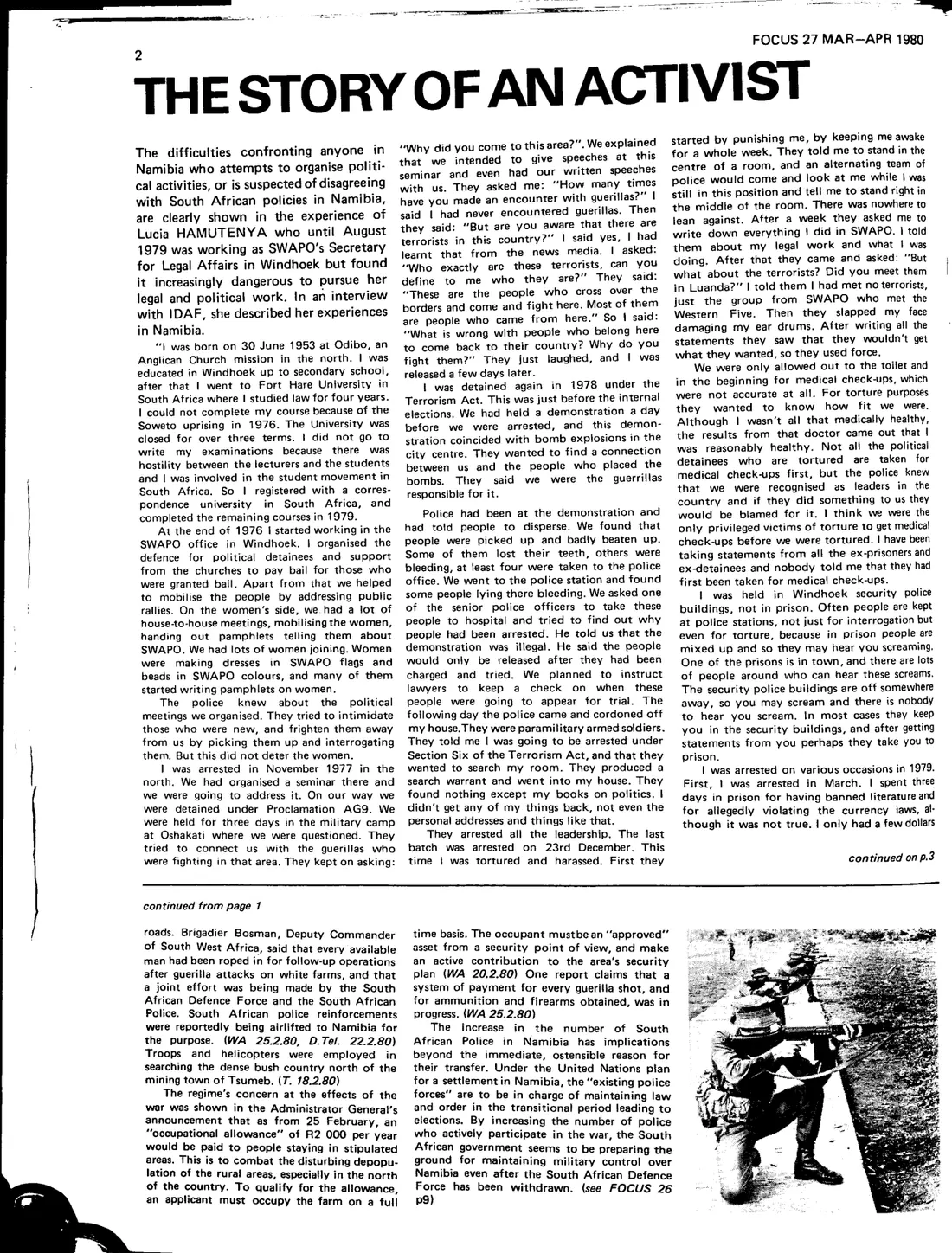
Further south, in the white farming areas of the triangle between Grootfontein, Otavi and Tsumeb, security forces are guarding white farms, and setting up road blocks. Motorbike units and mounted patrols are patrolling the roads. Brigadier Bosman, Deputy Commander of South West Africa, said that every available man had been roped in for follow-up operations after guerilla attacks on white farms, and that a joint effort was being made by the South African Defence Force and the South African Police. South African police reinforcements were reportedly being airlifted to Namibia for the purpose. Troops and helicopters were employed in searching the dense bush country north of the mining town of Tsumeb.
The regime's concern at the effects of the war was shown in the Administrator General's announcement that as from 25 February, an "occupational allowance" of R2 000 per year would be paid to people staying in stipulated areas. This is to combat the disturbing depopulation of the rural areas, especially in the north of the country. To qualify for the allowance, an applicant must occupy the farm on a full time basis. The occupant must be an "approved" asset from a security point of view, and make an active contribution to the area's security plan. One report claims that a system of payment for every guerilla shot, and for ammunition and firearms obtained, was in progress.
The increase in the number of South African Police in Namibia has implications beyond the immediate, ostensible reason for their transfer. Under the United Nations plan for a settlement in Namibia, the "existing police forces" are to be in charge of maintaining law and order in the transitional period leading to elections. By increasing the number of police who actively participate in the war, the South African government seems to be preparing the ground for maintaining military control over Namibia even after the South African Defence Force has been withdrawn.