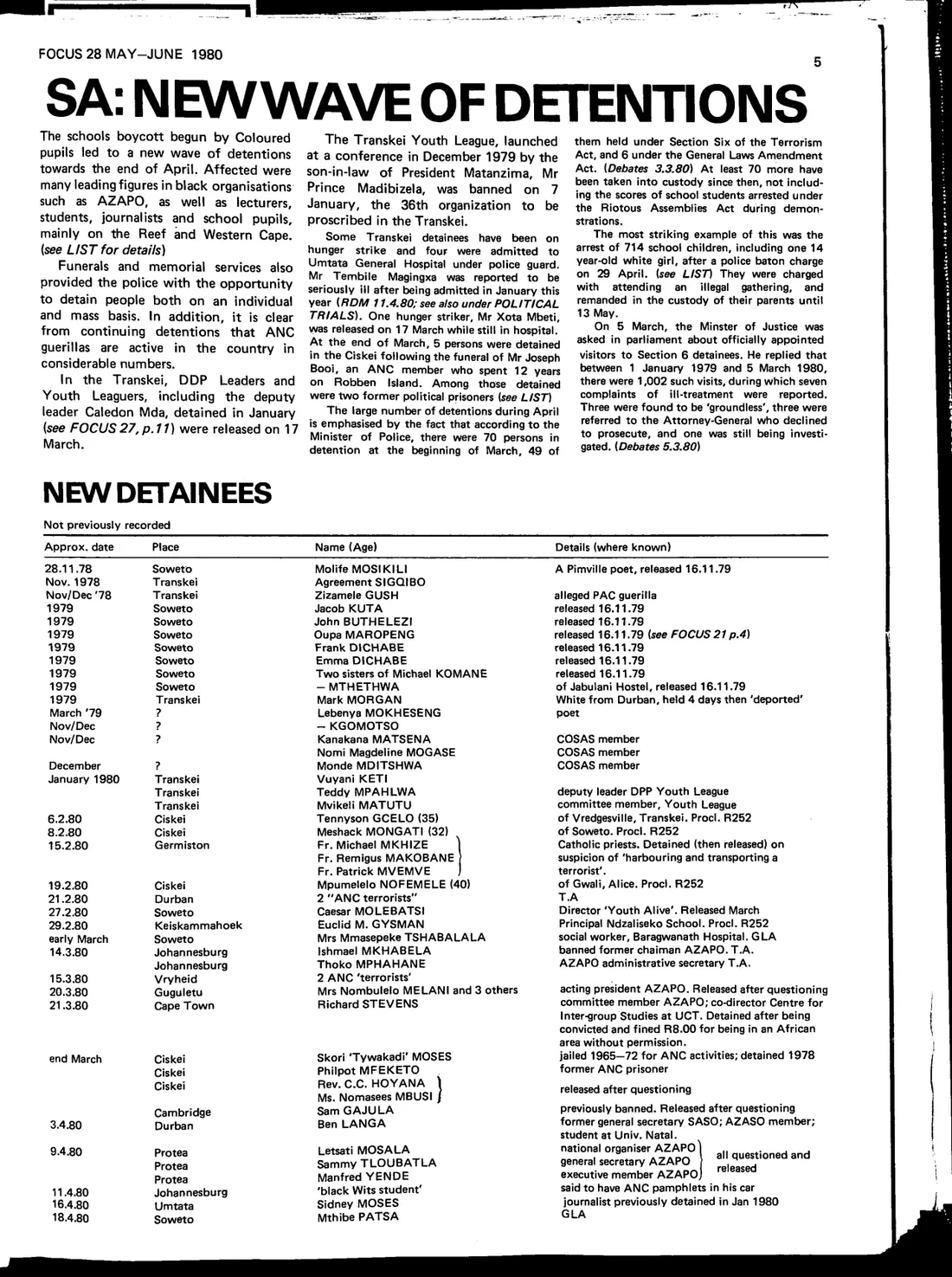
The schools boycott begun by Coloured pupils led to a new wave of detentions towards the end of April. Affected were many leading figures in black organisations such as AZAPO, as well as lecturers, students, journalists and school pupils, mainly on the Reef and Western Cape.
Funerals and memorial services also provided the police with the opportunity to detain people both on an individual and mass basis. In addition, it is clear from continuing detentions that ANC guerillas are active in the country in considerable numbers.
In the Transkei, DDP Leaders and Youth Leaguers, including the deputy leader Caledon Mda, detained in January were released on 17 March. The Transkei Youth League, launched at a conference in December 1979 by the son-in-law of President Matanzima, Mr Prince Madibizela, was banned on 7 January, the 36th organization to be proscribed in the Transkei.
Some Transkei detainees have been on hunger strike and four were admitted to Umtata General Hospital under police guard. Mr Tembile Magingxa was reported to be seriously ill after being admitted in January this year. One hunger striker, Mr Xota Mbeti, was released on 17 March while still in hospital. At the end of March, 5 persons were detained in the Ciskei following the funeral of Mr Joseph Booi, an ANC member who spent 12 years on Robben Island. Among those detained were two former political prisoners.
The large number of detentions during April is emphasised by the fact that according to the Minister of Police, there were 70 persons in detention at the beginning of March, 49 of them held under Section Six of the Terrorism Act, and 6 under the General Laws Amendment Act. At least 70 more have been taken into custody since then, not including the scores of school students arrested under the Riotous Assemblies Act during demonstrations.
The most striking example of this was the arrest of 714 school children, including one 14 year-old white girl, after a police baton charge on 29 April. They were charged with attending an illegal gathering, and remanded in the custody of their parents until 13 May.
On 5 March, the Minster of Justice was asked in parliament about officially appointed visitors to Section 6 detainees. He replied that between 1 January 1979 and 5 March 1980, there were 1,002 such visits, during which seven complaints of ill-treatment were reported. Three were found to be 'groundless', three were referred to the Attorney-General who declined to prosecute, and one was still being investigated.