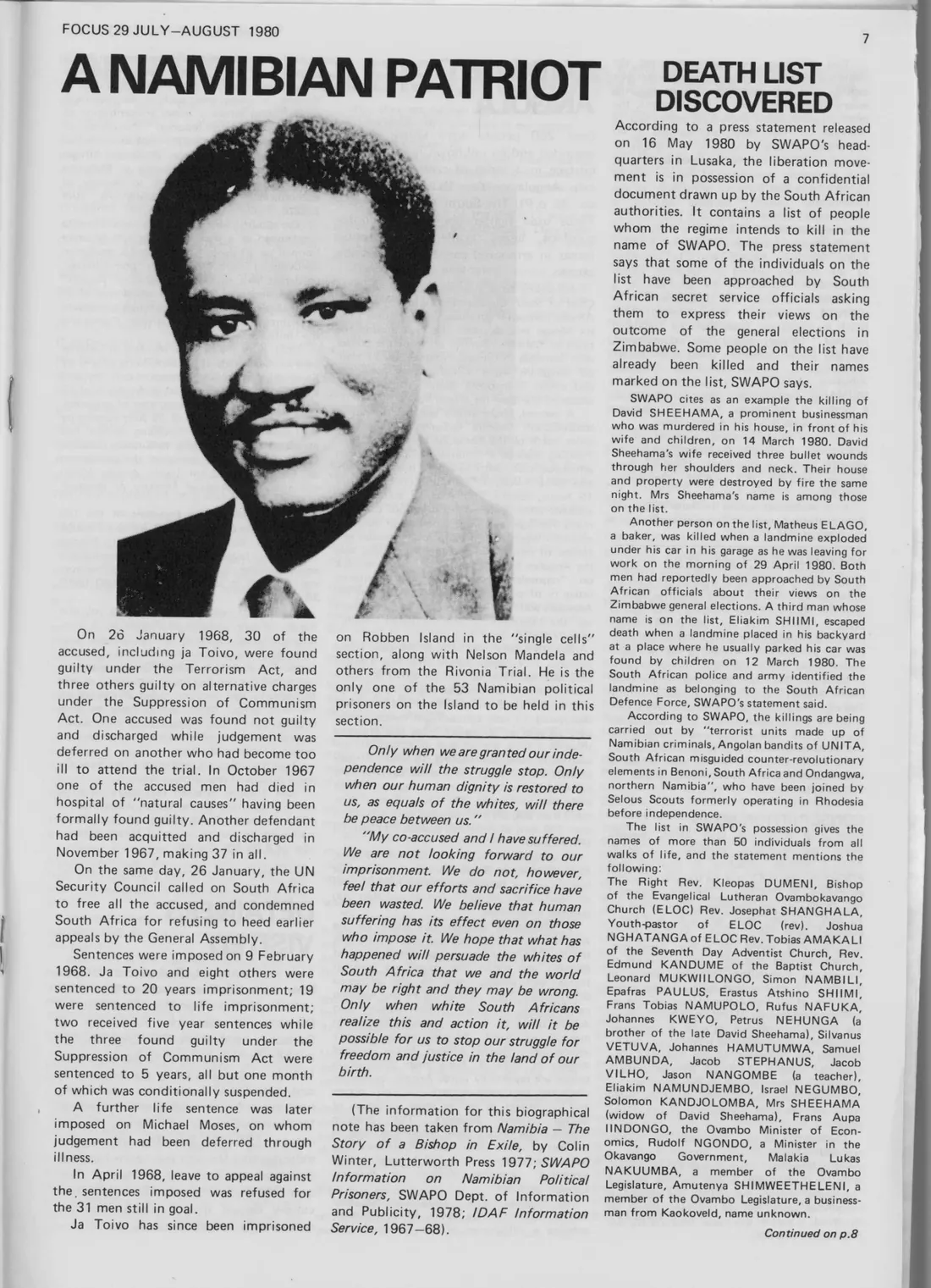
On 26 January 1968, 30 of the accused, including Ja Toivo, were found guilty under the Terrorism Act, and three others guilty on alternative charges under the Suppression of Communism Act. One accused was found not guilty and discharged while judgement was deferred on another who had become too ill to attend the trial. In October 1967 one of the accused men had died in hospital of "natural causes" having been formally found guilty. Another defendant had been acquitted and discharged in November 1967, making 37 in all.
On the same day, 26 January, the UN Security Council called on South Africa to free all the accused, and condemned South Africa for refusing to heed earlier appeals by the General Assembly.
Sentences were imposed on 9 February 1968. Ja Toivo and eight others were sentenced to 20 years imprisonment; 19 were sentenced to life imprisonment; two received five year sentences while the three found guilty under the Suppression of Communism Act were sentenced to 5 years, all but one month of which was conditionally suspended.
A further life sentence was later imposed on Michael Moses, on whom judgement had been deferred through illness.
In April 1968, leave to appeal against the sentences imposed was refused for the 31 men still in goal.
Ja Toivo has since been imprisoned on Robben Island in the "single cells" section, along with Nelson Mandela and others from the Rivonia Trial. He is the only one of the 53 Namibian political prisoners on the Island to be held in this section.
> Only when we are granted our independence will the struggle stop. Only when our human dignity is restored to us, as equals of the whites, will there be peace between us."
> "My co-accused and I have suffered. We are not looking forward to our imprisonment. We do not, however, feel that our efforts and sacrifice have been wasted. We believe that human suffering has its effect even on those who impose it. We hope that what has happened will persuade the whites of South Africa that we and the world may be right and they may be wrong. Only when white South Africans realize this and action it, will it be possible for us to stop our struggle for freedom and justice in the land of our birth.
(The information for this biographical note has been taken from *Namibia – The Story of a Bishop in Exile*, by Colin Winter, Lutterworth Press 1977; SWAPO Information on Namibian Political Prisoners, SWAPO Dept. of Information and Publicity, 1978; IDAF Information Service, 1967–68).
DEATH LIST DISCOVERED
According to a press statement released on 16 May 1980 by SWAPO's headquarters in Lusaka, the liberation movement is in possession of a confidential document drawn up by the South African authorities. It contains a list of people whom the regime intends to kill in the name of SWAPO. The press statement says that some of the individuals on the list have been approached by South African secret service officials asking them to express their views on the outcome of the general elections in Zimbabwe. Some people on the list have already been killed and their names marked on the list, SWAPO says.
SWAPO cites as an example the killing of David SHEEHAMA, a prominent businessman who was murdered in his house, in front of his wife and children, on 14 March 1980. David Sheehama's wife received three bullet wounds through her shoulders and neck. Their house and property were destroyed by fire the same night. Mrs Sheehama's name is among those on the list.
Another person on the list, Matheus ELAGO, a baker, was killed when a landmine exploded under his car in his garage as he was leaving for work on the morning of 29 April 1980. Both men had reportedly been approached by South African officials about their views on the Zimbabwe general elections. A third man whose name is on the list, Eliakim SHIIMI, escaped death when a landmine placed in his backyard at a place where he usually parked his car was found by children on 12 March 1980. The South African police and army identified the landmine as belonging to the South African Defence Force, SWAPO's statement said.
According to SWAPO, the killings are being carried out by "terrorist units made up of Namibian criminals, Angolan bandits of UNITA, South African misguided counter-revolutionary elements in Benoni, South Africa and Ondangwa, northern Namibia", who have been joined by Selous Scouts formerly operating in Rhodesia before independence.
The list in SWAPO's possession gives the names of more than 50 individuals from all walks of life, and the statement mentions the following:
The Right Rev. Kleopas DUMENI, Bishop of the Evangelical Lutheran Ovambokavango Church (ELOC) Rev. Josephat SHANGHALA, Youth-pastor of ELOC (rev). Joshua NGHATANGA of ELOC Rev. Tobias AMAKALI of the Seventh Day Adventist Church, Rev. Edmund KANDUME of the Baptist Church, Leonard MUKWIILONGO, Simon NAMBILI, Epafras PAULUS, Erastus Atshino SHIIMI, Frans Tobias NAMUPOLO, Rufus NAFUKA, Johannes KWEYO, Petrus NEHUNGA (a brother of the late David Sheehama), Silvanus VETUVA, Johannes HAMUTUMWA, Samuel AMBUNDA, Jacob STEPHANUS, Jacob VILHO, Jason NANGOMBE (a teacher), Eliakim NAMUNDJEMBO, Israel NEGUMBO, Solomon KANDJOLOMBA, Mrs SHEEHAMA (widow of David Sheehama), Frans Aupa IINDONGO, the Ovambo Minister of Economics, Rudolf NGONDO, a Minister in the Okavango Government, Malakia Lukas NAKUUMBA, a member of the Ovambo Legislature, Amutenya SHIMWEETHELENI, a member of the Ovambo Legislature, a businessman from Kaokoveld, name unknown.