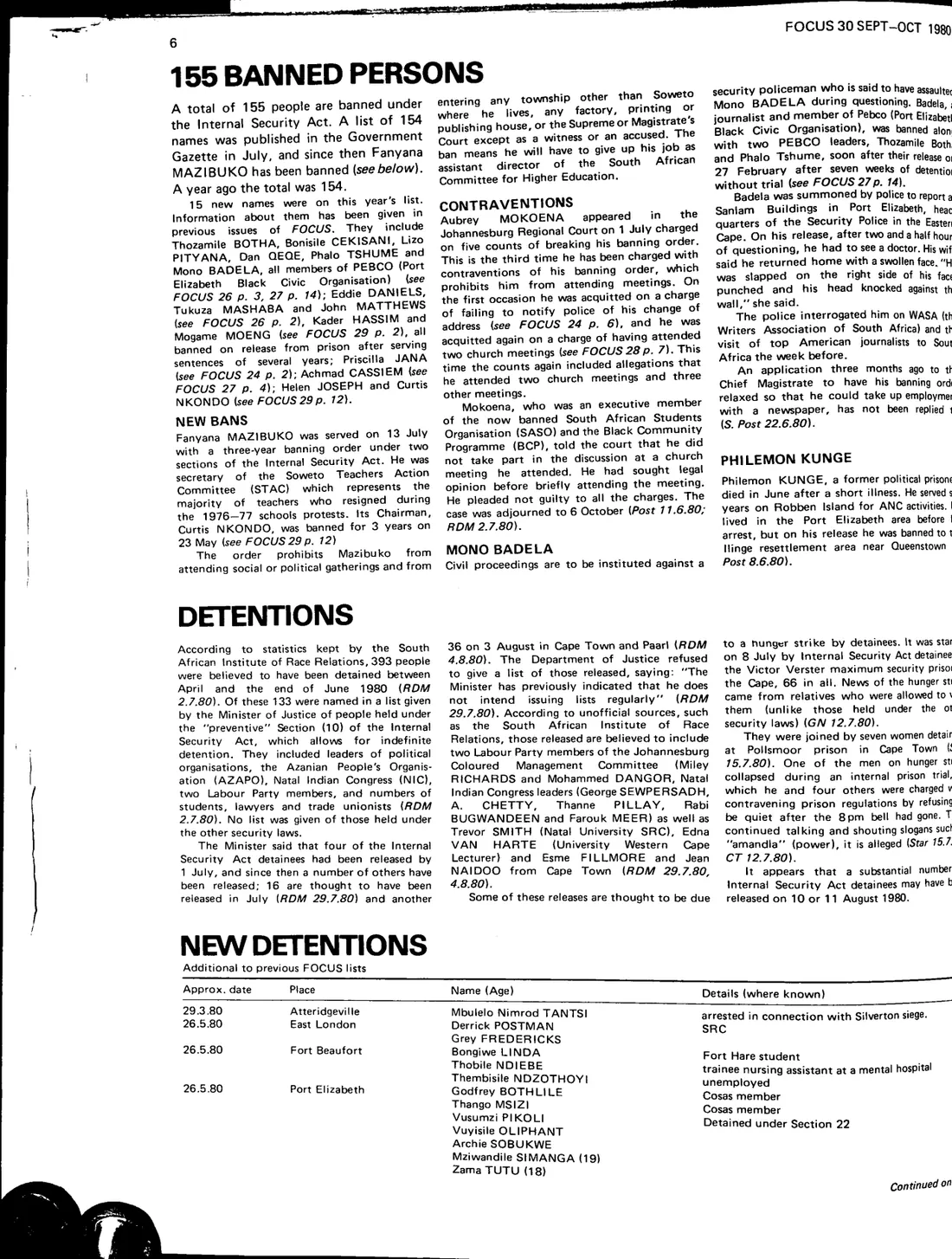
A total of 155 people are banned under the Internal Security Act. A list of 154 names was published in the Government Gazette in July, and since then Fanyana MAZIBUKO has been banned. A year ago the total was 154.
15 new names were on this year's list. Information about them has been given in previous issues of FOCUS. They include Thozamile BOTHA, Bonisile CEKISANI, Lizo PITYANA, Dan QEQE, Phalo TSHUME and Mono BADELA, all members of PEBCO (Port Elizabeth Black Civic Organisation); Eddie DANIELS, Tukuza MASHABA and John MATTHEWS, Kader HASSIM and Mogame MOENG, all banned on release from prison after serving sentences of several years; Priscilla JANA; Achmad CASSIEM; Helen JOSEPH and Curtis NKONDO.
Fanyana MAZIBUKO was served on 13 July with a three-year banning order under two sections of the Internal Security Act. He was secretary of the Soweto Teachers Action Committee (STAC) which represents the majority of teachers who resigned during the 1976-77 schools protests. Its Chairman, Curtis NKONDO, was banned for 3 years on 23 May.
The order prohibits Mazibuko from attending social or political gatherings and from entering any township other than Soweto where he lives, any factory, printing or publishing house, or the Supreme or Magistrate's Court except as a witness or an accused. The ban means he will have to give up his job as assistant director of the South African Committee for Higher Education.
Aubrey MOKOENA appeared in the Johannesburg Regional Court on 1 July charged on five counts of breaking his banning order. This is the third time he has been charged with contraventions of his banning order, which prohibits him from attending meetings. On the first occasion he was acquitted on a charge of failing to notify police of his change of address, and he was acquitted again on a charge of having attended two church meetings. This time the counts again included allegations that he attended two church meetings and three other meetings.
Mokoena, who was an executive member of the now banned South African Students Organisation (SASO) and the Black Community Programme (BCP), told the court that he did not take part in the discussion at a church meeting he attended. He had sought legal opinion before briefly attending the meeting. He pleaded not guilty to all the charges. The case was adjourned to 6 October.
Civil proceedings are to be instituted against a security policeman who is said to have assaulted Mono BADELA during questioning. Badela, a journalist and member of Pebco (Port Elizabeth Black Civic Organisation), was banned along with two PEBCO leaders, Thozamile Botha and Phalo Tshume, soon after their release on 27 February after seven weeks of detention without trial.
Badela was summoned by police to report a Sanlam Buildings in Port Elizabeth, head quarters of the Security Police in the Eastern Cape. On his release, after two and a half hours of questioning, he had to see a doctor. His wife said he returned home with a swollen face. "It was slapped on the right side of his face and punched and his head knocked against the wall," she said.
The police interrogated him on WASA (the Writers Association of South Africa) and the visit of top American journalists to South Africa the week before.
An application three months ago to the Chief Magistrate to have his banning order relaxed so that he could take up employment with a newspaper, has not been replied to.
Philemon KUNGE, a former political prisoner died in June after a short illness. He served 10 years on Robben Island for ANC activities. He lived in the Port Elizabeth area before the arrest, but on his release he was banned to living resettlement area near Queenstown.
According to statistics kept by the South African Institute of Race Relations, 393 people were believed to have been detained between April and the end of June 1980. Of these 133 were named in a list given by the Minister of Justice of people held under the "preventive" Section (10) of the Internal Security Act, which allows for indefinite detention. They included leaders of political organisations, the Azanian People's Organisation (AZAPO), Natal Indian Congress (NIC), two Labour Party members, and numbers of students, lawyers and trade unionists. No list was given of those held under the other security laws.
The Minister said that four of the Internal Security Act detainees had been released by 1 July, and since then a number of others have been released; 16 are thought to have been released in July and another 36 on 3 August in Cape Town and Paarl. The Department of Justice refused to give a list of those released, saying: "The Minister has previously indicated that he does not intend issuing lists regularly". According to unofficial sources, such as the South African Institute of Race Relations, those released are believed to include two Labour Party members of the Johannesburg Coloured Management Committee (Miley RICHARDS and Mohammed DANGOR, Natal Indian Congress leaders (George SEWPERSADH, A. CHETTY, Thanne PILLAY, Rabi BUGWANDEEN and Farouk MEER) as well as Trevor SMITH (Natal University SRC), Edna VAN HARTE (University Western Cape Lecturer) and Esme FILLMORE and Jean NAIDOO from Cape Town.
Some of these releases are thought to be due to a hunger strike by detainees. It was started on 8 July by Internal Security Act detainees the Victor Verster maximum security prison, the Cape, 66 in all. News of the hunger strike came from relatives who were allowed to visit them (unlike those held under the other security laws).
They were joined by seven women detained at Pollsmoor prison in Cape Town. One of the men on hunger strike collapsed during an internal prison trial, which he and four others were charged with contravening prison regulations by refusing to be quiet after the 8pm bell had gone. The continued talking and shouting slogans such as "amandla" (power), it is alleged.
It appears that a substantial number of Internal Security Act detainees may have been released on 10 or 11 August 1980.