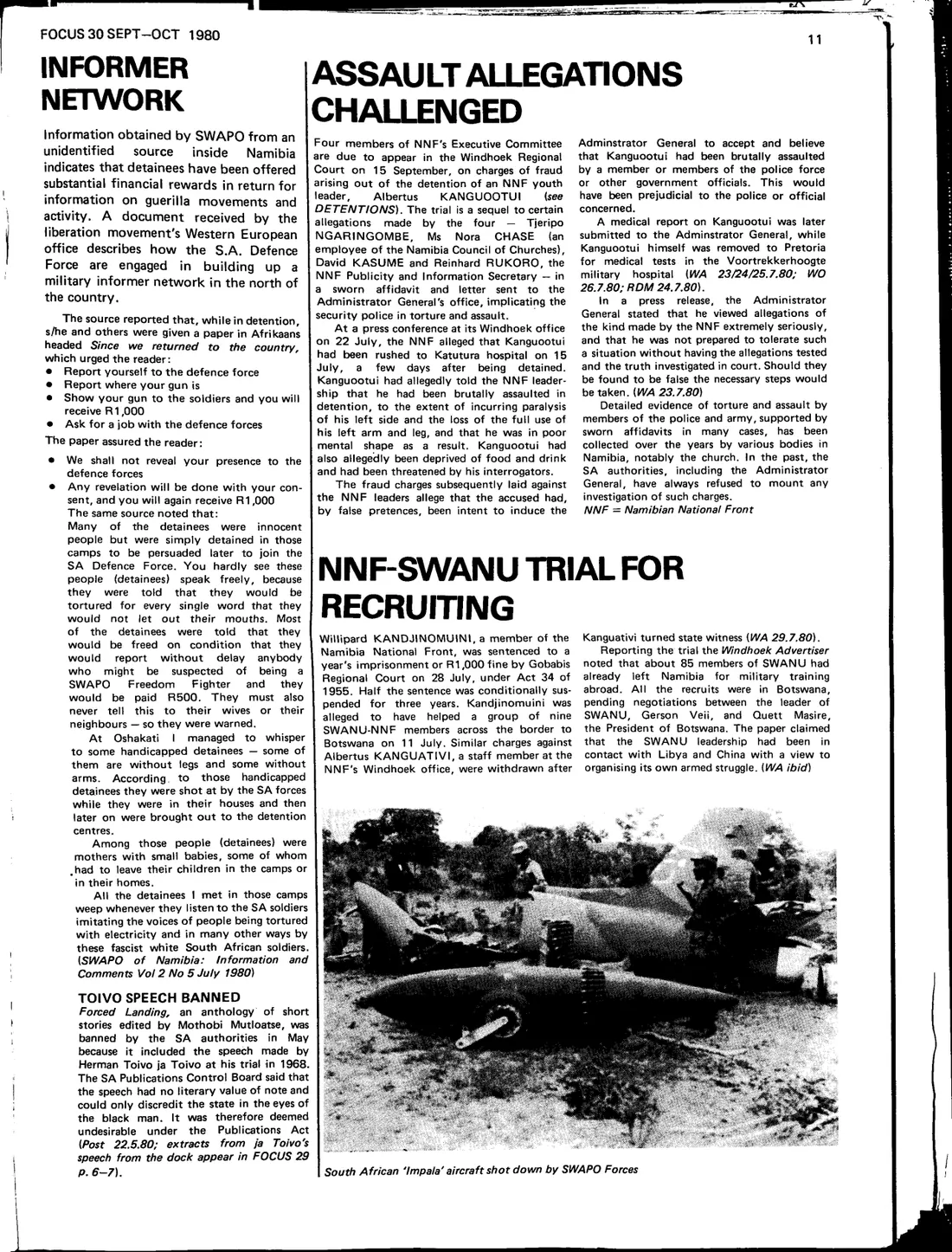
Attacks mounted by the SADF into Angola's southern provinces during June and July 1980 constitute the most serious South African aggression against this front line state since 1975-76. The situation in southern Angola has nevertheless attracted relatively little attention in the Western press and media.
In a statement issued at the beginning of August by the Political Bureau of its Central Committee, the MPLA Workers' Party said that South Africa's attacks on Angola since the beginning of June had "in fact assumed the proportions of an invasion of Angola's free and sovereign territory, when one (considers) the material and human resources being used and the depths of penetration into the territory of our fatherlands". Although the military tide appears to have turned in favour of the Angolan defending forces at the end of June, SA attacks were still continuing more than a month later.
According to figures issued by the Angolan government, South Africa mounted 529 incursions of various kinds into the provinces of Cunene, Cuando Cubango, Huila and Mossamedes over the six month period January – June 1980. This total comprised 476 reconnaissance flights, 27 bombing attacks, seven strafing attacks involving machine gun fire from the SA air force along the Lubango-N’jiva road, four parachute drops, and two major ground attacks and artillery bombardments against Angolan military units. There were 13 instances of troop concentrations along the Angolan frontier.
On 7 June, this long established and systematic pattern of SA aggression escalated sharply when 3,000 SA troops, according to Angolan figures, Mirage aircraft and ML-90 tanks, supported by armoured personnel carriers, transport planes and helicopters, were deployed into southern Angola in what the South Africans termed "Operation Smokeshell". The South Africans entrenched themselves at various positions in the southern provinces and fighting continued. On 28 June, a battalion of FAPLA troops (Angolan regulars) succeeded in dislodging the South Africans from the town of Mongua. Evale was retaken on 1 July after heavy fighting.
A communique issued by the Angolan Ministry of Defence said that FAPLA troops were then able to establish defensive positions on the line Xangongo-Mongua-Evale and to mount a counter-offensive. Cuamato and Chiede were retaken on 2 July, and the village of Mulemba, where the South Africans had installed their command post, on 4 July.
Despite denials from the SA authorities, the Angolan government reported that eight SA infantry battalions remained in southern Angola, particularly Cunene province. Over the month from 7 June, 600 people were killed in the attacks. On 3 July, for example, two people were reported killed, and three wounded, when two SA Mirages strafed an ambulance carrying three patients to the Tchiulo hospital 90 km from the Angolan border.
Speaking at the end of July, the Commander of the Fifth Angolan Military Region said that although South Africa had started to withdraw its troops from the interior of Angola, its territorial violations and landing tactics continued. The SAAF were still making daily reconnaissance flights along the Angolan frontier, while attempting to infiltrate UNITA bands into Angola.
On 12 July, for example, SA troops were reported to have attacked the head office of Calai municipality near the Namibian border. Boatloads of SA soldiers were sent across the Cubango river in an attempt to occupy the town of Calai. Five SA lorries were also seen transporting metal bridges to the confluence of the Cubango and Cafulo rivers. Six SA soldiers were reported killed and two boats sunk by the Angolan forces.
On 28 July, allegedly in response to a mortar attack by SWAPO guerillas on the town of Rucana in northern Namibia, in which six SADF personnel were killed, SA airborne troops penetrated into the area between Cuamato and N'jiva on the Angolan side. The town of Chitade, 20 miles inside Angola, was attacked by a helicopter-borne force and occupied for a 10 hour period. A SADF spokesman said that 27 Angolan soldiers and SWAPO guerillas had been killed and that all the 80 SA troops involved had been withdrawn after blowing up buildings in the town and conducting a house-to-house search for arms, ammunition and documents. Chitado was allegedly used by SWAPO as a transit camp for incursions into the Kaoko region of north-western Namibia. The spokesman added that about 20,000 leaflets had been dropped on Chitade before the raid "explaining" that the South Africans did not wish to fight Angolans.