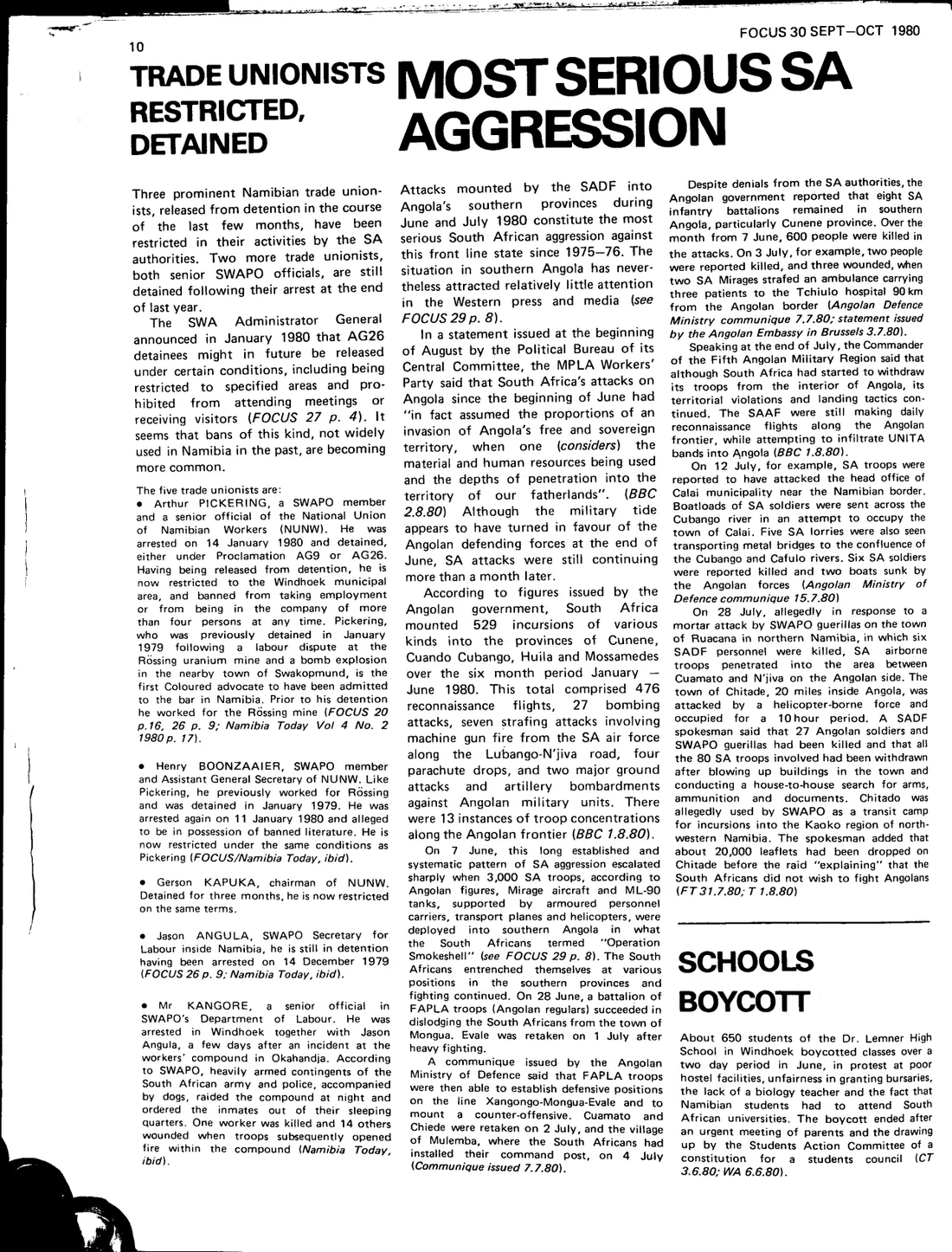
The head of the security police in Namibia, Col. Johan van der Merwe, stated on 15 July that a total of 11 people were at that time being detained under Proclamation AG 26. He said that 15 detainees had been conditionally released in the course of the past few months, and that there had been no new detentions recently.
Proclamation AG 26 was promulgated by the SWA Administrator General in April 1978. It provides for the indefinite detention of persons who "promote violence or intimidation".
Those still detained under AG 26 include:-
Axel JOHANNES, SWAPO Administrative Secretary, arrested and detained at the end of April 1979 in a countrywide purge of the SWAPO leadership.
Skinny HILUNDWA, Chairman of SWAPO's Northern region, detained at the end of April 1979.
Johannes KONJORE, Secretary of the SWAPO Youth League, detained in October 1979, following an attempt by the liberation movement to reopen its Windhoek office.
Jason ANGULA, SWAPO Secretary for Labour, detained in December 1979.
An unknown number of people, in addition, are detained under Proclamation AG 9, the "martial law" regulations. AG 9, promulgated in 1977, was amended by the Administrator General in May 1979 to provide for detention without charge for up to 30 days for persons arrested in "security districts". Approximately 80% of Namibia's population live in security districts, under de facto martial law.
Two leaders of the Youth League of the Namibia National Front, Lazarus NUNUHE and Albertus KANGUOTUI, were arrested and detained under AG 9 in the first half of July. Other recent detentions, probably under AG 9, include:-
Rev. Titus NGULA, a Lutheran pastor from Ovamboland, detained on 26 May 1980
Rev. Micah ILONGA, a Lutheran pastor from Okahao and Dean of the Western Area, detained on 27 May
Kefas SHIPUATA, Nangolo JACOB and Sylvanus VATURE, all businessmen, detained on 27 May.
Eliakim NAMUNDJEBO, a businessman and church warden of St. Mary's, Odibo, arrested at the Kalahari Sands Hotel, Windhoek, around 11 June.
Amon KALOMBO, a headman from Onamutayi.
Col. van der Merwe confirmed in May that two men were being detained in connection with an armed guerilla attack on a farm three months previously. Police dockets had been handed to the SWA Attorney General for possible prosecution. The attack, in which no-one was killed, took place on the farm Goabis, about 82 km north-east of Grootfontein, in February 1980.
The small but influential elite of wealthy Ovambo businessmen appears to have joined church and political leaders as a particular target for arrest and detention. A number of such businessmen have also been murdered by persons unknown, but suspected by SWAPO to be South African soldiers or government agents.
The Windhoek Observer has suggested that police operations against the Ovambo business community have been prompted by the fact that a number of businessmen have paid substantial amounts of money to SWAPO and that some of them have sons or close relatives fighting in the guerilla movement. The newspaper claimed that "Windhoek's wholesalers are facing a potential crisis because the collective value of the men suspected of SWAPO activities and support, run (sic) into tens of millions of Rand". The arrest of so many shop owners and entrepreneurs implied, the paper suggested, that in future an increasing proportion of commerce would be channeled through the state corporation ENOK.
Eliakim NAMUNDJEBO (41), for example (see above), was arrested in his suite at the Kalahari Sands hotel by six plainclothes secret police. He is one of Namibia's richest black men providing valuable business for Windhoek wholesalers, in turn supplied by South African manufacturers. His wife said she was afraid of never seeing him again.
According to unconfirmed reports, Axel JOHANNES has been released from detention, together with two other SWAPO officials, Rahimiese KAHIMIESE and Immanuel MWATARA. They had all been detained in April 1979. It is not known whether they have been placed under restriction.