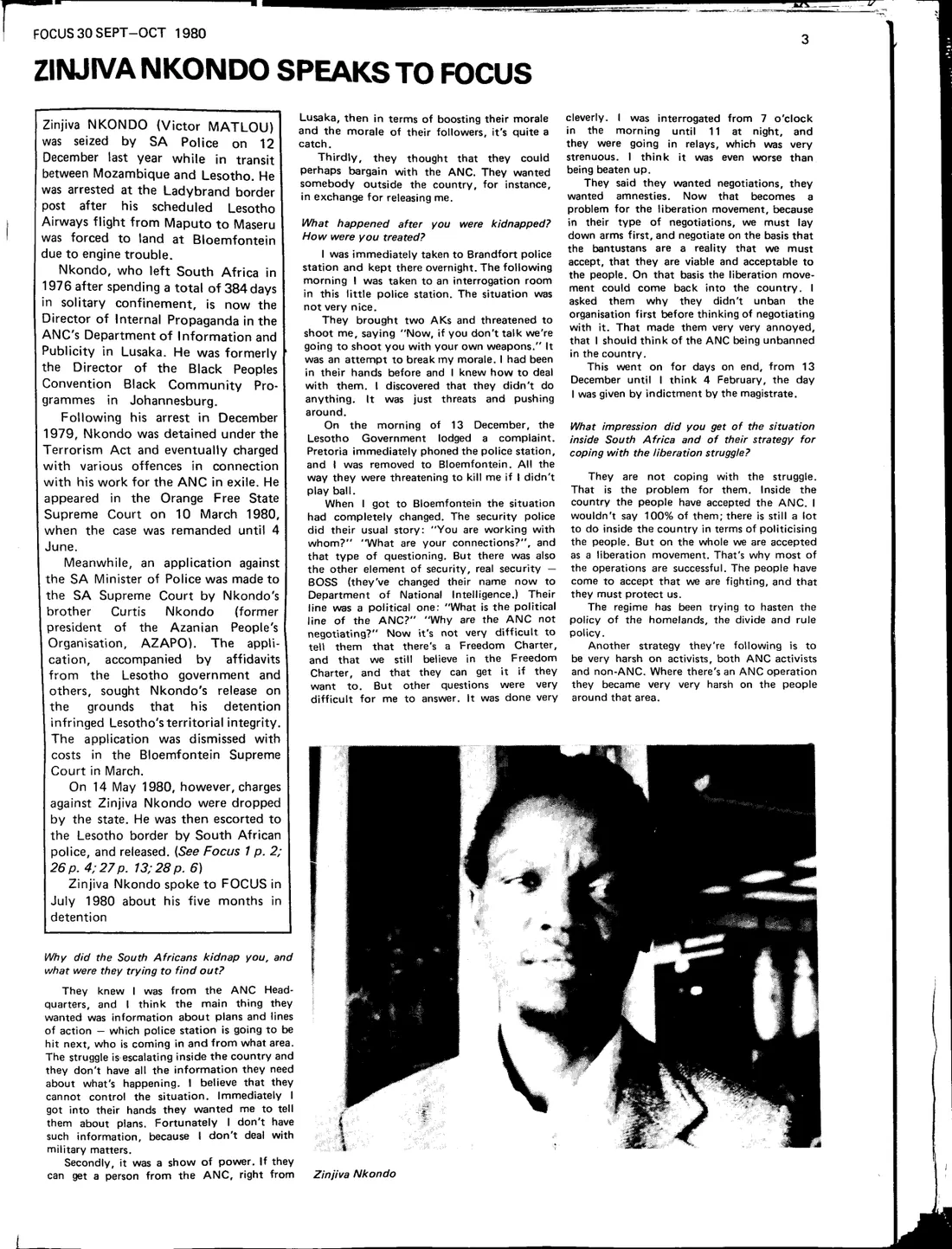
Zinjiva NKONDO (Victor MATLOU) was seized by SA Police on 12 December last year while in transit between Mozambique and Lesotho. He was arrested at the Ladybrand border post after his scheduled Lesotho Airways flight from Maputo to Maseru was forced to land at Bloemfontein due to engine trouble.
Nkondo, who left South Africa in 1976 after spending a total of 384 days in solitary confinement, is now the Director of Internal Propaganda in the ANC's Department of Information and Publicity in Lusaka. He was formerly the Director of the Black Peoples Convention Black Community Programs in Johannesburg.
Following his arrest in December 1979, Nkondo was detained under the Terrorism Act and eventually charged with various offences in connection with his work for the ANC in exile. He appeared in the Orange Free State Supreme Court on 10 March 1980, when the case was remanded until 4 June.
Meanwhile, an application against the SA Minister of Police was made to the SA Supreme Court by Nkondo's brother Curtis Nkondo (former president of the Azanian People's Organisation, AZAPO). The application, accompanied by affidavits from the Lesotho government and others, sought Nkondo's release on the grounds that his detention infringed Lesotho's territorial integrity. The application was dismissed with costs in the Bloemfontein Supreme Court in March.
On 14 May 1980, however, charges against Zinjiva Nkondo were dropped by the state. He was then escorted to the Lesotho border by South African police, and released.
Zinjiva Nkondo spoke to FOCUS in July 1980 about his five months in detention.
Why did the South Africans kidnap you, and what were they trying to find out?
They knew I was from the ANC Headquarters, and I think the main thing they wanted was information about plans and lines of action — which police station is going to be hit next, who is coming in and from what area. The struggle is escalating inside the country and they don't have all the information they need about what's happening. I believe that they cannot control the situation. Immediately I got into their hands they wanted me to tell them about plans. Fortunately I don't have such information, because I don't deal with military matters.
Secondly, it was a show of power. If they can get a person from the ANC, right from Lusaka, then in terms of boosting their morale and the morale of their followers, it's quite a catch.
Thirdly, they thought that they could perhaps bargain with the ANC. They wanted somebody outside the country, for instance, in exchange for releasing me.
What happened after you were kidnapped? How were you treated?
I was immediately taken to Brandfort police station and kept there overnight. The following morning I was taken to an interrogation room in this little police station. The situation was not very nice.
They brought two AKs and threatened to shoot me, saying "Now, if you don't talk we're going to shoot you with your own weapons." It was an attempt to break my morale. I had been in their hands before and I knew how to deal with them. I discovered that they didn't do anything. It was just threats and pushing around.
On the morning of 13 December, the Lesotho Government lodged a complaint. Pretoria immediately phoned the police station, and I was removed to Bloemfontein. All the way they were threatening to kill me if I didn't play ball.
When I got to Bloemfontein the situation had completely changed. The security police did their usual story: "You are working with whom?" "What are your connections?", and that type of questioning. But there was also the other element of security, real security — BOSS (they've changed their name now to Department of National Intelligence.) Their line was a political one: "What is the political line of the ANC?" "Why are the ANC not negotiating?" Now it's not very difficult to tell them that there's a Freedom Charter, and that we still believe in the Freedom Charter, and that they can get it if they want to. But other questions were very difficult for me to answer. It was done very cleverly. I was interrogated from 7 o'clock in the morning until 11 at night, and they were going in relays, which was very strenuous. I think it was even worse than being beaten up.
They said they wanted negotiations, they wanted amnesties. Now that becomes a problem for the liberation movement, because in their type of negotiations, we must lay down arms first, and negotiate on the basis that the bantustans are a reality that we must accept, that they are viable and acceptable to the people. On that basis the liberation movement could come back into the country. I asked them why they didn't unban the organisation first before thinking of negotiating with it. That made them very very annoyed, that I should think of the ANC being unbanned in the country.
This went on for days on end, from 13 December until I think 4 February, the day I was given by indictment by the magistrate.
What impression did you get of the situation inside South Africa and of their strategy for coping with the liberation struggle?
They are not coping with the struggle. That is the problem for them. Inside the country the people have accepted the ANC. I wouldn't say 100% of them; there is still a lot to do inside the country in terms of politicising the people. But on the whole we are accepted as a liberation movement. That's why most of the operations are successful. The people have come to accept that we are fighting, and that they must protect us.
The regime has been trying to hasten the policy of the homelands, the divide and rule policy.
Another strategy they're following is to be very harsh on activists, both ANC activists and non-ANC. Where there's an ANC operation they became very very harsh on the people around that area.