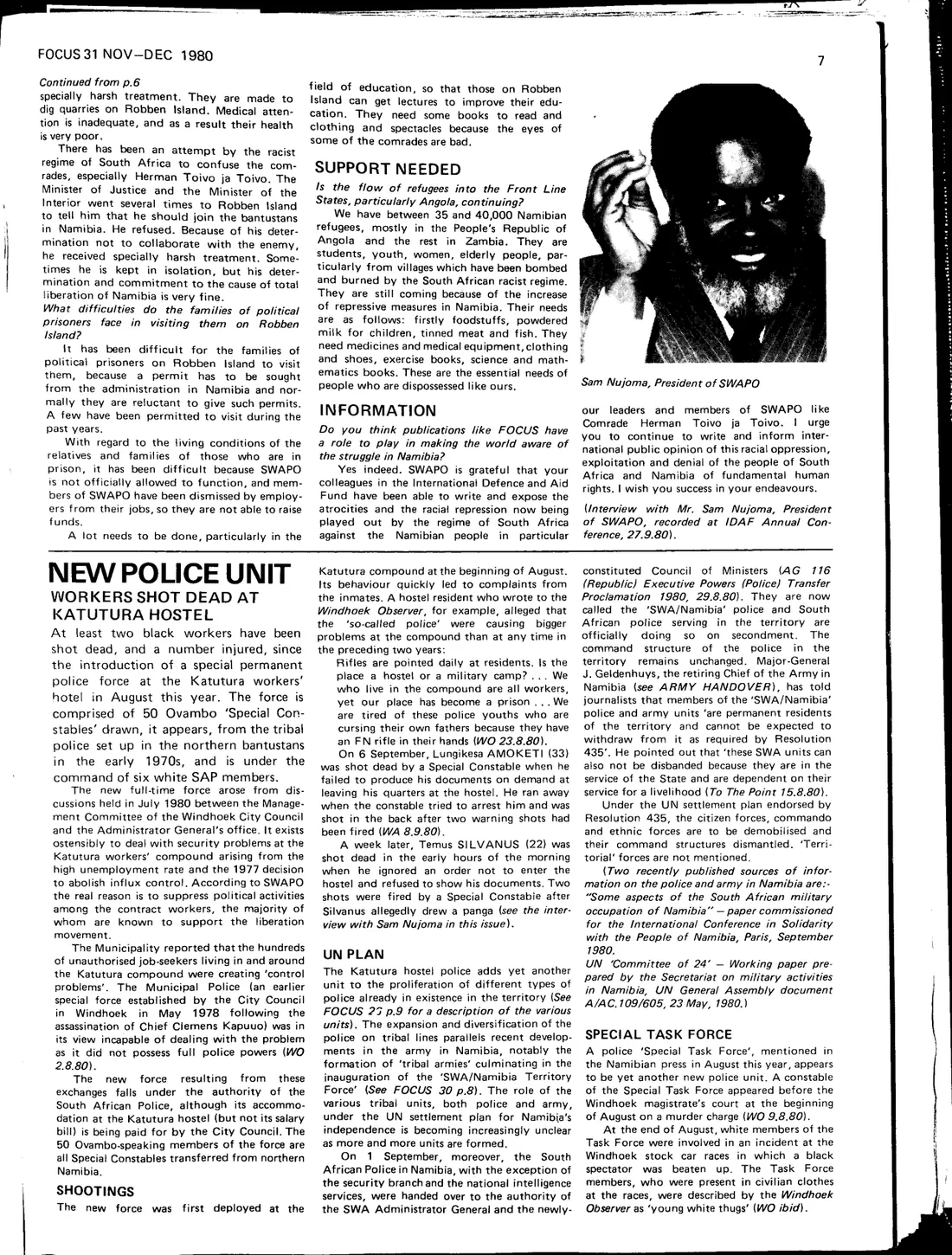
Mr. Sam Nujoma, President of SWAPO, was a special guest at the IDAF Annual Conference which took place in Weybridge, Britain, on 26–28 September, 1980. In his address to delegates, Mr. Nujoma paid special tribute to the work of the IDAF and particularly to its President, Canon L.J. Collins. He praised Canon and Mrs. Collins 'for their dynamism, clear vision and sense of sympathy and understanding of the problems of fascism, repression and brutalisation of the people of Southern Africa by the white minority racist regime of South Africa'.
'During the 17 years of his leadership of the IDAF, Canon Collins has consistently dedicated a relentless commitment to the fight against the abhorrent policies of racial enslavement, exploitation and dehumanisation of the majority of the Southern African people', Mr. Nujoma said. He thanked the Fund for providing 'documentation, publications and comprehensive information on the practices of the racist South African regime in South Africa and Namibia', thus helping to 'raise the consciousness of the world community on all aspects of the deplorable situation in Southern Africa'.
Mr. Nujoma spoke of the serious threat of war facing the entire international community, and arising from South Africa's military build-up. He pointed to the attacks on Zambia and Angola, the deployment of mercenaries and the increasing militarisation of Namibia. South Africa had deployed its divisions, armed with Mirages, Buccaneer bombers, Impalas, helicopters and tanks, against the People's Republic of Angola under the pretext of bombing SWAPO bases. Hundreds of civilians, particularly women and children in villages in the bush, had been killed and maimed. Mr. Nujoma criticised the Western powers for failing to act on appeals from Zambia and Angola, and noted that very little publicity had been given in the Western press to South African aggression against neighbouring independent African countries.
The President of SWAPO warned that the political situation in Namibia was critical. South Africa was deploying all methods to destroy SWAPO, without actually banning the organisation. He described the methods used by the security police of arrest, detention and torture of opponents of the regime, and gave details of a number of recent cases resulting in deaths and disappearances of prominent businessmen and other individuals. He warned that 'South Africa wants to make Namibia a permanent base and a battleground'.
Questioned about the Kassinga detainees, Mr. Nujoma confirmed previous reports from other sources that they are being held in a detention camp at Hardap Dam. He said that a local farmer, who had inadvertently come across the camp, saw the detainees and confirmed the mutilations they are reported to have suffered. Mr. Nujoma pointed out that SWAPO was treating South African prisoners of war according to the Geneva Conventions, while South Africa treated SWAPO freedom fighters as criminals. He expressed grave concern about the conditions of detention of SWAPO guerillas, and about the disappearance of people.
PRESIDENT NUJOMA SPEAKS TO FOCUS REPRESSION *What are the distinctive features of political repression in Namibia?* It started with the Terrorism Act in 1967, which was passed after the launching of the armed struggle in 1966. SWAPO leaders who were arrested, including Herman Toivo ja Toivo, remained in prison for one year without trial while the Act was being formulated. Many of our colleagues were arrested under the Terrorism Act, which was applied in South Africa itself later.
During the country-wide strike in 1971/2, the administration proclaimed a state of emergency. This was in fact similar to the Terrorism Act and strengthened the position of the police and army to act without recourse to the Courts.
Early last year, the South African Administrator General Steyn proclaimed martial law to protect the soldiers and empower them to carry out all kinds of torture and even kill people. The families of these victims, lawyers or doctors have often been unable to trace them.
Recently, the South African government have trained a special Murder Squad similar to the Nazi Hitler SS. In Namibia it comprises about 40 whites and 50 blacks. Sometimes the whites paint themselves black and put on uniforms and carry weapons similar to those of SWAPO freedom fighters. They attack people, they shoot people, they rape women. The South African radio will then broadcast immediately that SWAPO guerilla fighters have done this. Landmines are planted on roads, killing people.
South African soldiers and tribal armies are encircling the workers' compound at Katutura on the outskirts of Windhoek. They have so far killed two workers and injured more than four. They are there to threaten the people because they consider this to be a hotbed of SWAPO.
*Do you think that South Africa's claims that apartheid is being abolished in Namibia have any truth?* The regime was compelled by our military and political actions to create the cosmetic sort of changes they have made, to allow some Africans who are well-dressed to enter certain hotels and restaurants. SWAPO does not fight for reforms in the colonial system, we are fighting to completely overthrow and uproot all the colonial institutions that have been imposed on our people. The kind of independence South Africa envisages for Namibia is nothing but the bantustans.
ORGANISATIONAL PROBLEMS *With the growing repression, what difficulties is SWAPO facing in mobilising people inside the country?* The difficulties are certainly there. Our comrades the party functionaries in Windhoek and the entire leadership have been arrested, they are in detention right now. Some of them are restricted to their residences and not allowed to move without police permits.
The main aim is to silence SWAPO. There is a policeman, who is armed, to see who is opening the office. As soon as somebody enters the office he is seized, taken to the police and thrown into prison under the notorious Proclamation AG26. Our office is still there, but it is not opened because of this constant harrassment, arrest and torture of SWAPO leaders and members.
We are able to mobilise the masses of the people politically because the majority of Africans in Namibia today are politically mature. We organise all kinds of meetings, we also broadcast from Zambia, from Tanzania and Angola, telling the people to be on the alert. Of course our army is already striking up to Windhoek and the south of Windhoek. Hundreds and hundreds of people from all walks of life in Namibia, students, youth, women, workers, intellectuals, are daily joining the People's Liberation Army of Namibia. We rely on our people and with their support there is no doubt we will win the final victory.
POLITICAL PRISONERS *Do you have any up-to-date information on conditions for Namibian prisoners on Robben Island?* The scant information we have received about the health conditions of our colleagues is that they are terribly bad. They are given specially harsh treatment. They are made to dig quarries on Robben Island. Medical attention is inadequate, and as a result their health is very poor.
There has been an attempt by the racist regime of South Africa to confuse the comrades, especially Herman Toivo ja Toivo. The Minister of Justice and the Minister of the Interior went several times to Robben Island to tell him that he should join the bantustans in Namibia. He refused. Because of his determination not to collaborate with the enemy, he received specially harsh treatment. Sometimes he is kept in isolation, but his determination and commitment to the cause of total liberation of Namibia is very fine.
What difficulties do the families of political prisoners face in visiting them on Robben Island? It has been difficult for the families of political prisoners on Robben Island to visit them, because a permit has to be sought from the administration in Namibia and normally they are reluctant to give such permits. A few have been permitted to visit during the past years.
With regard to the living conditions of the relatives and families of those who are in prison, it has been difficult because SWAPO is not officially allowed to function, and members of SWAPO have been dismissed by employers from their jobs, so they are not able to raise funds.
A lot needs to be done, particularly in the field of education, so that those on Robben Island can get lectures to improve their education. They need some books to read and clothing and spectacles because the eyes of some of the comrades are bad.
SUPPORT NEEDED Is the flow of refugees into the Front Line States, particularly Angola, continuing? We have between 35 and 40,000 Namibian refugees, mostly in the People's Republic of Angola and the rest in Zambia. They are students, youth, women, elderly people, particularly from villages which have been bombed and burned by the South African racist regime. They are still coming because of the increase of repressive measures in Namibia. Their needs are as follows: firstly foodstuffs, powdered milk for children, tinned meat and fish. They need medicines and medical equipment, clothing and shoes, exercise books, science and mathematics books. These are the essential needs of people who are dispossessed like ours.
INFORMATION Do you think publications like FOCUS have a role to play in making the world aware of the struggle in Namibia? Yes indeed. SWAPO is grateful that your colleagues in the International Defence and Aid Fund have been able to write and expose the atrocities and the racial repression now being played out by the regime of South Africa against the Namibian people in particular our leaders and members of SWAPO like Comrade Herman Toivo ja Toivo. I urge you to continue to write and inform international public opinion of this racial oppression, exploitation and denial of the people of South Africa and Namibia of fundamental human rights. I wish you success in your endeavours.