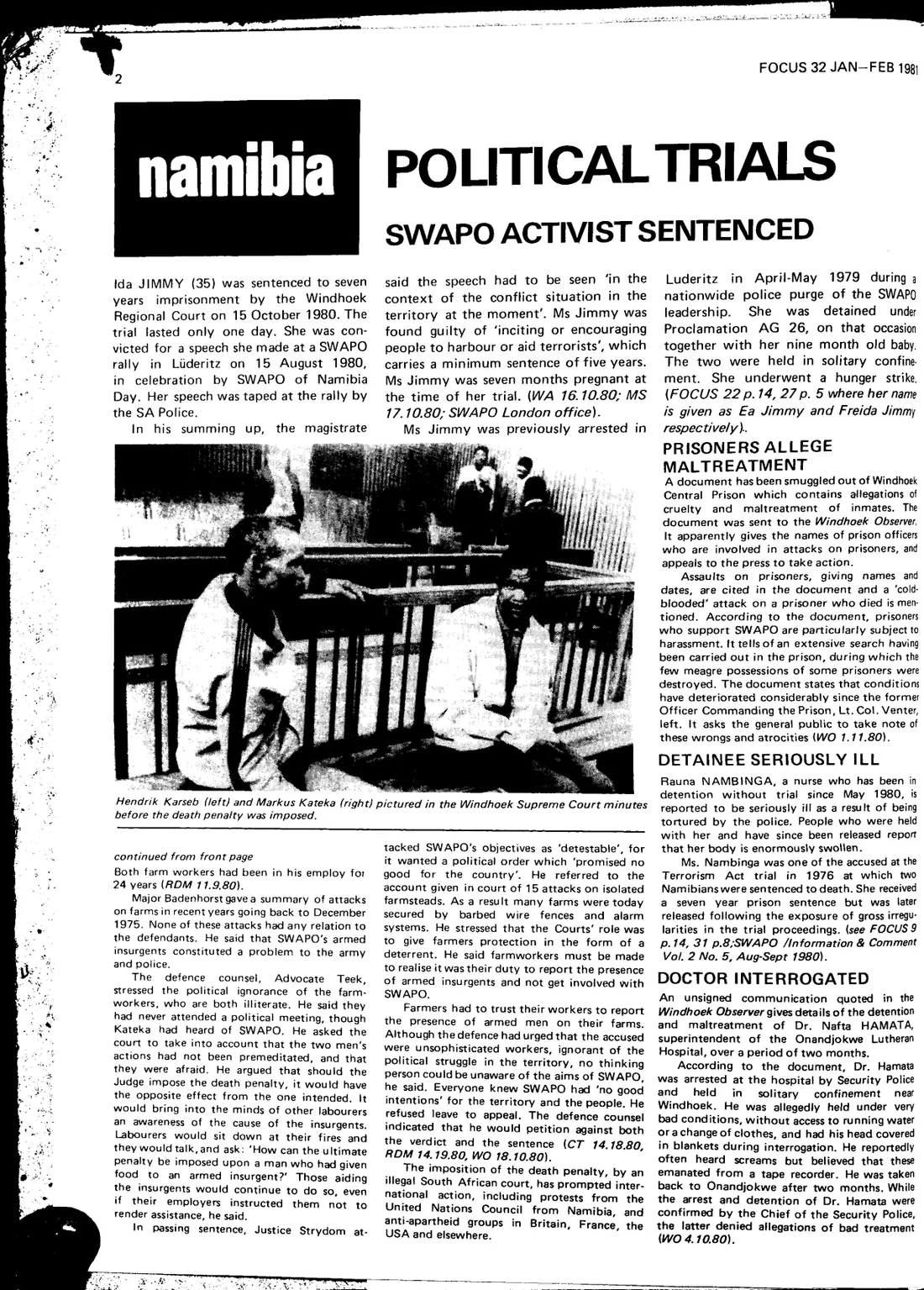
On 13 October 1980, Markus KATEKA (40), a Namibian farm labourer, was sentenced to death in the Windhoek Supreme Court. Hendrik KARISEB (45), also a farmworker, was given a prison sentence of 10 years. Both were convicted on charges under the Terrorism Act. Leave to appeal was refused.
The death penalty has in only one trial been previously imposed in Namibia in connection with political charges under the Terrorism Act. In May 1976, Aaron MUCHIMBA, SWAPO's National Organising Secretary, and Hendrik SHIKONGO, a SWAPO member, were sentenced to death after a three-month trial in Swakopmund Supreme Court. Their sentences were set aside and their convictions cancelled by the Appellate Division of the Bloemfontein Supreme Court in May 1977, after evidence of serious irregularities in the original trial had been produced by the defence. They were released from prison.
M. Kateka and H. Kariseb were first arrested in May 1980 in connection with an armed guerilla attack on Goabis farm in the Grootfontein district on 17 February 1980. No one was killed or injured in the attack.
The trial opened in the Windhoek Supreme Court on 27 August 1980. The two men were charged with participating in guerilla activities, alternatively with aiding and abetting guerillas. Advocate Pio Teek appeared pro deo for the defence.
The State alleged that the two accused had supplied SWAPO guerillas with food and accommodation on the farm where they were employed and had 'urged, advised and instigated' the guerillas to murder the Louw family who own the farm, as well as relatives on a neighbouring farm. According to the prosecution, Kateka left the farm on 16 February 1980 to take some porridge and milk to his brother-in-law on a neighbouring farm. It was later allegedly discovered that he had no relatives there and had not delivered food. He had returned to his living quarters later that night, allegedly accompanied by two armed men. Another farm labourer, who normally shared living quarters with Kateka, was asked to sleep in another room to provide space for the men. According to the prosecution, the two armed men were given a meal by Kateka that night and left in the morning. Later that morning, two different SWAPO men arrived. They allegedly convened a meeting of all the farmworkers and took them in to the bush where they were joined by a group of guerillas. Advocate Hiemstra, for the state, said both accused complained to the guerillas about their conditions of employment, and provided information about the occupants of the farm. He alleged that Kateka and Kariseb told the guerillas that their employers must be killed, and urged that the Louws' son, who occupies a neighbouring farm, should also be killed.
Kateka sketched a plan of the farmstead on the ground and explained where the various rooms were, the prosecution claimed. Kariseb offered to go with Kateka and the guerillas and show them the layout of the farmstead. They left with some of the guerillas in the direction of the house, while two armed men stayed behind to look after the other employees. A short while later, the farm was attacked by the guerillas. The accused rejoined the other farmworkers allegedly telling them that Mr. Louw was dead.
The prosecution called a number of witnesses, including Jacobus Francois Louw (60), the owner of the farm, and Major Gerrit Badenhorst of the Police Security Branch in Windhoek. As in the Muchimba/Shikongo trial, the court proceedings concentrated on discrediting SWAPO as a political organisation and on presenting any association with SWAPO as leading to 'terrorist' activities. Louw said he had regarded the two accused as among his most trusted workers; they were both foremen. He said that prior to the attack, one of his workers had warned him to be careful of Kariseb because he was 'SWAPO oriented'. On the day of the attack he had instructed Kariseb to warn a family on a neighbouring farm of guerilla presence in the area, but Kariseb had refused. After that he had dismissed Kariseb.
Both farm workers had been in his employ for 24 years. Major Badenhorst gave a summary of attacks on farms in recent years going back to December 1975. None of these attacks had any relation to the defendants. He said that SWAPO's armed insurgents constituted a problem to the army and police.
The defence counsel, Advocate Teek, stressed the political ignorance of the farmworkers, who are both illiterate. He said they had never attended a political meeting, though Kateka had heard of SWAPO. He asked the court to take into account that the two men's actions had not been premeditated, and that they were afraid. He argued that should the Judge impose the death penalty, it would have the opposite effect from the one intended. It would bring into the minds of other labourers an awareness of the cause of the insurgents. Labourers would sit down at their fires and they would talk, and ask: 'How can the ultimate penalty be imposed upon a man who had given food to an armed insurgent?' Those aiding the insurgents would continue to do so, even if their employers instructed them not to render assistance, he said.
In passing sentence, Justice Strydom attacked SWAPO's objectives as 'detestable', for it wanted a political order which 'promised no good for the country'. He referred to the account given in court of 15 attacks on isolated farmsteads. As a result many farms were today secured by barbed wire fences and alarm systems. He stressed that the Courts' role was to give farmers protection in the form of a deterrent. He said farmworkers must be made to realise it was their duty to report the presence of armed insurgents and not get involved with SWAPO.
Farmers had to trust their workers to report the presence of armed men on their farms. Although the defence had urged that the accused were unsophisticated workers, ignorant of the political struggle in the territory, no thinking person could be unaware of the aims of SWAPO, he said. Everyone knew SWAPO had 'no good intentions' for the territory and the people. He refused leave to appeal. The defence counsel indicated that he would petition against both the verdict and the sentence.
The imposition of the death penalty, by an illegal South African court, has prompted international action, including protests from the United Nations Council from Namibia, and anti-apartheid groups in Britain, France, the USA and elsewhere.