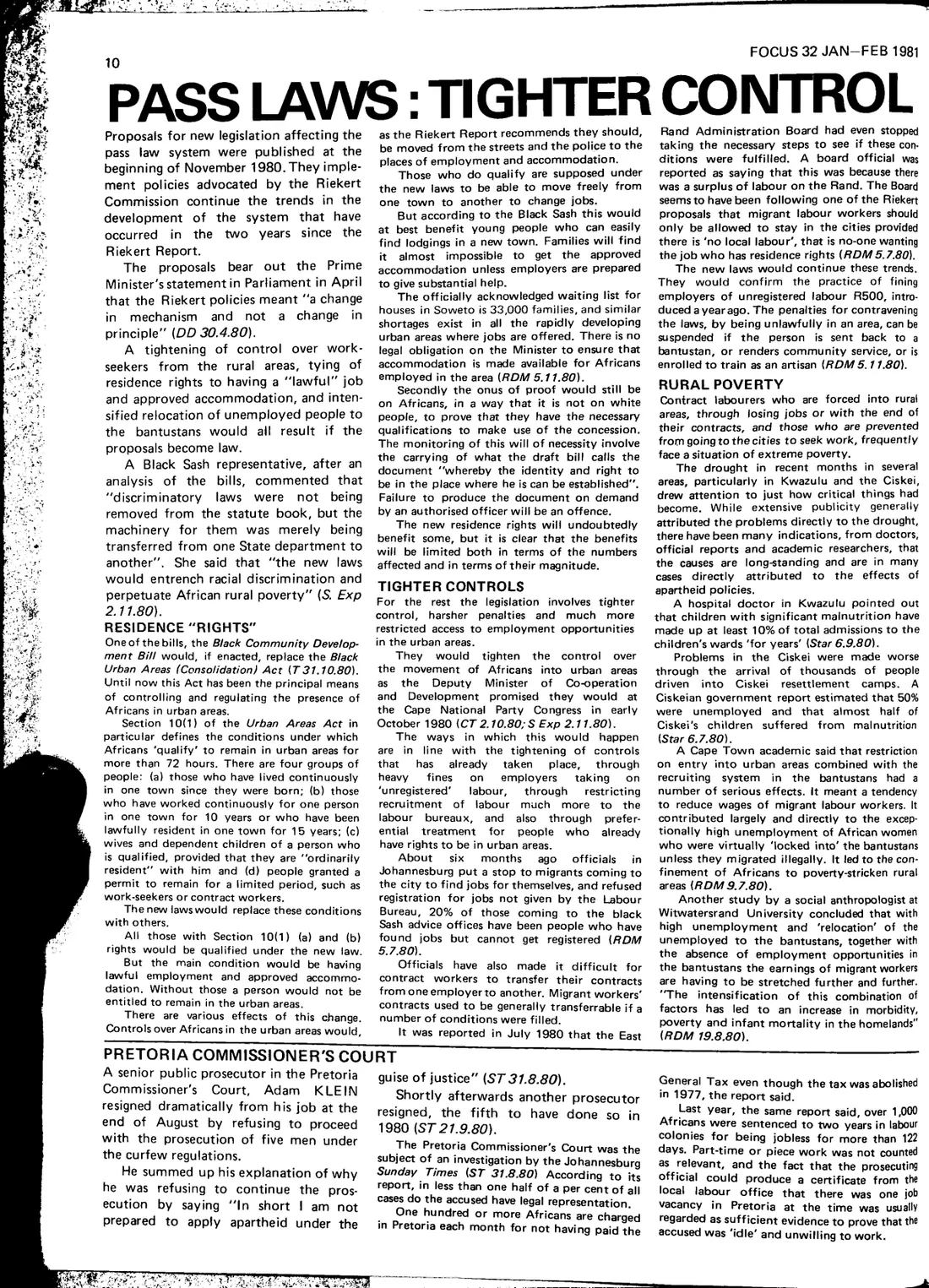
Proposals for new legislation affecting the pass law system were published at the beginning of November 1980. They implement policies advocated by the Riekert Commission continue the trends in the development of the system that have occurred in the two years since the Riekert Report.
The proposals bear out the Prime Minister's statement in Parliament in April that the Riekert policies meant "a change in mechanism and not a change in principle".
A tightening of control over work-seekers from the rural areas, tying of residence rights to having a "lawful" job and approved accommodation, and intensified relocation of unemployed people to the bantustans would all result if the proposals become law.
A Black Sash representative, after an analysis of the bills, commented that "discriminatory laws were not being removed from the statute book, but the machinery for them was merely being transferred from one State department to another". She said that "the new laws would entrench racial discrimination and perpetuate African rural poverty".
One of the bills, the Black Community Development Bill would, if enacted, replace the Black Urban Areas (Consolidation) Act. Until now this Act has been the principal means of controlling and regulating the presence of Africans in urban areas.
Section 10(1) of the Urban Areas Act in particular defines the conditions under which Africans 'qualify' to remain in urban areas for more than 72 hours. There are four groups of people: (a) those who have lived continuously in one town since they were born; (b) those who have worked continuously for one person in one town for 10 years or who have been lawfully resident in one town for 15 years; (c) wives and dependent children of a person who is qualified, provided that they are "ordinarily resident" with him and (d) people granted a permit to remain for a limited period, such as work-seekers or contract workers.
The new laws would replace these conditions with others.
All those with Section 10(1) (a) and (b) rights would be qualified under the new law.
But the main condition would be having lawful employment and approved accommodation. Without those a person would not be entitled to remain in the urban areas.
There are various effects of this change. Controls over Africans in the urban areas would, as the Riekert Report recommends they should, be moved from the streets and the police to the places of employment and accommodation.
Those who do qualify are supposed under the new laws to be able to move freely from one town to another to change jobs.
But according to the Black Sash this would at best benefit young people who can easily find lodgings in a new town. Families will find it almost impossible to get the approved accommodation unless employers are prepared to give substantial help.
The officially acknowledged waiting list for houses in Soweto is 33,000 families, and similar shortages exist in all the rapidly developing urban areas where jobs are offered. There is no legal obligation on the Minister to ensure that accommodation is made available for Africans employed in the area.
Secondly, the onus of proof would still be on Africans, in a way that it is not on white people, to prove that they have the necessary qualifications to make use of the concession. The monitoring of this will of necessity involve the carrying of what the draft bill calls the document "whereby the identity and right to be in the place where he is can be established". Failure to produce the document on demand by an authorised officer will be an offence.
The new residence rights will undoubtedly benefit some, but it is clear that the benefits will be limited both in terms of the numbers affected and in terms of their magnitude.
For the rest the legislation involves tighter control, harsher penalties and much more restricted access to employment opportunities in the urban areas.
They would tighten the control over the movement of Africans into urban areas as the Deputy Minister of Co-operation and Development promised they would at the Cape National Party Congress in early October 1980.
The ways in which this would happen are in line with the tightening of controls that has already taken place, through heavy fines on employers taking on 'unregistered' labour, through restricting recruitment of labour much more to the labour bureaux, and also through preferential treatment for people who already have rights to be in urban areas.
About six months ago officials in Johannesburg put a stop to migrants coming to the city to find jobs for themselves, and refused registration for jobs not given by the Labour Bureau, 20% of those coming to the black Sash advice offices have been people who have found jobs but cannot get registered.
Officials have also made it difficult for contract workers to transfer their contracts from one employer to another. Migrant workers' contracts used to be generally transferrable if a number of conditions were filled.
It was reported in July 1980 that the East Rand Administration Board had even stopped taking the necessary steps to see if these conditions were fulfilled. A board official was reported as saying that this was because there was a surplus of labour on the Rand. The Board seems to have been following one of the Riekert proposals that migrant labour workers should only be allowed to stay in the cities provided there is 'no local labour', that is no-one wanting the job who has residence rights.
The new laws would continue these trends. They would confirm the practice of fining employers of unregistered labour R500, introduced a year ago. The penalties for contravening the laws, by being unlawfully in an area, can be suspended if the person is sent back to a bantustan, or renders community service, or is enrolled to train as an artisan.
Contract labourers who are forced into rural areas, through losing jobs or with the end of their contracts, and those who are prevented from going to the cities to seek work, frequently face a situation of extreme poverty.
The drought in recent months in several areas, particularly in Kwazulu and the Ciskei, drew attention to just how critical things had become. While extensive publicity generally attributed the problems directly to the drought, there have been many indications, from doctors, official reports and academic researchers, that the causes are long-standing and are in many cases directly attributed to the effects of apartheid policies.
A hospital doctor in Kwazulu pointed out that children with significant malnutrition have made up at least 10% of total admissions to the children's wards 'for years'.
Problems in the Ciskei were made worse through the arrival of thousands of people driven into Ciskei resettlement camps. A Ciskeian government report estimated that 50% were unemployed and that almost half of Ciskei's children suffered from malnutrition.
A Cape Town academic said that restriction on entry into urban areas combined with the recruiting system in the bantustans had a number of serious effects. It meant a tendency to reduce wages of migrant labour workers. It contributed largely and directly to the exceptionally high unemployment of African women who were virtually 'locked into' the bantustans unless they migrated illegally. It led to the confinement of Africans to poverty-stricken rural areas.
Another study by a social anthropologist at Witwatersrand University concluded that with high unemployment and 'relocation' of the unemployed to the bantustans, together with the absence of employment opportunities in the bantustans the earnings of migrant workers are having to be stretched further and further. "The intensification of this combination of factors has led to an increase in morbidity, poverty and infant mortality in the homelands".
A senior public prosecutor in the Pretoria Commissioner's Court, Adam KLEIN resigned dramatically from his job at the end of August by refusing to proceed with the prosecution of five men under the curfew regulations.
He summed up his explanation of why he was refusing to continue the prosecution by saying "In short I am not prepared to apply apartheid under the guise of justice".
Shortly afterwards another prosecutor resigned, the fifth to have done so in 1980.
The Pretoria Commissioner's Court was the subject of an investigation by the Johannesburg Sunday Times. According to its report, in less than one half of a per cent of all cases do the accused have legal representation.
One hundred or more Africans are charged in Pretoria each month for not having paid the General Tax even though the tax was abolished in 1977, the report said.
Last year, the same report said, over 1,000 Africans were sentenced to two years in labour colonies for being jobless for more than 122 days. Part-time or piece work was not counted as relevant, and the fact that the prosecuting official could produce a certificate from the local labour office that there was one job vacancy in Pretoria at the time was usually regarded as sufficient evidence to prove that the accused was 'idle' and unwilling to work.