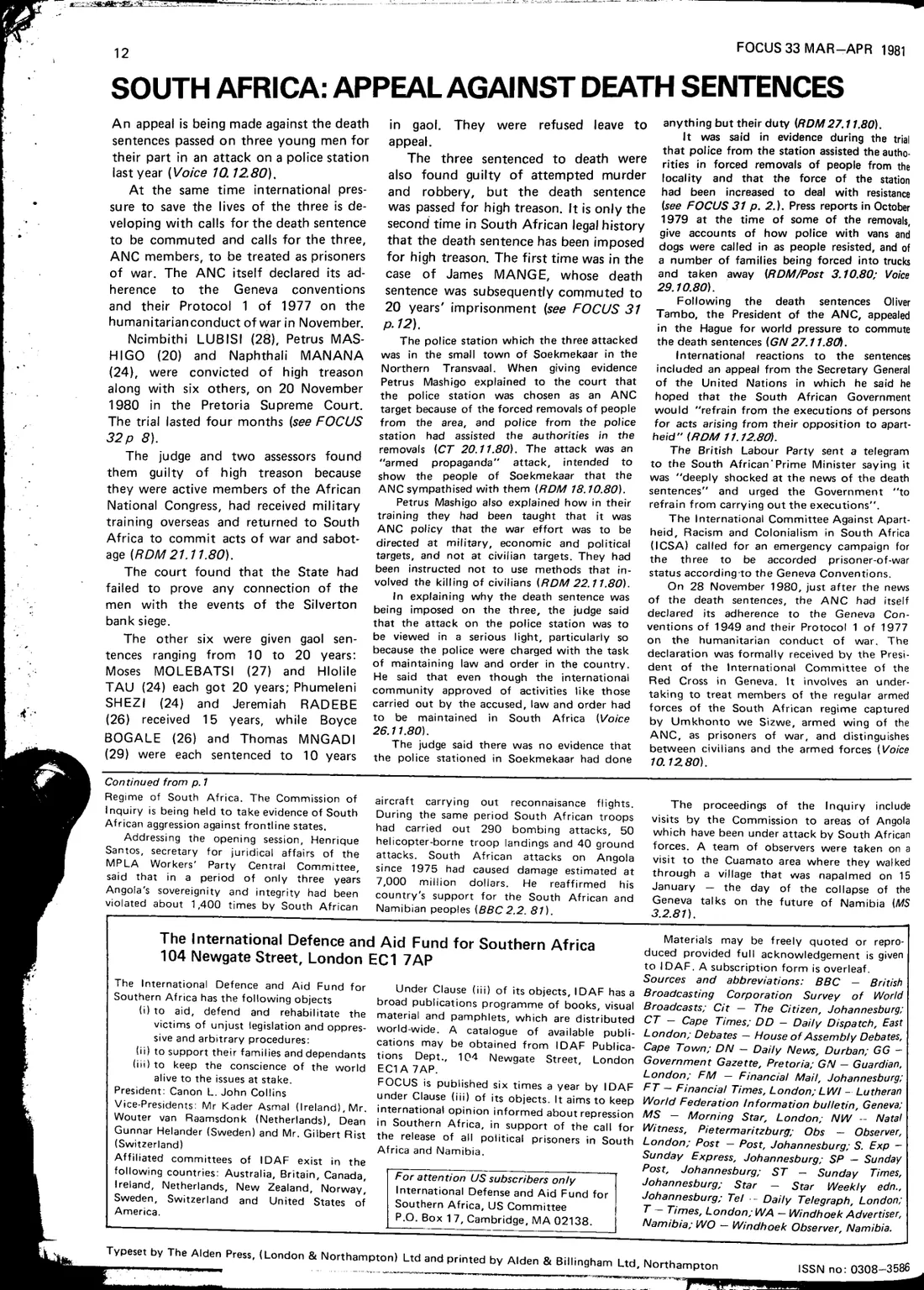
An appeal is being made against the death sentences passed on three young men for their part in an attack on a police station last year.
At the same time international pressure to save the lives of the three is developing with calls for the death sentence to be commuted and calls for the three, ANC members, to be treated as prisoners of war. The ANC itself declared its adherence to the Geneva conventions and their Protocol 1 of 1977 on the humanitarian conduct of war in November.
Ncimbithi LUBISI (28), Petrus MASHIGO (20) and Naphthali MANANA (24), were convicted of high treason along with six others, on 20 November 1980 in the Pretoria Supreme Court. The trial lasted four months.
The judge and two assessors found them guilty of high treason because they were active members of the African National Congress, had received military training overseas and returned to South Africa to commit acts of war and sabotage.
The court found that the State had failed to prove any connection of the men with the events of the Silverton bank siege.
The other six were given gaol sentences ranging from 10 to 20 years: Moses MOLEBATSI (27) and Hlolile TAU (24) each got 20 years; Phumeleni SHEZI (24) and Jeremiah RADEBE (26) received 15 years, while Boyce BOGALE (26) and Thomas MNGADI (29) were each sentenced to 10 years in gaol. They were refused leave to appeal.
The three sentenced to death were also found guilty of attempted murder and robbery, but the death sentence was passed for high treason. It is only the second time in South African legal history that the death sentence has been imposed for high treason. The first time was in the case of James MANGE, whose death sentence was subsequently commuted to 20 years' imprisonment.
The police station which the three attacked was in the small town of Soekmekaar in the Northern Transvaal. When giving evidence Petrus Mashigo explained to the court that the police station was chosen as an ANC target because of the forced removals of people from the area, and police from the police station had assisted the authorities in the removals. The attack was an "armed propaganda" attack, intended to show the people of Soekmekaar that the ANC sympathised with them.
Petrus Mashigo also explained how in their training they had been taught that it was ANC policy that the war effort was to be directed at military, economic and political targets, and not at civilian targets. They had been instructed not to use methods that involved the killing of civilians.
In explaining why the death sentence was being imposed on the three, the judge said that the attack on the police station was to be viewed in a serious light, particularly so because the police were charged with the task of maintaining law and order in the country. He said that even though the international community approved of activities like those carried out by the accused, law and order had to be maintained in South Africa.
The judge said there was no evidence that the police stationed in Soekmekaar had done anything but their duty.
It was said in evidence during the trial that police from the station assisted the authorities in forced removals of people from the locality and that the force of the station had been increased to deal with resistance. Press reports in October 1979 at the time of some of the removals, give accounts of how police with vans and dogs were called in as people resisted, and of a number of families being forced into trucks and taken away.
Following the death sentences Oliver Tambo, the President of the ANC, appealed in the Hague for world pressure to commute the death sentences.
International reactions to the sentences included an appeal from the Secretary General of the United Nations in which he said he hoped that the South African Government would "refrain from the executions of persons for acts arising from their opposition to apartheid".
The British Labour Party sent a telegram to the South African Prime Minister saying it was "deeply shocked at the news of the death sentences" and urged the Government "to refrain from carrying out the executions".
The International Committee Against Apartheid, Racism and Colonialism in South Africa (ICSA) called for an emergency campaign for the three to be accorded prisoner-of-war status according to the Geneva Conventions.
On 28 November 1980, just after the news of the death sentences, the ANC had itself declared its adherence to the Geneva Conventions of 1949 and their Protocol 1 of 1977 on the humanitarian conduct of war. The declaration was formally received by the President of the International Committee of the Red Cross in Geneva. It involves an undertaking to treat members of the regular armed forces of the South African regime captured by Umkhonto we Sizwe, armed wing of the ANC, as prisoners of war, and distinguishes between civilians and the armed forces.